Forstbotanischer Garten Köln
Botanical garden in Cologne's south showcasing trees and shrubs from around the world — from a rhododendron ravine and Japanese garden to North American giant sequoias.
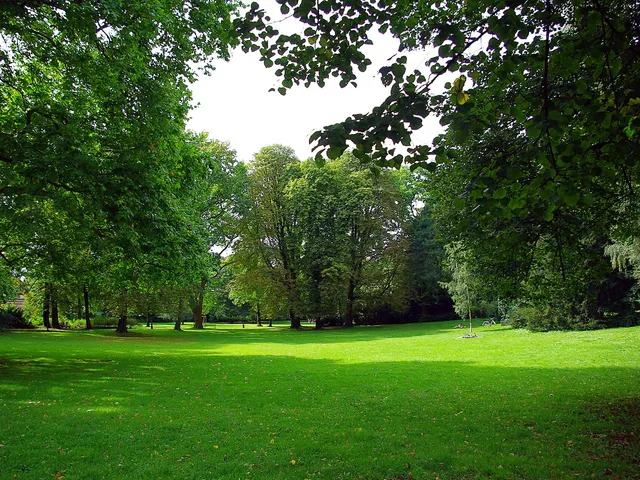
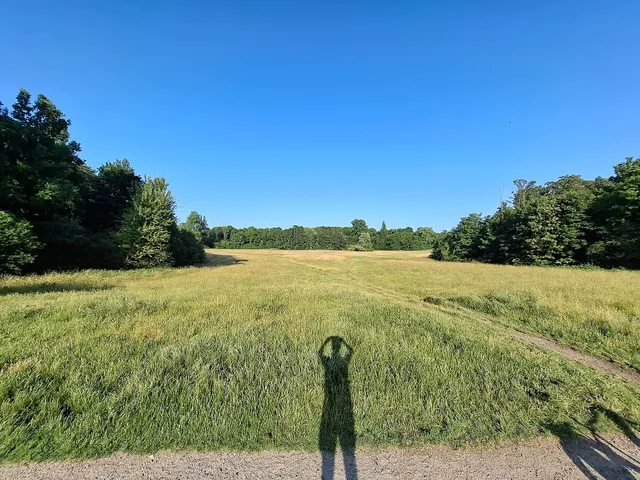
Growing on what was once farmland, this garden brings together trees, shrubs, and perennials from across the globe, complemented by an adjoining woodland area.
At a Glance
- Type
- Botanical garden with adjacent woodland
- Location
- Southern Cologne, Rodenkirchen district, on the outer green belt
- Size
- approx. 90 hectares of connected green space
- Established
- Construction began autumn 1962
- Admission
- Free, open daily
- Suitable for
- Leisure walks, guided tours
In the Friedenswald (Peace Forest), created in the 1980s on the southern edge of the garden, a tree or shrub was planted for every country with which West Germany maintained diplomatic relations at the time – tropical nations whose native plants cannot survive Cologne winters are represented by symbolic substitute trees.
Things to do here
- Stroll through the rhododendron ravine and the heather garden
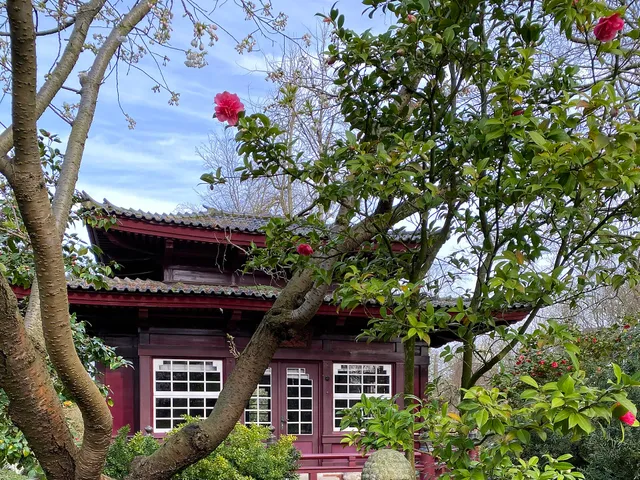
- Admire the cherry and azalea blossoms in the Japanese section
- Discover the mighty North American giant sequoias
- Take a walk in the adjacent woodland and enjoy nature
- Linger on a bench and photograph the peony meadow
- Explore trees and shrubs from around the world in the Peace Forest
Area comparison
Area compared with other Cologne parks and green spaces.
Plant World
The garden offers something to see in every season: a rhododendron ravine, a heather garden, and a peony meadow. The Japanese section features cherry and azalea blossom in spring, and in autumn the fiery colours of Japanese maples and katsura trees, alongside bamboo. A 1.5-hectare woodland plot is home to North American species including giant sequoia, ponderosa pine, incense cedar, and white fir.
History
The site formed part of Cologne's outer ring of fortifications until the First World War. In the mid-1950s, earlier plans for a green belt surrounding the city were revived. On the initiative of city director Hans Berge and forestry manager Herbert Aden, construction of a parkland recreation area began in autumn 1962 — serving the sparsely wooded south of the city. The park was realised under the then still independent municipality of Rodenkirchen.
Peace Forest
To the south lies the Friedenswald (Peace Forest), a 20-hectare woodland laid out in the 1980s. Trees and shrubs were planted representing every country with which the Federal Republic of Germany held diplomatic relations at the time. Countries whose native vegetation cannot survive the local winters are represented by symbolic species.
Location
The garden sits in the southeastern corner of the Köln-Süd motorway interchange. The roughly pentagonal site is bounded by Friedrich-Ebert-Straße, Bonner Landstraße, and Straße Zum Forstbotanischen Garten, among others. The main car park is located at the eastern end of the park.
Timeline
- bis 1914Site was part of Cologne's outer fortress ring
- 14. Juli 1945Riphahn presents foundational ideas for Cologne's reconstruction
- 1955Hans Berge becomes head of the property office, champions green spaces
- Frühjahr 1962Herbert Aden takes over as head of the forestry administration
- Herbst 1962Construction of the Forstbotanischer Garten begins on former farmland
- 1. Januar 1975Rodenkirchen is incorporated into Cologne via municipal reform
- 1980er Jahre20-hectare Friedenswald planted with trees from countries worldwide
Map
Blue dots: other places nearby — tap to explore.
Address
Schillingsrotter Str. 100
50996 Köln
Hours
Mo: 09:00–20:00
Di: 09:00–20:00
Mi: 09:00–20:00
Do: 09:00–20:00
Fr: 09:00–20:00
Sa: 09:00–20:00
So: 09:00–20:00
Contact
You might also like — related or nearby
Comments
- Loading comments…
Sources & links
- Official website
- Official website (retrieved 2026-06-25)
- Wikidata (retrieved 2026-06-23)
- Wikipedia (retrieved 2026-06-23, rev 264247594)
Auto-generated, last verified: 2026-06-26
How this page is made
This page draws on open sources — Wikipedia, Wikidata, official websites and the city’s open data. Every statement is checked against the sources linked here, and pages are refreshed regularly.
Spotted a mistake anyway? Tell us below — we read every submission.