Alter Deutzer Friedhof
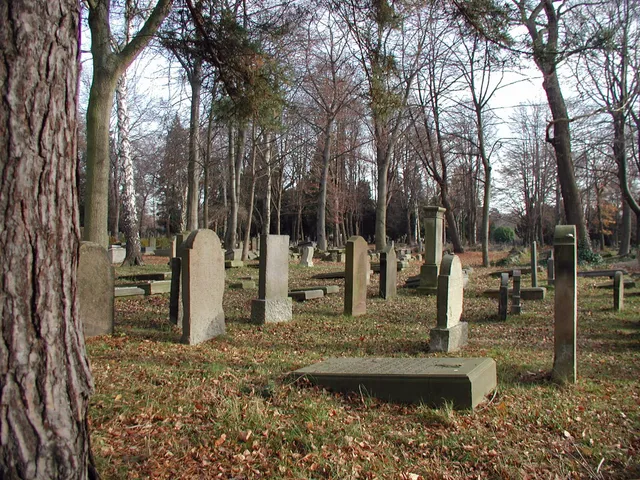
A former municipal cemetery turned listed park in Deutz, home to a sandstone crucifixion group from 1849 and a rare Reform-style enclosure from 1913/14.
The site traces its origins back to the churchyard of Alt St. Urban, the first parish church in what is now Cologne's right-bank district.
Source: Wikipedia
At a Glance
- Type
- Former municipal cemetery, now a park
- Location
- Deutz district (Innenstadt borough)
- Opened
- 1822
- In use
- Until decommissioning in 1922 (partial closure in 1894)
- Heritage protection
- Listed since 1 July 1980, no. 32
- Highlight
- Sandstone crucifixion group from 1849
- Adjacent
- Pyramidenpark, 1.7 hectares
For the 1957 Federal Garden Show, the old cemetery hosted a cemetery exhibition of historic Deutz grave monuments, almost all of which have since gone missing.
History
Until the 19th century, Deutz had a churchyard belonging to the parish church of Alt St. Urban. When the Prussian military claimed this site on the Rhine for barracks, Deutz mayor Wilhelm Franz Neuhöffer and the "engineer of the place" Erdmann von Uthmann chose a replacement plot in 1819, east of the city gates on the road to Kalk. In 1820, Frederick William III granted the land to the municipality as a communal cemetery, also for the burial of the Protestant congregation and military personnel. Opened in 1822, the grounds formed a triangle between two old paths and were laid out with a west-east main path and five cross paths. Row burials ended in 1894, while hereditary family burials remained possible until decommissioning in 1922.
A Reform-Style Enclosure
As the former Rayon zone was redeveloped into the "Deutzer Neustadt," the cemetery received a new Reform-style enclosure in 1913/14 at a cost of 29,400 marks. Broad, iron-reinforced pillars of artificial stone frame metal railings, some of them ornamental, set on a low wall. The wrought-iron main gate was made by Deutz art locksmith Heinrich Hörkens. The First World War prevented the planned new district between Deutz and Kalk, for which the cemetery and the Deutz-Kalk baths were meant to form the green centre.
From Cemetery to Park
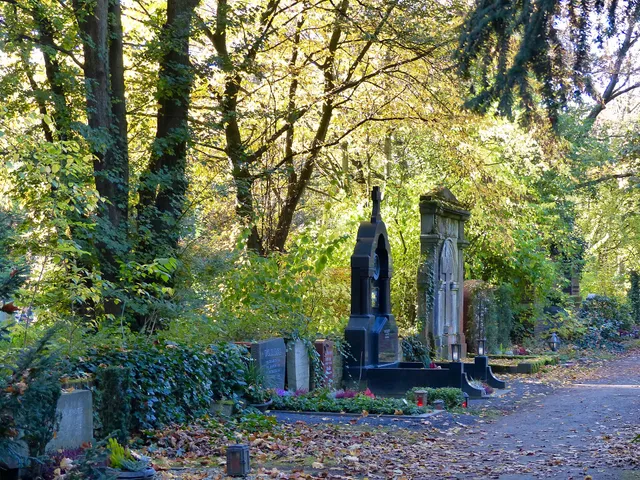
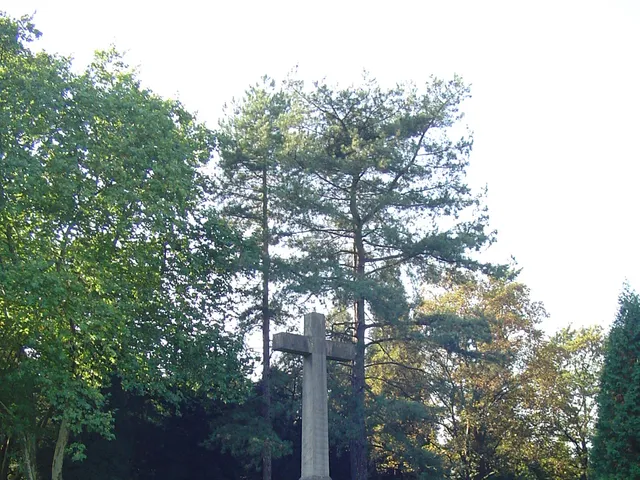
The present layout largely dates from the 1950s. For the 1957 Cologne Federal Garden Show, the axial main path was replaced by a circular path; the grounds hosted a cemetery exhibition showing historic Deutz grave monuments, almost all of which have since disappeared. A few gravestones still recall the earlier use, and the sandstone crucifixion group from 1849 stands at the centre. At the boundary with Pyramidenpark, the remnant of a chestnut avenue traces the historic cross path.
Heritage Status and Surroundings
The City of Cologne listed the Alter Deutzer Friedhof as a protected monument (no. 32) on 1 July 1980, and in November 2012 the Rheinischer Verein für Denkmalpflege named it "Monument of the Month." Since 2000, the site has merged into the 1.7-hectare Pyramidenpark, so the two green spaces flow into one another. Until 1994, the park's grounds were home to the Kölner Verkehrs-Betriebe's Betriebshof Ost depot.
Timeline
- 1819Site on the road to Kalk chosen as replacement cemetery
- 1820Land granted to the municipality as a cemetery by Frederick William III
- 1822Cemetery opened
- 1849Sandstone crucifixion group created
- 1894Closed for row burials
- 1913/14New Reform-style enclosure built for 29,400 marks
- 1922Cemetery deconsecrated
- 1980Listed as a protected monument (no. 32)
Gallery
Map
Blue dots: other places nearby — tap to explore.
You might also like — related or nearby
Comments
- Loading comments…
Sources & links
Auto-generated, last verified: 2026-09-21
How this page is made
This page draws on open sources — Wikipedia, Wikidata, official websites and the city’s open data. Every statement is checked against the sources linked here, and pages are refreshed regularly.
Spotted a mistake anyway? Tell us below — we read every submission.