Am Godorfer Hafen
A 23-hectare nature reserve beside the Godorf harbour in southern Cologne — a grassland-and-scrub mosaic that grew out of an old gravel deposit and now shelters rare animals and plants.
since 1991
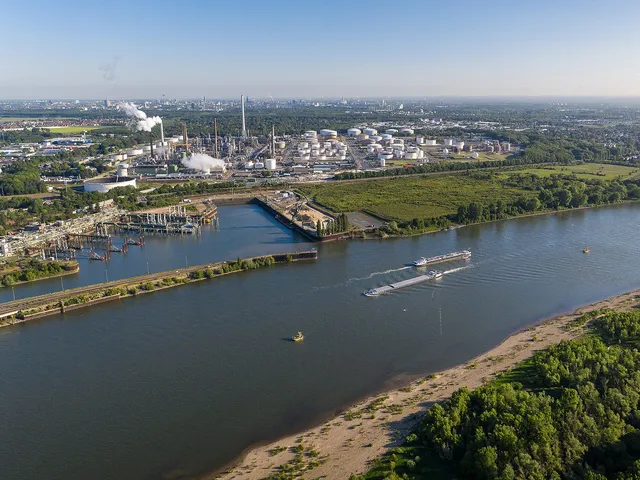
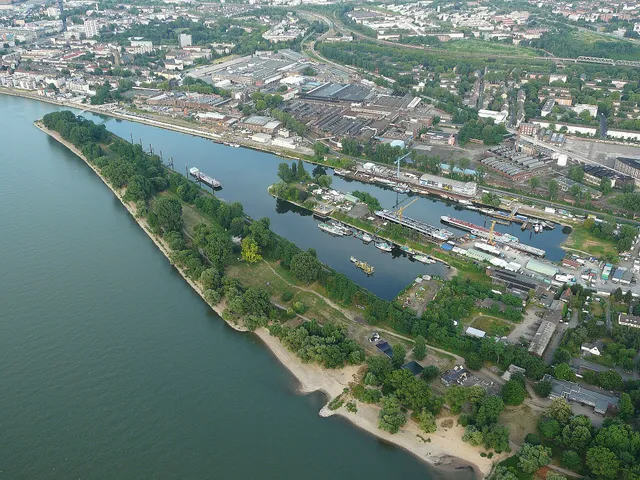
In the south of Cologne, right next to the Godorf harbour, lies a 23-hectare protected area that grew out of a former gravel deposit. Because a distinctive mosaic of scrub and fallow land developed over the years on the poor, dry and warm soil, the site was designated as worthy of protection in 1991.
At a Glance
- Location
- Godorf district of Cologne, directly beside the Godorf harbour
- Protection status
- nature reserve, designated as worthy of protection in 1991
- Area
- 23.23 hectares
- Origin
- formed from an old gravel deposit
- What makes it special
- dry, warm, nutrient-poor ground providing habitat for threatened species
- Surroundings
- adjoining arable and grassland areas plus an old orchard meadow
Area comparison
Area compared with other Cologne parks and green spaces.
Age comparison
Age compared with other places in Cologne.
Location & Landscape
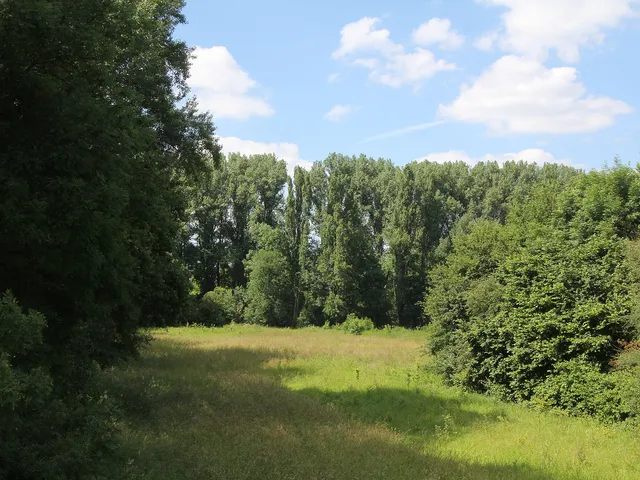
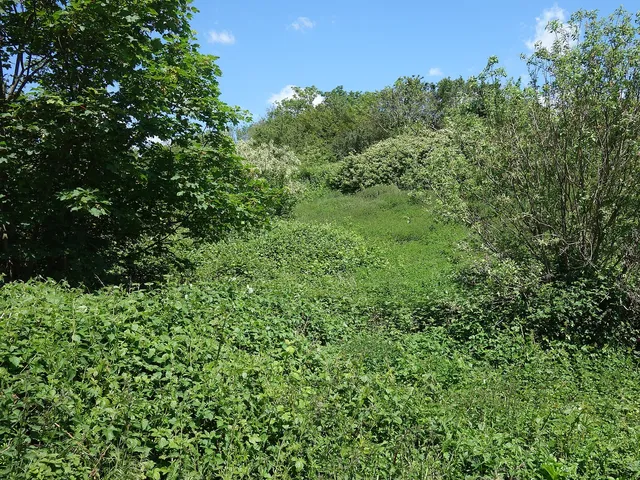
Most of the area is made up of richly structured scrub in which dog rose, various willows and common dogwood set the tone. Between the shrubs, treeless clearings repeatedly open up, carpeted with grasses such as false oat-grass and wood small-reed, and here and there lie open patches of coarse gravel with no growth at all. In the north-west the ground gives way to heavily overgrown fallow grassland, while to the south-east, above a break in the terrain, stretches a nutrient-poor, species-rich fallow.
Habitats
Many biotope types meet here in a small space. The largest share, at around eleven hectares, is fallow nutrient-poor grassland, complemented by scrub and shrub groups, lush meadows, small copses and arable land. Along the eastern edge lies an overgrown orchard meadow with old fruit trees, some of them dead, and to the south a small copse of willows and poplars adjoins it. A meadow dominated by meadow foxtail, with four sturdy poplars, completes the picture — and it is precisely this diversity that makes the area so valuable for threatened species.
Wildlife & Plants
In the open and semi-open areas grow plants of nutrient-poor ground such as meadow sage, wild carrot, viper's bugloss, field eryngo, wild teasel and salad burnet. The dense scrub offers nesting sites for birds such as the nightingale, red-backed shrike, common whitethroat, skylark and goldfinch. In the meadows you can find butterflies and grasshoppers, among them the marbled white, common blue, great green bush-cricket and field grasshopper.
Land Management
To keep the nutrient-poor ground intact, the area is deliberately managed with a light touch: grazing and mowing hold the vegetation open, while fertiliser and biocides are largely avoided. Afforestation and any enrichment of the soil with nutrients are purposely kept out.
Map
Blue dots: other places nearby — tap to explore.
Hours
So: 00:00–24:00
You might also like — related or nearby
Comments
- Loading comments…
Sources & links
- Official website
- Official website (retrieved 2026-08-10)
- Wikipedia (retrieved 2026-08-09, rev 258180241)
- Wikidata (retrieved 2026-08-09)
Auto-generated, last verified: 2026-08-09
How this page is made
This page draws on open sources — Wikipedia, Wikidata, official websites and the city’s open data. Every statement is checked against the sources linked here, and pages are refreshed regularly.
Spotted a mistake anyway? Tell us below — we read every submission.