Deutzer Hafen
The Deutzer Hafen is a former industrial harbour on the right bank of the Rhine in Cologne's Deutz district, being redeveloped since 2021 into a residential and office quarter across roughly 35 hectares. A working cargo port is turning into a new neighbourhood that aims to preserve its industrial heritage.
since 1907
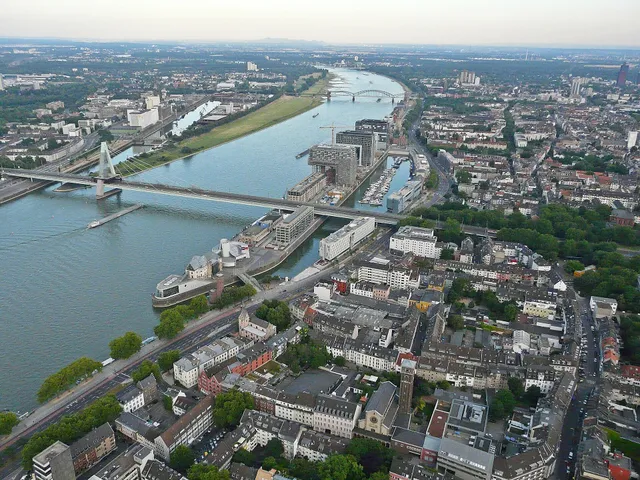
The Deutzer Hafen sits on the right bank of the Rhine in the Deutz district at Rhine kilometre 687.3. Once a commercial industrial harbour handling cargo, it is currently being transformed into a new residential and office quarter.
At a Glance
- Location
- Right bank of the Rhine in Cologne-Deutz, Rhine-km 687.3
- Opened
- 14 December 1907
- Harbour basin
- roughly 1,098 m long, about 82 m wide on average
- Water area
- 123,700 m² (34% of the total site)
- Cargo handled in 2011
- 295,000 tonnes
- Landmark
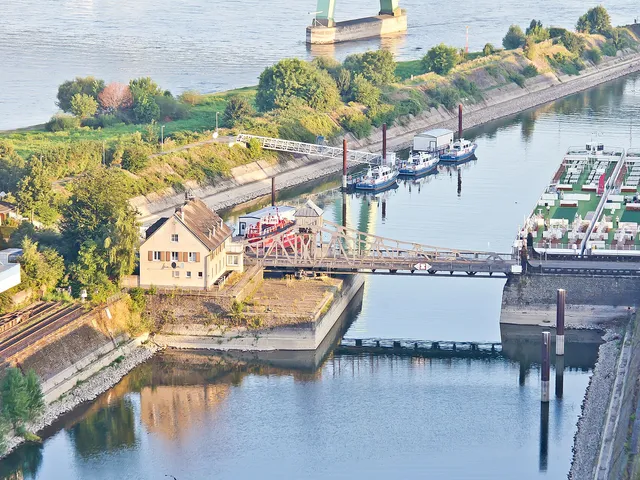
- listed, electrically operated swing bridge (177 t, 1908)
- Redevelopment
- since 2021, about 35 hectares becoming a residential and office quarter
Age comparison
Age compared with other places in Cologne.
From Ferry Point to Harbour
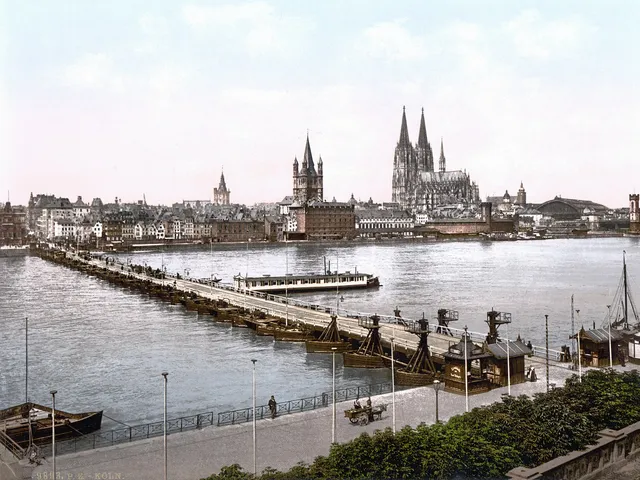
For a long time Deutz had only a small sheltered harbour serving the ferry link to Cologne. The ferry right had been granted by Emperor Otto I to his brother, Archbishop Bruno I, as a hereditary privilege; the hereditary ferry was confirmed in 1417, with a formal charter following in 1428. With no bridge, the ferry was the only way across the river — with tragic consequences: on 9 July 1595 a Deutz ferry sank below the Salzgasse, killing around 50 people. In 1674 a flying reaction ferry replaced the ferry service.
A large harbour was long unthinkable, as the fortress's strict rayon regulations forbade any building nearby until 1907. Before that the bank was marked by the Poller Köpfe, an embankment built from 1560 that was largely destroyed by the severe flood of 1784.
Industrialisation and Construction
With the Cologne–Minden railway (first section 1845) and rising industry, the need for a dedicated Deutz harbour grew. Major firms settled nearby: the van der Zypen & Charlier rolling-stock works (1845), N. A. Otto & Compagnie, founded in 1864 — the origin of the Gasmotorenfabrik Deutz and later Deutz AG, the world's first engine factory — and what became the Chemische Fabrik Kalk (1858).
First dredging began in 1895, but lengthy expropriations delayed actual construction until 1904. The harbour opened on 14 December 1907. The electric swing bridge, brought into service in March 1908 — today a listed monument weighing 177 tonnes — separated the two basins: the southern one as an industrial and winter harbour (6 ha), the smaller northern one as a safety harbour (3.5 ha).
A Working Harbour
In 1909 the Leysieffer & Lietzmann mills became the first major customer; the later Ellmühle grew out of it, ranking among Europe's most significant mills with an annual capacity of 365,000 tonnes and dominating the harbour's appearance for decades. In the 1920s four electric and three steam-powered cranes were at work here. The Chemische Fabrik Kalk handled salt and phosphates, joined over time by scrap trading, an asphalt mixing plant and a tank farm for calcium carbonate. After storm "Kyrill", around 100,000 tonnes of tree trunks, mostly from the Sauerland, were loaded here for a French sawmill. Cologne's fire brigade has stationed its fireboats at the swing bridge since 1994, and the water police have had their mooring here since 1998.
Transformation into a Quarter
As the Rheinauhafen opposite became a residential and services location, the Deutzer Hafen and its growing vacancies also came up for debate. Following a site study, a planning workshop and a feasibility study, Cologne's city council decided in principle in 2015 to convert it into an office and residential quarter — room for up to 6,900 residents and 7,000 jobs. In 2017 the land passed to the development company moderne stadt, which has been reordering the roughly 35-hectare site since 2021. At least 30 percent of the homes are to be publicly subsidised.
Worth Knowing
The urban design competition was won by the Copenhagen firm COBE Architects. Its design turns the industrial heritage — crane tracks, the old unloading crane and the mill buildings — into the "DNA" of the new district. The listed mill building is to be integrated into the residential complex. One special touch: a water basin at the southern end of the harbour opens up a view across the water to the towers of Cologne Cathedral.
Map
Blue dots: other places nearby — tap to explore.
Address
Deutzer Hafen
50679 Köln
Hours
So: 00:00–24:00
You might also like — related or nearby
Comments
- Loading comments…
Sources & links
Auto-generated, last verified: 2026-07-31
How this page is made
This page draws on open sources — Wikipedia, Wikidata, official websites and the city’s open data. Every statement is checked against the sources linked here, and pages are refreshed regularly.
Spotted a mistake anyway? Tell us below — we read every submission.