Deutzer Schiffbrücke (Deutz Pontoon Bridge)
Historic pontoon bridge that linked the Rhine banks between Cologne and Deutz from 1822 to 1915 – no longer standing today.
since 1822
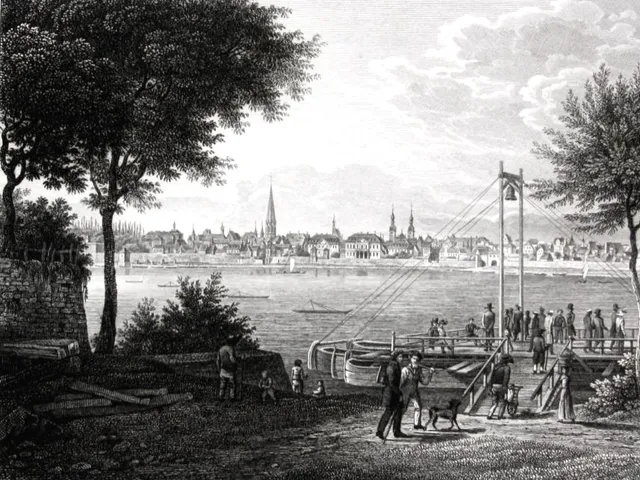
The Deutzer Schiffbrücke was a floating pontoon bridge that connected the two banks of the Rhine between Cologne and Deutz for nearly a century, from 1822 to 1915. It no longer exists today – but its story reveals much about life along the Rhine in the 19th century.
Source: Wikipedia
At a Glance
- Type
- Floating pontoon bridge ("standing Rhine bridge")
- Period
- 1822 to 1915
- Commissioned by
- Order of the Prussian King Friedrich Wilhelm III
- Location
- Between Markmannsgasse on the Cologne side and Deutz (first Inselstraße, later Deutzer Freiheit)
- Construction
- 39 pontoons, roughly 1,250 feet long and 24 feet wide
- Notable feature
- Could be opened for river traffic via passage sections
- Today
- No longer standing – surviving remnants in the Historischer Park Deutz
Things to do here
Age comparison
Age compared with other places in Cologne.
History
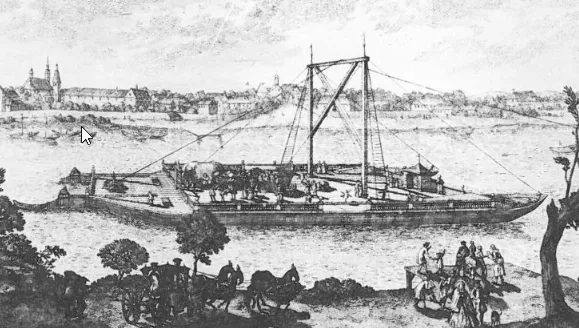
A fixed bridge once stood here in Roman times: the Constantine Bridge, first mentioned in the year 315, which ran from the Obenmarspforten market gate to the fortress at Deutz. It fell into disrepair from the 5th century onward, and Archbishop Bruno (935–965) eventually had it demolished. For centuries afterward the Rhine could only be crossed by boat, and from 1674 by a ferry known as the Deutzer Gierponte.
By order of Friedrich Wilhelm III on 6 December 1821, the pontoon bridge was built and ceremonially inaugurated with military honours on 16 November 1822. After 900 years, it was the first bridge to reconnect the territories on both sides of the Rhine, as well as Westphalia. Its advantage: traffic led directly into the city districts without the usual ramps and inclines.
Construction and Operation
The bridge rested on a total of 39 pontoons, measuring around 1,250 feet in length and 24 feet in width. It could be opened for river traffic through first two, later four passage sections – at first by muscle power, later with the help of gas engines. Each section had a winch and a rudder, making it manoeuvrable. In the evenings, 20 paraffin lamps lit the crossing.
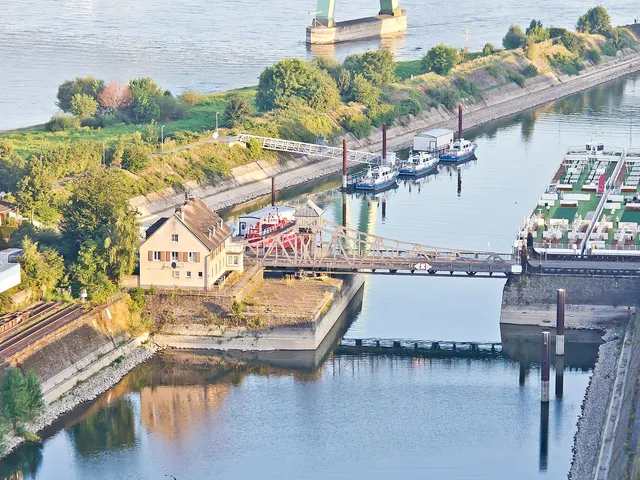
Between 1871 and 1873, the bridge was widened to cope with growing traffic, adding footbridges 1.80 m wide on each side. Pedestrians paid a toll of two pfennigs, while carts and ships paid accordingly more. During floods and ice drift the bridge had to be dismantled – for which a winter harbour was set up in 1823 at the "Schnellert", an old arm of the Rhine in Deutz.
Life Around the Bridge
The bridge was far more than a traffic route. Whenever it was closed for passing ships, the puppeteer Franz Andreas Millowitsch entertained waiting passers-by on the Deutz bank with his travelling theatre – the family later opened a permanent theatre in Cologne. On Sundays, the "Zweipennings Kunzääte", afternoon concerts by the Prussian garrison, drew crowds for just two pfennigs of bridge toll.
On the Kaiser's birthday the crossing was toll-free, and many seized the chance for a free visit to the other side of the Rhine. As early as 1824, a firmly anchored bathing vessel with 16 tubs was attached to the bridge; more followed later, allowing men and women to bathe separately. Also notorious was the smuggler Scholastika Bolz (1825–1902), known as "Et Bolze Lott", who brought coffee, tobacco and sugar into Cologne hidden beneath her crinoline skirt.
The End of the Bridge
Between 1913 and 1915, the Deutz Suspension Bridge – later called the Hindenburgbrücke – was built about 50 metres further south, rendering the old pontoon bridge unnecessary. It was dismantled in September 1914, shipped to Linz and put into service there as a wartime bridge from 1 October 1914, before being removed for good on 4 March 1915. What became of its individual parts is unknown.
Today
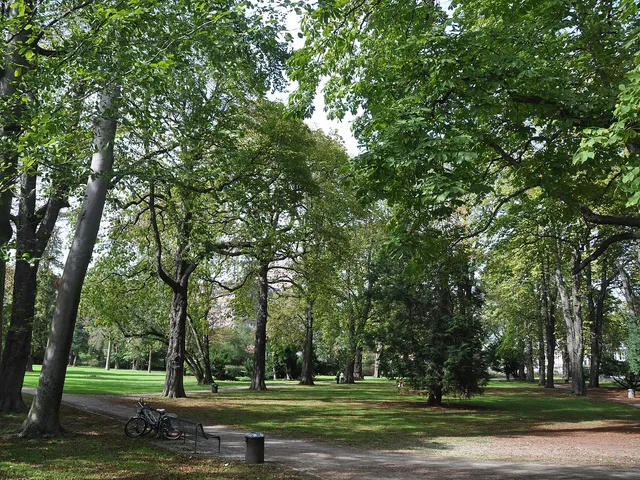
Nothing of the Deutzer Schiffbrücke can be seen today. However, two arches of the old embankment wall of the former "Bahnhof Schiffbrücke" (Schiffbrücke station) survive, along with the foundations of a turntable of the Bergisch-Märkische railway. These remnants can be visited in the Historischer Park Deutz on the Rheinboulevard, near the Deutz Bridge.
Gallery
Map
Blue dots: other places nearby — tap to explore.
You might also like — related or nearby
Comments
- Loading comments…
Sources & links
Auto-generated, last verified: 2026-07-10
How this page is made
This page draws on open sources — Wikipedia, Wikidata, official websites and the city’s open data. Every statement is checked against the sources linked here, and pages are refreshed regularly.
Spotted a mistake anyway? Tell us below — we read every submission.