Mülheimer Hafen
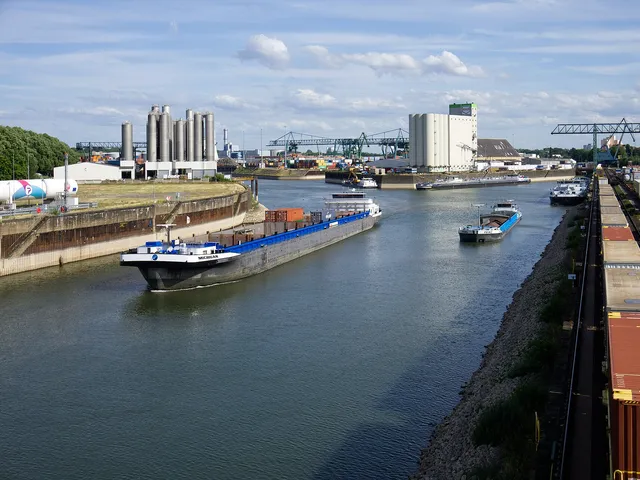
No cargo handling since 2000: the harbour in Cologne-Mülheim is now a shipyard site and the only port in Cologne not owned by the HGK.
Long before a harbour was built here, Mülheim already played a role in Rhine trade: merchants trying to get around Cologne’s staple right of 1259 reloaded their goods onto wagons in Zündorf and took them overland to Mülheim am Rhein. Those caught doing so risked having their goods confiscated.
Source: Wikipedia
At a Glance
- Type
- right-bank harbour without cargo handling
- Location
- Cologne-Mülheim, Rhine km 691.5
- In operation
- since 1880
- Area
- 260,000 m² of land, 127,300 m² of water
- Owner
- Federal Republic of Germany
- Use
- shipyard with slipways for vessels up to 110 metres in length
- Special feature
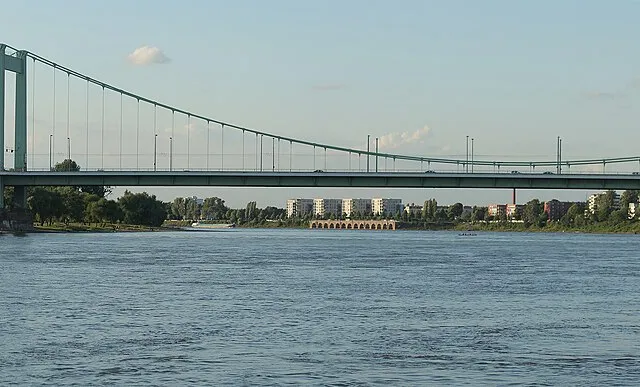
- “Katzenbuckel” pedestrian bridge from 1955
The Mülheim Harbour is the only harbour within Cologne's city limits not owned by the municipal HGK; together with its basin it is part of the federal waterway Rhine and thus belongs to the Federal Republic of Germany. Between 1989 and 1996 the Kelly Family also lived here on a 34-metre houseboat, a coal ship built in the Netherlands in 1929.
From Free Port to Works Harbour
The harbour opened in 1880 with an octagonal customs tower for the free port, and part of it lay on Deutz territory. The cable manufacturer Felten & Guilleaume (F&G) bought the harbour facilities on Kranstraße in 1896. Between 1922 and 1925, the City of Cologne built a new works harbour at the Schlackenberg, the remnant of the former Mülheimer Hütte, and leased it to F&G under a 99-year heritable building right. Bulk and general cargo were handled here, with F&G as the largest customer. On 12 May 1940, the harbour was a target of the first bombing raids on Cologne in the Second World War.
A Federal Harbour
The Mülheimer Hafen, including its harbour basin, is the only harbour within Cologne’s city limits not owned by Häfen und Güterverkehr Köln (HGK). It is part of the international waterway “Rhine”, designated under Section 1 of the Federal Waterways Act (Bundeswasserstraßengesetz), and therefore belongs to the Federal Republic. The Cologne Waterways and Shipping Office operates it on behalf of the federal government; its branch office, the Tonnenhof, maintains navigational marks here.
Shipyard Site
Cargo handling ended when the harbour’s only heavy-lift crane was dismantled in May 2000. As early as 1914, Sachsenberg AG received permission to build a slipway; in 1929 Berninghaus took over the operation and produced numerous newbuilds until it went bankrupt in 1976. Since 1978, the Kölner Schiffswerft Deutz has repaired, modernised and converted cargo and passenger vessels in the eastern basin. Its equipment includes 14 slipway carriages with a capacity of about 100 t each, a 450-t Steven dock and a propeller repair workshop. In winter, the white fleet of the Köln-Düsseldorfer is serviced here; the Goethe, too, was fitted with a diesel engine at this site.
Good to Know
The 180-metre-long “Katzenbuckel”, made of prestressed concrete, was built to plans by Bernhard Hermkes for the 1957 Federal Garden Show (Bundesgartenschau). From 1989 to 1996, the Kelly Family lived in the harbour on the houseboat “Sean O’Kelley”, a 34-metre coal freighter built in the Netherlands in 1929. The underwater construction company Moissl is based on Auenweg; its motor barge MS Obelix can place special concrete underwater.
Timeline
- 1880Port with octagonal customs tower for the free port enters operation
- 1896Felten & Guilleaume acquires the Mülheim port facility at Kranstraße
- 1914Sachsenberg AG receives permit to build a slipway facility in the port
- 1922–1925Construction of the new F&G works port at the Schlackenberg
- 1929Berninghaus acquires the Cologne shipyard from Sachsenberg AG
- 1940Port targeted in first bombing raids on Cologne (12 May)
- 1978Kölner Schiffswerft Deutz (KSD) founded
- 2000Only heavy-lift crane dismantled, no more cargo handling (May)
Map
Blue dots: other places nearby — tap to explore.
You might also like — related or nearby
Comments
- Loading comments…
Sources & links
Auto-generated, last verified: 2026-09-28
How this page is made
This page draws on open sources — Wikipedia, Wikidata, official websites and the city’s open data. Every statement is checked against the sources linked here, and pages are refreshed regularly.
Spotted a mistake anyway? Tell us below — we read every submission.