Godorfer Hafen
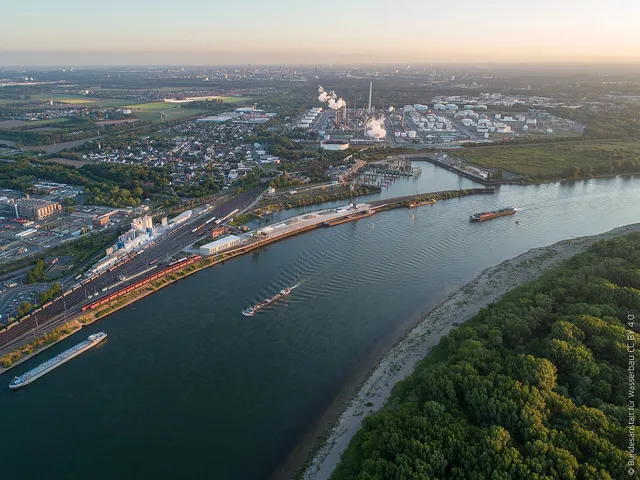
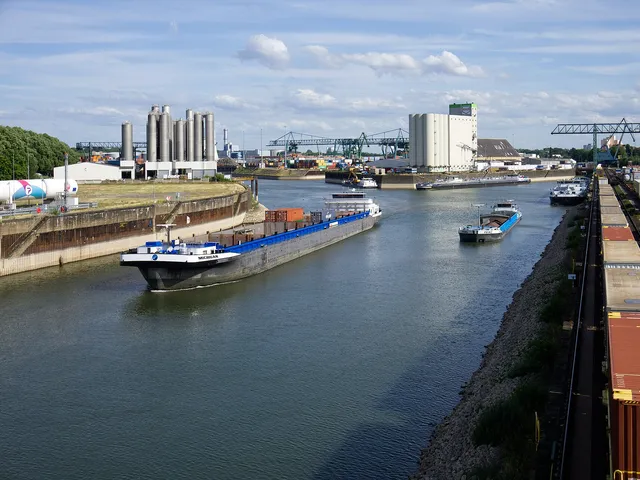
Cologne's busiest cargo port: pipelines run from the berths straight into the Shell and Basell plants, while Rhine-side cranes handle gravel, clay and gypsum.
Until 1960 the facility was known as the Wesselinger Hafen. Its new name reflected a shift in focus toward the Rheinland refinery of Royal Dutch Shell in Godorf.
Source: Wikipedia
Auf einen Blick
- Type
- Cargo port
- Location
- Köln-Godorf in the Rodenkirchen district, on the left bank of the Lower Rhine at kilometre 671.9
- Opened
- 1901
- Harbour basins
- three
- Area
- 192,900 m² of water, 170,200 m² of land
- Operator
- Häfen und Güterverkehr Köln AG (HGK)
- Suitability
- not for passenger or leisure shipping
Until 1960, the Godorf harbour was called the Wesseling harbour; the renaming reflected its new focus on the Shell refinery in Godorf, since both towns were then part of the Cologne district.
History
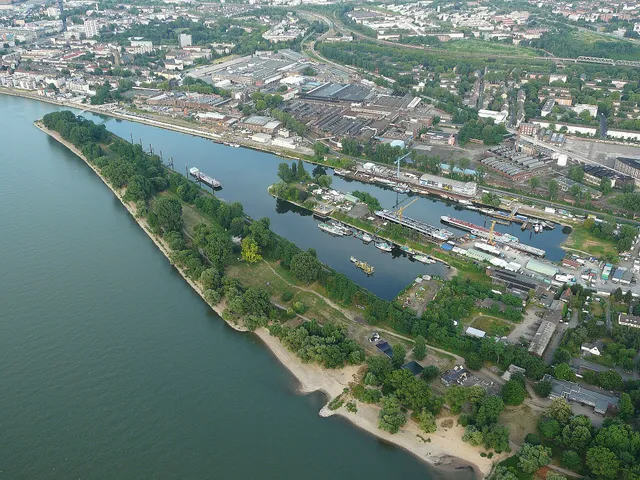
It all began with a freight railway: the seven-kilometre Querbahn from Brühl via Vochem, Berzdorf and Wesseling to Godorf led to the construction of the port, which opened in the same year as the line. A first harbour basin was added in 1928, followed in 1960/61 by the Ölhafen as the second basin and the Gashafen as the third. At the time of the renaming, Wesseling and Godorf both belonged to the Köln district (Landkreis Köln). In 1992 the previous operator, the Köln-Bonner Eisenbahn, was absorbed into the Stadtwerke Köln group.
Cargo and facilities
No other Cologne port handles more cargo. In 2011 it moved almost 5 million tonnes of liquid and gaseous hydrocarbons and around 966,000 tonnes of bulk goods, mainly gravel, salt and Feuchthydrat (moist hydrated lime). Pipelines run from the liquid-cargo berths directly into the plants of neighbouring companies Shell and Basell. Right on the river, two portal luffing cranes handle goods such as gravel, clay, limestone and gypsum. Between them, a hopper makes it easier to load railway wagons; it spans the tracks between the storage bays and the river.
Importance for the region
Among other things, the port supplies the region's chemical industry with mineral oil.
Getting there
An HGK railway station is located at the port. In the southern and northern basins, extension tracks lead onto the quays, while the berths in the middle section are not connected for ship-to-rail transfer. Trucks can reach the port via the Godorf exit of the A 555, near the Cologne motorway ring. By light rail, it is accessible from the Godorfer Bahnhof stop.
No fourth harbour basin
In September 2019, the Cologne city council definitively abandoned plans for a fourth basin. HGK had been pursuing the expansion since the 1980s/1990s, and in 2006 the Bezirksregierung Köln approved the planning permission. Supporters, including the Chamber of Industry and Commerce and the German Trade Union Confederation, mainly expected considerable relief from traffic in other parts of Cologne. Critics, and local residents in particular, feared the loss of a nearby recreation area in southern Cologne and of the Sürther Aue nature reserve.
Timeline
- 1901Querbahn opens; Godorf (Wesseling) harbour enters service
- 1928First harbour basin put into operation
- 1960Wesseling Harbour renamed Godorf Harbour
- 1960/61Oil harbour (basin II) and gas harbour (basin III) opened
- 1992KBE, the operator, merged into Stadtwerke Köln group; port becomes part of HGK
- 2006Freight traffic on Rheinuferbahn ended; planning approval for expansion
- 2019Cologne city council finally abandons expansion plans (fourth basin)
Gallery
Map
Blue dots: other places nearby — tap to explore.
You might also like — related or nearby
Comments
- Loading comments…
Sources & links
Auto-generated, last verified: 2026-09-28
How this page is made
This page draws on open sources — Wikipedia, Wikidata, official websites and the city’s open data. Every statement is checked against the sources linked here, and pages are refreshed regularly.
Spotted a mistake anyway? Tell us below — we read every submission.