Severinstorburg
One of only four surviving medieval city gate towers in Cologne — a landmark of the Severinsviertel and today a vibrant community venue at Chlodwigplatz.
since 1230
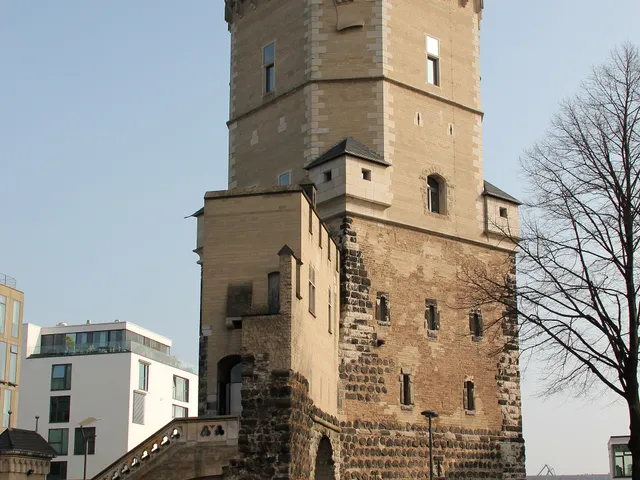
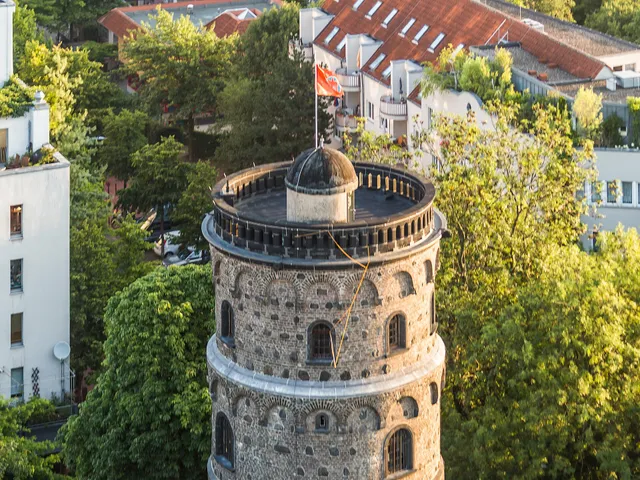
The Severinstorburg is one of four surviving gate towers of Cologne's medieval city wall and, alongside St. Severin's church, is considered the defining landmark of the Severinsviertel. It takes its name from the parish of St. Severinus; in Cologne dialect it is known as "Vringspooz".
At a Glance
- Type
- Medieval city gate tower, historic monument
- Location
- Severinsviertel, Altstadt-Süd district, at Chlodwigplatz
- Built
- First half of the 13th century
- Construction
- Gate tower in tufa stone with an asymmetric, hexagonal tower
- Distinction
- One of only four surviving gate towers of Cologne's city wall (along with Eigelsteintor, Hahnentor, and Ulrepforte)
- Today
- Community centre with three historic event spaces available for hire
When Cologne welcomed English Princess Isabella, wife of Emperor Frederick II, in 1235, the ceremony took place at the Severinstor — and in 1327, the future Emperor Louis IV opened an eight-day jousting tournament there with his wife, turning the gate into a medieval stage for European royalty.
Age comparison
Age compared with other places in Cologne.
History
The gate secured the road south into the empire toward Bonn and protected several monasteries. It ranked among Cologne's prestige gates: distinguished visitors were received here with jousting tournaments and courtly entertainments. In 1235, Cologne welcomed Isabella of England, wife of Emperor Frederick II, at the Severinstor; in 1327, the future Emperor Louis IV of Bavaria opened an eight-day tournament here. Around the 15th century, artillery chambers were added. In 1474, a bulwark was erected in front of the gate against a threatened attack by Duke Charles the Bold — its foundations came to light again in 2005 during construction work for the underground railway.
Architecture
Rising above a rectangular base with a gate passage, the tower stands four storeys tall and is crowned by a battlemented roof platform. An original fighting platform above the gateway was later removed from the sides and replaced on the field-facing front by two small, two-storey flanking turrets (corner watchtowers), which have carried conical caps since the 17th century.
Schmitz-Backes
In front of the gate stood the Schmitz bakehouse, where a historically unverified punishment practice is said to have ended: anyone who had been driven down Severinstraße had endured their punishment once they passed the Schmitz-Backes. This gave rise to the Cologne proverb "Du bes noch nit lans Schmitz-Backes" — you're not out of the woods yet. A bakery of the same name still stands on that spot to this day.
Today
After the city walls were demolished in 1881, the gate first housed a natural history museum and later a hygiene museum. In 1979 it was converted into a community centre with rentable rooms. Every year on Women's Carnival Thursday (Weiberfastnacht), the Reiter-Korps Jan von Werth re-enacts the legend of Jan von Werth in front of the gate.
Timeline
- 1. Hälfte 13. Jh.Severinstorburg built as a heavy tower gatehouse from tuff stone
- 1235Princess Isabella of England, wife of Emperor Frederick II, received at the gate
- 1327Emperor Louis IV opens an eight-day tournament at the gate
- um 1474Bulwark built in front of the gate against troops of Charles the Bold
- 17. Jh.Flanking towers receive conical helmets replacing battlements
- mind. 1797Schmitz bakehouse documented at Severinstraße 5
- 1881After demolition of city walls: gate houses natural history and later hygiene museum
- 1979Converted into a community centre
- Juli 2005Foundations of the bulwark discovered during metro construction work
Gallery
Map
Blue dots: other places nearby — tap to explore.
Address
Chlodwigpl. 19
50678 Köln
Contact
You might also like — related or nearby
Comments
- Loading comments…
Sources & links
- Official website
- Official Instagram (@severinstorburg)
- Official website (retrieved 2026-06-25)
- Wikidata (retrieved 2026-06-24)
- Wikipedia (retrieved 2026-06-24, rev 253202571)
Auto-generated, last verified: 2026-06-27
How this page is made
This page draws on open sources — Wikipedia, Wikidata, official websites and the city’s open data. Every statement is checked against the sources linked here, and pages are refreshed regularly.
Spotted a mistake anyway? Tell us below — we read every submission.