Bismarck Monument (Augustinerplatz)
The second Bismarck statue in the German Empire — unveiled in 1879 in Catholic Cologne as a deliberate provocation, lost to war.
On Augustinerplatz in Cologne stood a bronze statue of Otto von Bismarck until the Second World War — the second public Bismarck monument in the German Empire, after the one in Bad Kissingen.
Source: Wikipedia
At a Glance
- Type
- Bronze statue on a public square
- Location
- Augustinerplatz, Altstadt-Süd (Innenstadt district)
- Sculptor
- Fritz Schaper of Berlin
- Height
- 2.83 m
- Unveiled
- 1 April 1879
- Today
- No longer extant (destroyed or stolen during World War II)
The Cologne Bismarck monument was the first publicly erected Bismarck statue in the entire Rhineland – and its unveiling on April 1, 1879 was deliberately staged as a provocation during the ongoing Kulturkampf: the statue depicted Bismarck as a soldier bearing arms, erected in Catholic-dominated Cologne and funded by a Protestant industrialist family that had been forced to leave the city 165 years earlier.
Things to do here
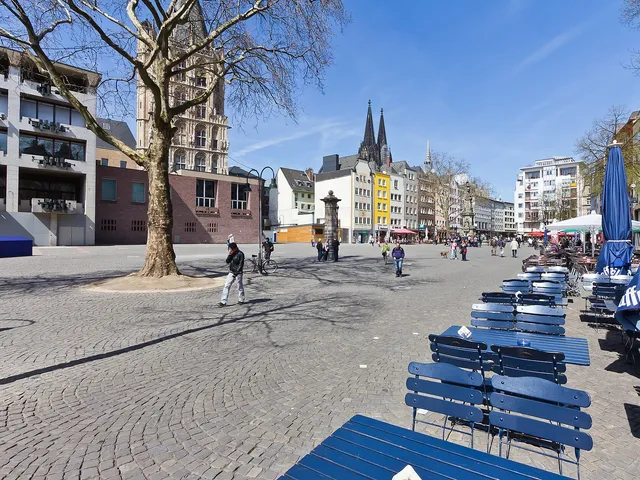
- Stroll across Augustinerplatz, where the monument once stood
- Trace the eventful history of the lost Bismarck statue
- Watch the lively bustle on this Old Town square
- Pause for a break at one of the cafés around the square
- Explore the surrounding Cologne Old Town South from here
Endowment and Erection
The monument was funded by industrialist and Royal Commercial Councillor Christoph Andreae, a native of Mülheim. In his will he bequeathed 20,000 marks on the condition that the monument be erected within three years of his death; as Andreae died in 1876, the deadline fell in 1879. Bismarck had already been made an honorary citizen of Cologne on 1 April 1875, to mark his 60th birthday. Baron Friedrich Heinrich von Diergardt of Bonn pledged a further 20,000 marks, securing the financing.
A Provocation in Catholic Cologne
The city council debated heatedly over the unusual honour of commemorating a living politician who was not of the ruling family. In predominantly Catholic Cologne, the erection of the statue during the Kulturkampf was widely regarded as a provocation — as was the depiction of Bismarck as a soldier bearing arms. The unveiling was accompanied by protests, though the local press contested this.
The Andreae Family's History
The endowment carried a particular edge: Andreae's ancestors had founded a textile manufactory in Cologne in 1687, but were forced to leave the city as Protestants in 1714. On 18 June 1714 the family received a settlement charter for Mülheim am Rhein from Elector Johann Wilhelm of the Palatinate. Two hundred years later, they honoured that very Elector with a monument.
The Statue
The design was selected through an open competition. The bronze figure showed Bismarck in a composed stance gazing into the distance, dressed in the undress uniform of his Halberstadt Cuirassiers. His left hand rested on a pallasch, his right gripped his buttoned coat. The foundry Hermann Gladenbeck & Sohn also cast three scaled-down versions in considerable numbers, which can still be found in the antiques trade today.
Loss
According to Iris Benner, the monument was stolen from the courtyard of the city hall in the post-war chaos; other accounts hold that it was already destroyed during the Second World War.
Timeline
- 1. April 1875Bismarck appointed honorary citizen of Cologne
- 19. März 1876Death of donor Christoph Andreae; 20,000 marks bequeathed for the monument
- 30. März 1876City council votes to accept the donation
- 1879Sculptor Fritz Schaper wins the announced competition
- 1. April 1879Unveiling of the 2.83 m bronze statue, accompanied by protests
- Zweiter WeltkriegMonument stolen or destroyed during World War II (exact circumstances unclear)
Map
Blue dots: other places nearby — tap to explore.
You might also like — related or nearby

Comments
- Loading comments…
Sources & links
Auto-generated, last verified: 2026-06-25
How this page is made
This page draws on open sources — Wikipedia, Wikidata, official websites and the city’s open data. Every statement is checked against the sources linked here, and pages are refreshed regularly.
Spotted a mistake anyway? Tell us below — we read every submission.