Heinzelmännchen – Cologne's Household Spirits and Their Fountain
Cologne's legendary household sprites who worked through the night while citizens slept — caught once, gone forever. Their fountain stands near the Cathedral.
since 1900
According to legend, the Heinzelmännchen were Cologne's household spirits who completed the work of sleeping citizens under cover of darkness. When they were once caught in the act, they disappeared forever.
At a Glance
- Type
- Cologne legendary figures (household spirits) and a fountain dedicated to them
- Fountain location
- Am Hof street, near the Cathedral, Altstadt-Nord district
- Opposite
- Brauhaus Früh, Cologne's oldest brewery
- Fountain built
- 1899–1900, by architect Heinrich Renard and sculptor Edmund Renard the Elder
- Donated by
- the Cologne Beautification Society on the 100th birthday of poet August Kopisch
- Reliefs
- eight on the sandstone balustrade — six depicting trades, two bearing poem excerpts
The fountain was commissioned in 1899/1900 not primarily as a work of art but as a centenary gift from the Cologne Beautification Society to mark the 100th birthday of poet August Kopisch — who had himself transplanted the legend to Cologne from the Siebengebirge region in 1836, meaning it was never a genuine Cologne tradition to begin with.
Things to do here
- Marvel at the playful fountain with its Heinzelmännchen figures
- Discover the eight reliefs along the balustrade, from baker to tailor
- Trace the Cologne legend of the Heinzelmännchen and the curious tailor's wife
- Take memorable photos in front of the historic fountain
- Combine your visit with a stroll to the nearby cathedral and the Früh brewery
Age comparison
Age compared with other places in Cologne.
The Legend
With their small stature, pointed caps, and industrious nature, the Heinzelmännchen belong to the broader family of goblins, sprites, and dwarfs. A tale recorded orally in 1816 in the Brothers Grimm collection is considered a likely source for the Cologne story. It appeared in writing in 1826 through Cologne author Ernst Weyden, but it was August Kopisch's popular ballad of 1836 that made it famous — and relocated the originally Rhineland legend from the Siebengebirge region to Cologne itself.
Origin of the Name
Folklorist Marianne Rumpf identified two possible roots in 1976: "Heinzelmännlein" was a term for the mandrake root kept as a household spirit. Separately, "Heinz" or "Heinzenkunst" referred to drainage devices used in mining — and the workers who operated them may have been called Heinzelmänner.
The Fountain
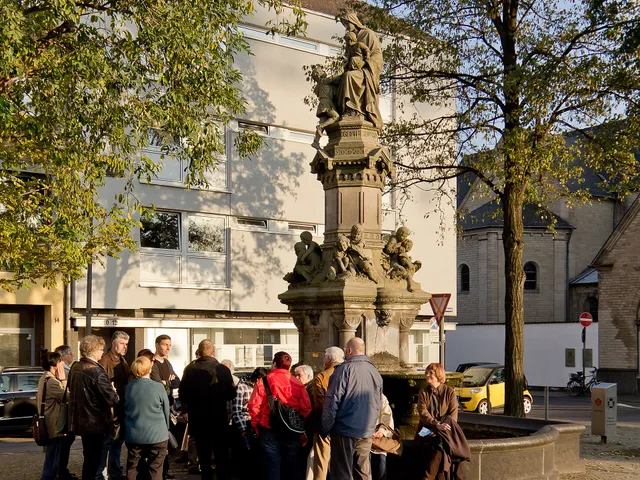
The fountain's base forms a circular arc around a trefoil-shaped granite basin. Above it, on a double staircase, stands the tailor's wife holding a lantern, casting light on the Heinzelmännchen tumbling down on either side. On the central pillar, above a tailor's coat of arms, the poem's pivotal line reads: "Neugierig war des Schneiders Weib" — "Curious was the tailor's wife." The eight sandstone reliefs show the sprites at their nightly trades: carpenter, joiner, baker, butcher, innkeeper, and tailor, with two panels bearing verse in Gothic script. An owl with a magnifying glass on the back of the fountain nods to Kopisch's work. The original tailor's wife sculpture is preserved in the Kölnisches Stadtmuseum; the fountain displays a more weatherproof replica.
Timeline
- 1816Legend 'Des kleinen Volkes Hochzeitsfest auf der Eilenburg' first orally recorded (Brothers Grimm)
- 1826First written version of the Cologne legend by Ernst Weyden (1805–1869)
- 1836Popular ballad version by August Kopisch (1799–1853) relocates the legend to Cologne
- 1899–1900Heinzelmännchenbrunnen built by Heinrich Renard and Edmund Renard the Elder
- 1899Fountain donated for the 100th birthday of August Kopisch by the Kölner Verschönerungsverein
- 1976Marianne Rumpf publishes research on the name origin of Heinzelmännchen in 'Fabula'
- 2017/18Renovation of the Heinzelmännchenbrunnen
- 2021Publication of the book 'Die Heinzelmännkes. Auf Abenteuer im Ruhrgebiet'
Gallery
Map
Blue dots: other places nearby — tap to explore.
Address
Am Hof 12-14
50667 Köln
Hours
So: 00:00–24:00
You might also like — related or nearby
Comments
- Loading comments…
Sources & links
Auto-generated, last verified: 2026-06-26
How this page is made
This page draws on open sources — Wikipedia, Wikidata, official websites and the city’s open data. Every statement is checked against the sources linked here, and pages are refreshed regularly.
Spotted a mistake anyway? Tell us below — we read every submission.