Deichmannhaus – Office Landmark by Cologne's Main Station
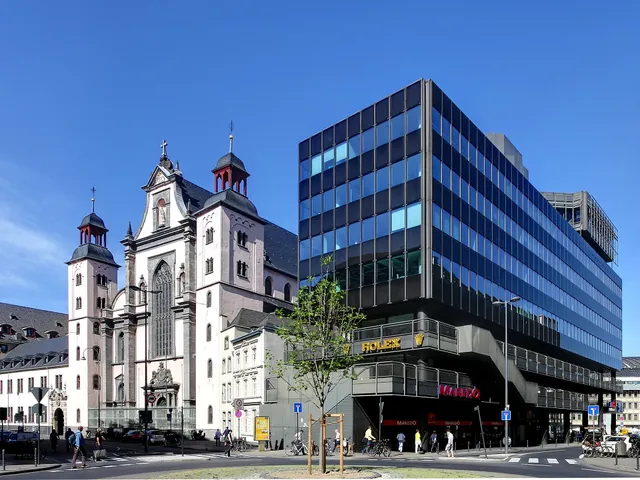
The Deichmannhaus is a seven-storey office and commercial building in Cologne's Altstadt-Nord, set right between the main station and the cathedral plaza. Its site on Trankgasse has carried more than five centuries of city history.
Just steps from the cathedral and the main station, the Deichmannhaus stands at Trankgasse 7–9. Completed in 1914, the striking shell-limestone building is only the latest in a long line of structures on this historic plot.
Source: Wikipedia
At a Glance
- Location
- Trankgasse 7–9, Altstadt-Nord, near the main station and cathedral plaza
- Completed
- August 1914
- Architect
- Heinrich Müller-Erkelenz
- Construction
- seven-storey corner building, shell-limestone façade with monumental half-columns
- Footprint
- roughly 60 × 50 metres
- Heritage status
- listed since 13 December 1985
- Dining
- "Gaffel am Dom" with a taproom of around 700 m²
History of the Site
The earliest known predecessor was the "Kölner Hof", first recorded in 1449. Over time it took on the role of the old episcopal residence and housed several archbishops, among them Johann Gebhard von Mansfeld. After a fire in 1593, Archbishop Joseph Clemens of Bavaria had it entirely rebuilt before 1721, with a two-storey, ten-bay façade in the Italian manner.
During the French period a criminal court sat here, and in 1800 several inmates escaped from the prison inside the building. In 1815 the royal district court moved in.
From Museum to Banking Palace
In 1818 Ferdinand Franz Wallraf bequeathed his vast art collection to the city on the condition that a suitable museum be found. Because of its closeness to the cathedral, the city council decided in 1827 to use the vacated "Kölner Hof" for this purpose; as the "Wallrafianum" it held the collection until 1861.
After demolition in 1863, the banker Wilhelm Ludwig Deichmann bought the plot and in 1867 had Hermann Otto Pflaume build the "Palais Deichmann" in the Historicist style. Parts of the founding concept for Deutsche Bank were drawn up in this house in 1869, and it was also the birthplace of Freya Deichmann, later the wife of resistance figure Helmuth James Graf von Moltke.
The Building Today
After the palace was pulled down in 1913, the present Deichmannhaus rose in its place, opening with its corner position onto the station forecourt and Trankgasse. Following its opening, the Gerling group consolidated activities on the fourth floor.
Dining and offices define the building today: since 2006 the Gaffel brewery has run the "Gaffel am Dom" restaurant here, preceded from 1971 by the "Alt-Köln" tavern. The Dompatent patent-law firm has been an anchor tenant since 1947. After a gut renovation completed in 2008, the North Rhine-Westphalia Film and Media Foundation planned a move into the building in early 2025. Its immediate neighbour is the Excelsior Hotel Ernst.
Gallery
Map
Blue dots: other places nearby — tap to explore.
You might also like — related or nearby
Comments
- Loading comments…
Sources & links
Auto-generated, last verified: 2026-08-27
How this page is made
This page draws on open sources — Wikipedia, Wikidata, official websites and the city’s open data. Every statement is checked against the sources linked here, and pages are refreshed regularly.
Spotted a mistake anyway? Tell us below — we read every submission.