Kölner Häfen
Cologne's harbours rank second only to Duisburg in cargo handling – and their history reaches back to Roman times.
Unlike in Duisburg, port operations in Cologne are spread across several sites. Hotel ships, passenger vessels and administrative vessels moor at landing stages assigned by an occupancy schedule.
Source: Wikipedia
At a Glance
- Type
- Inland ports on the Rhine
- Area
- 877,000 m² of water and 1.307 km² of land
- Roman harbour gate
- Kurt-Hackenberg-Platz, Altstadt-Nord (Innenstadt district)
- Discovery of the gate
- April 2008, at a depth of 13 metres
- Roman landing stage
- around 60,000 m² of water surface for 200 ships
- Staple right
- since 1259
In 1074, Archbishop Anno II had a ship in Cologne's harbour arbitrarily seized, but the owner resisted and rallied angry citizens – Anno had to escape the city through the Anno tunnel.
The Roman Harbour
A barge known as a Prahm, found beneath the Alter Markt and dating from around AD 43, is evidence of harbour activity at this spot. From about AD 50, the harbour lay between Groß St. Martin and today's Kurt-Hackenberg-Platz on a Rhine channel 60 to 70 metres wide. An island up to 180 metres wide and over a kilometre long separated it from the main stream. After the Romans extended the channel eastwards, the expanded harbour reached roughly from today's Breslauer Platz to the Holzmarkt, where the channel rejoined the main river. Around AD 150, the basin silted up after an extreme dry spell and was abandoned.
Wine, Oil and Oysters
Finds between the Alter Markt and Bechergasse suggest that food from the Mediterranean was unloaded here. Evidence includes wines from southern Spain, Italy and Crete, olive oil from Spain and North Africa, and seasoning sauces from Spain and southern Italy. Oysters came from Normandy. All of it was transported in amphorae.
The Harbour Gate at Kurt-Hackenberg-Platz
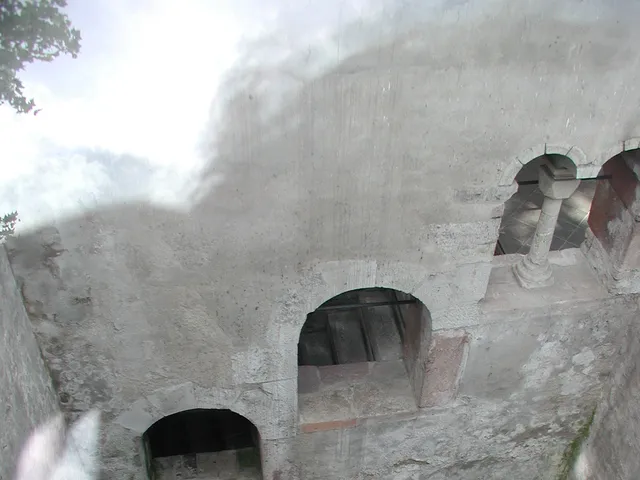
The Roman harbour gate is the only one of Cologne's nine Roman city gates that can be visited as architecture still standing in its original location. It was discovered during construction of the Nord-Süd-Stadtbahn, together with other remains dating from after AD 150. The gate was probably about 13.5 metres high and the city wall about 8 metres; a tower in the wall guarded the passage. For structural reasons, the gates along the harbour front did not project beyond the axis of the city wall. The 2.7-metre-wide, double-leaf wooden gate led to the quays and to the basalt-paved harbour road, which joined the Cardo maximus and is now laid out at the Römisch-Germanisches Museum. According to studies by the University of Cologne, more than 150 oak piles were all felled in the same year, AD 89 – so the city wall, harbour gate and drain outlet were built in the last decade of the 1st century AD.
A Transshipment Hub in the Middle Ages
As a cargo transshipment point, the harbours made Cologne the most important port on the Rhine; the fortified riverbanks served as landing places. Because of the current, the Dutch “Niederländer” vessels went only as far as north of Groß St. Martin, while the “Oberländer” operated south of Cologne. A timber structure near the Salzgasse marked the boundary, and the transshipment harbour lay there. Anton Woensam's 1531 view of the city shows Dutch aaks being towed from the bank, returning with colonial goods such as coffee, tea, sugar and spices. Because of the heavy freight traffic, Archbishop Konrad von Hochstaden introduced the staple right: captains first had to offer their goods to Cologne's citizens for three days.
A Dispute over a Ship
According to Lampert of Hersfeld, in June 1074 Archbishop Anno II had a ship seized in Cologne's harbour so that his friend Frederick I could travel home. The owner successfully resisted, and angry citizens threatened the archbishop. Anno fled unnoticed through the recently built Annostollen and left the city in the direction of Neuss.
Timeline
- um 43 n. Chr.Barge wreck under Alter Markt dated, evidence of port activity
- um 50 n. Chr.Roman port located on a Rhine channel behind an island
- 89 n. Chr.Uniform oak-felling campaign for the city wall and harbour gate
- um 150 n. Chr.Harbour basin silts up after extreme drought and is abandoned
- 1074Archbishop Anno II flees after seizing a ship in Cologne's port
- 1259Archbishop Konrad von Hochstaden introduces the staple right
- 1531Woensam's city view depicts towed Dutch Aaken vessels
- 2008Roman harbour gate discovered at Kurt-Hackenberg-Platz
Gallery
You might also like — related or nearby
Comments
- Loading comments…
Sources & links
Auto-generated, last verified: 2026-09-28
How this page is made
This page draws on open sources — Wikipedia, Wikidata, official websites and the city’s open data. Every statement is checked against the sources linked here, and pages are refreshed regularly.
Spotted a mistake anyway? Tell us below — we read every submission.