Hermann Joseph Fountain
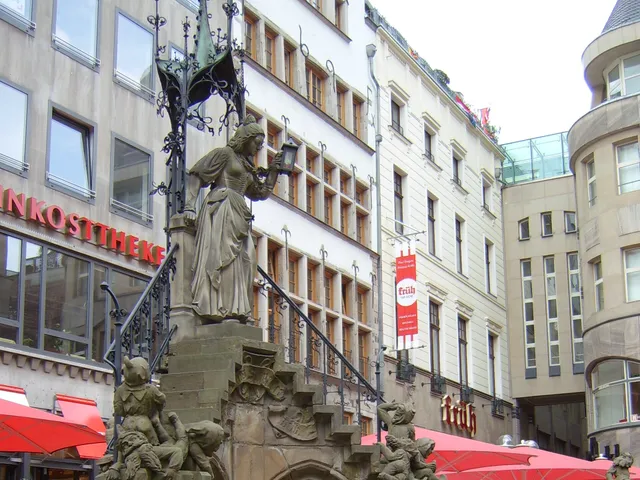
A richly figured 1894 fountain on Waidmarkt telling the legend of the "apple saint" Hermann Joseph — considered the high point of sculptor Wilhelm Albermann's work.
since 1894
On Waidmarkt in Cologne's southern old town stands a fountain that tells a whole picture story: boys brawling below, and high above a boy holding out an apple to the Christ Child. It was donated in 1894 by the Cologne Beautification Society, originally as a working drinking fountain.
At a glance
- Type
- Sculptural fountain, originally a running fountain, today purely ornamental
- Sculptor
- Wilhelm Albermann
- Donated
- 1894 by the Cologne Beautification Society
- Subject
- The life and legend of the "apple saint" Hermann Joseph of Steinfeld
- Material
- Local weatherproof sandstone and basalt lava (a competition requirement)
- Dimensions
- 6.80 m high, 6.30 m wide, 4.50 m deep — other sources give a height of around 8 m
- Location
- Waidmarkt, Cologne Altstadt-Süd, north of St. Georg
- Heritage status
- Listed since 1 July 1980, Cologne monument list no. 164
The fountain was meant to edify schoolchildren with the pious example of Hermann Joseph — though the record suggests the children mostly played pranks on it instead. And once the tram began running right past it in 1903, some came to see the devotional spot as urban planning gone wrong.
Age comparison
Age compared with other places in Cologne.
Origins
After the Jan von Werth Fountain on Alter Markt, this was the second fountain the Cologne Beautification Society gave to the city. The civic association had set out to redesign Cologne's squares and improve the look of the city. In 1889 it invited designs for a "monumental running fountain" that would form an eye-catcher at the entrance to Waidmarkt. The brief set a budget of 15,000 marks, the materials sandstone and basalt lava, and a shortlist of figures: Thomas Aquinas, Albertus Magnus or Hermann Joseph, who at the time was venerated only as a blessed.
The jury included Arthur Pabst, director of the museum of applied arts, city building councillor Josef Stübben, banker Eduard von Oppenheim, and architect and building councillor Hermann Otto Pflaume — the latter on the society's board and a close friend of Albermann's. The choice fell on Albermann and, as with Jan von Werth before, on the most popular of the motifs. Because the money had to be raised and the society had to negotiate with the city, the commission was only awarded in 1893. Albermann handed the fountain over to the society in September 1894; the society gave it to the city, which connected it to the water mains that October, and it began operating in spring 1895.
The setting on Waidmarkt
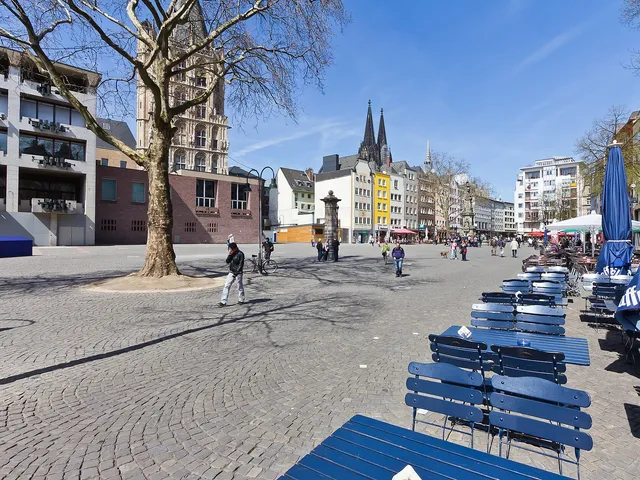
Waidmarkt is a long square on the city's oldest north–south axis, between Severinstraße to the south and Hohe Pforte to the north, where the historic Roman quarter begins. The name recalls the medieval dyers' quarter and the woad traded here. In the southern part, the west choir of the Romanesque basilica of St. Georg juts into the square; Georgstraße branches off to the north of it. Until secularisation the parish church of St. Jakob also stood here, demolished in 1825. Around 1880 the north side of St. Georg was thoroughly renovated — the fountain was placed just north of it, its display side facing north towards Hohe Pforte.
Design
The basin, enclosed at roughly knee height, was originally cloverleaf-shaped. From it rises a square plinth with two side water bowls, columns and capitals at its corners and a cornice on top. Below the cornice, two dolphin heads spout water into the side basins, from where it flows through five dolphin masks each into the lower basin.
On the four corners of the cornice stand small figure groups: two boys apiece scuffling over an animal — a dog, a fish, an eagle and a crab. Above them rises a richly moulded octagonal column crowned by a seated Madonna with the Christ Child and the blessed Hermann Joseph as a boy, offering the Child an apple — which, as the legend goes, the Child accepts.
The plinth bears the signature "Albermann fec.", the central structure carries "Verschönerungsverein 1894" on the front, and the lettering "S. Hermann Joseph Köln 150" runs around the octagonal upper section at the Madonna's feet.
Symbolism
The fountain monument was meant to serve the "moral and spiritual education of humankind" — and it is composed to that end down to the details. The fountain itself stands for the earth; four Romanesque-style columns carry the world on which humanity wrestles over worldly goods. How futile that struggle is shows in the boys' groups: a salting barrel topples in the fight over the fish, the crab pinches a boy's finger, and the dog and eagle cannot be held onto anyway. A book lies ignored at the edge — instead of pursuing learning, they quarrel over possessions. The Madonna high on the octagonal plinth, by contrast, stands for the heavenly sphere: Hermann Joseph kneels before her, has left worldly striving behind and gives away his one small possession, the apple. The reward is God's grace.
Where it sits in art history
The fountain is regarded as the high point of Wilhelm Albermann's work; ten years earlier he had created the Jan von Werth Fountain on Alter Markt. The animal-head spouts echo the Renaissance and Mannerism, the four supporting columns with cushion capitals are Romanesque in flavour, and the tall octagonal plinth recalls the crossing tower of a Hohenstaufen church.
Traffic, war and rebuilding
In urban design terms the fountain rounded off the exterior renovation of St. Georg effectively — but as a place of moral and religious edification it soon competed with growing inner-city traffic: from 1903 the tram, successor to the horse-drawn railway, ran right along the north–south axis. Some considered it urban planning gone wrong. An air raid on 2 March 1945 struck the west choir of St. Georg and damaged the fountain too; the blast lifted the sculpture partly out of its anchoring. Heritage authorities prevented demolition after the war, and in 1954–55 the fountain was restored in simplified form.
What is missing today
Several original details never returned: there were once additional lion's-head spouts at the front and back, four small pillars shaped like pine cones, and a trough at the rear. None were rebuilt — the running fountain became a purely ornamental one.
Today
The Hermann Joseph Fountain now stands among trees. Around the time of the 2009 collapse of the Cologne city archive right next door, flowers, memorial plaques and candles were laid here.
Timeline
- 1889Beautification Society invites designs for a monumental running fountain
- 1894Albermann hands over the finished fountain; the society gives it to the city
- 1895Put into operation in the spring
- 1945Air raid on 2 March damages the fountain and the west choir of St. Georg
- 1954–1955Rebuilt in simplified form
- 1980Added to Cologne's monument list (no. 164)
Gallery
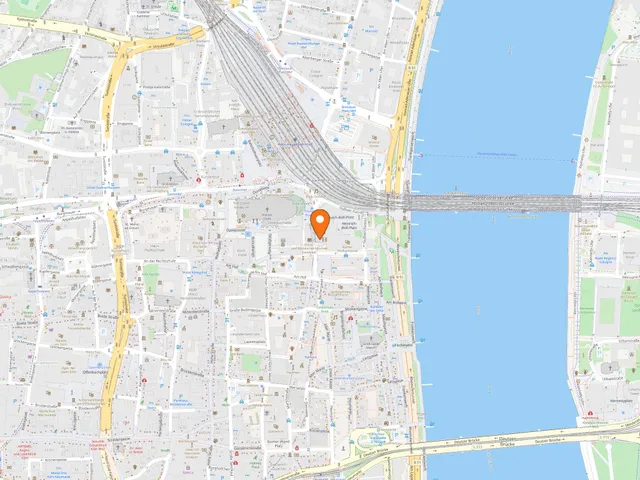
Map
Blue dots: other places nearby — tap to explore.
Address
Waidmarkt
50676 Köln
Hours
So: 00:00–24:00
You might also like — related or nearby

Comments
- Loading comments…
Sources & links
- Official website
- Wikidata (retrieved 2026-07-16)
- Wikipedia (retrieved 2026-07-16, rev 252843350)
Auto-generated, last verified: 2026-07-16
How this page is made
This page draws on open sources — Wikipedia, Wikidata, official websites and the city’s open data. Every statement is checked against the sources linked here, and pages are refreshed regularly.
Spotted a mistake anyway? Tell us below — we read every submission.