St. Peter – Kunst-Station
Cologne's latest surviving Gothic church — and since 1987 a venue for contemporary art and new music, run by Jesuits.
since 1515
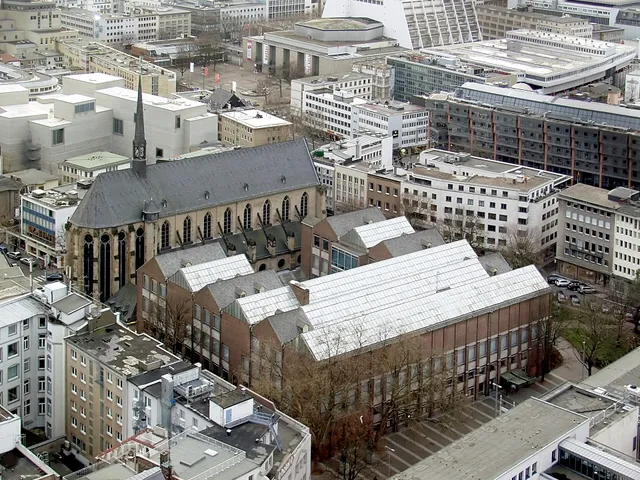
St. Peter in Cologne's Altstadt-Süd is the city's latest surviving Gothic church and, as a Kunst-Station, a place where a worshipping congregation, international contemporary art, and new music converge.
At a Glance
- Type
- Catholic parish church, run by Jesuits since 1960
- Location
- Altstadt-Süd, city district Innenstadt
- Construction
- 1512–1533 (Late Gothic)
- Interior
- 37.5 m long, 21 m wide
- Heritage
- Listed monument in North Rhine-Westphalia
- Kunst-Station
- Venue for international contemporary art since 1987
- Music
- Around 50 free music concerts per year
- Opening hours
- Wednesday to Sunday, 12–6 pm
The church was built on the foundations of Roman thermal baths and is the latest surviving Gothic church building in Cologne – after reconstruction, the city conservator Hiltrud Kier remarked that the effect of the new wooden coffered ceiling was reminiscent of "a coffin lid".
Age comparison
Age compared with other places in Cologne.
History and Architecture
A church is believed to have stood on this site as early as late Roman times. What is certain is a Romanesque predecessor from the tenth century — a three-aisled gallery basilica — to which a Romanesque west tower was added in 1170. The current Late Gothic church was built between 1512 and 1533 on the foundations of Roman baths and the earlier Romanesque structure. The neighbouring Cäcilienstift was dissolved in 1802; St. Peter survived as one of the few remaining parish churches in the old city.
Destruction and Reconstruction
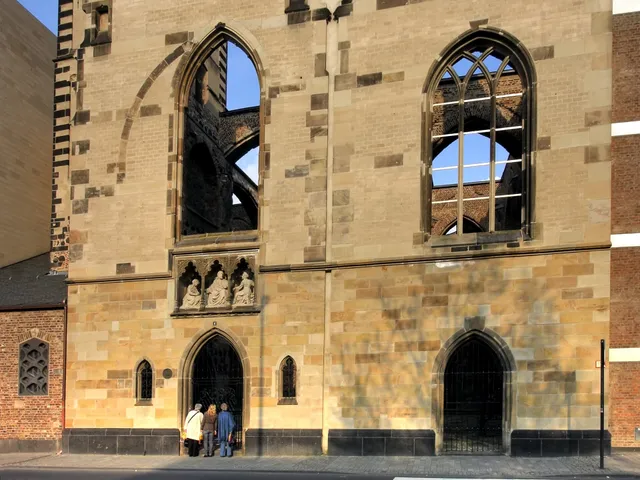
On the night of 29 June 1943 — the so-called 'Peter and Paul raid' — the church was reduced to bare walls and pillars. Altars, pulpit, and the 1907 organ were lost to the flames. Rebuilding under Karl Band and Wilhelm Schorn lasted from 1950 to 1960. Limited resources and the spirit of the age resulted in a deliberately fragmentary interior: vault springers left exposed between the clerestory windows still recall the destroyed net vaults. The Jesuits moved in in 1960; the altarpieces by Schut and Rubens were returned in 1961.
Today
Between 1997 and 2000 the interior was comprehensively redesigned by the architectural practice Wiegmann & Trübenbach. Together with the neighbouring Cäcilienkirche, St. Peter forms the only surviving double-church complex of collegiate and parish church in Cologne. Alongside regular services, the church hosts exhibitions, interventions, and performances, as well as monthly organ concerts and the festival 'orgel-mixturen'.
Timeline
- 888Foundation of Cäcilia collegiate church by Archbishop Willibert
- 1170Romanesque west tower added to the predecessor building
- 1512–1533Construction of the late Gothic church on Roman foundations
- 1802Dissolution of St. Cäcilia collegiate church
- 1943Church almost entirely destroyed in the Peter and Paul bombing raid (29 June)
- 1950–1960Reconstruction under Karl Band; Jesuits move in July 1960
- 1987Launch of Kunst-Station: venue for international contemporary art
- 1997–2000Comprehensive renovation and redesign of the interior
Gallery
Map
Blue dots: other places nearby — tap to explore.
Address
Jabachstraße 1
50676 Köln
Hours
Mi: 12:00–18:00
Do: 12:00–18:00
Fr: 12:00–18:00
Sa: 12:00–18:00
So: 12:00–18:00
You might also like — related or nearby
Comments
- Loading comments…
Sources & links
- Official website
- Wikidata (retrieved 2026-06-24)
- Wikipedia (retrieved 2026-06-24, rev 265082538)
- Official website (retrieved 2026-06-24)
- offenedaten-koeln.de (retrieved 2026-06-30)
Auto-generated, last verified: 2026-06-27
How this page is made
This page draws on open sources — Wikipedia, Wikidata, official websites and the city’s open data. Every statement is checked against the sources linked here, and pages are refreshed regularly.
Spotted a mistake anyway? Tell us below — we read every submission.