Taubenbrunnen
Cologne's first post-war fountain and the city's first abstract fountain: designed in 1953 by Ewald Mataré as a drinking trough for the Cathedral pigeons.
since 1953
The Taubenbrunnen is a fountain sculpture by Ewald Mataré, erected in 1953 on the western side of Cologne Cathedral at the edge of the Cathedral forecourt. Mataré designed it as a drinking place for the city's famous "Cathedral pigeons".
At a Glance
- Type
- Fountain sculpture
- Artist
- Ewald Mataré
- Built
- 1953
- Location
- Altstadt-Nord, in front of Cologne Cathedral (today Kardinal-Höffner-Platz)
- Mosaic field
- Oval, 540 × 400 cm, four-colour
- Notable
- Cologne's first post-war fountain and the city's first abstract fountain
- Status
- Listed monument
At the inauguration on 4 August 1953 – Mataré called it "a charming little cheerful affair" – not a single pigeon appeared, even though the fountain had been designed expressly as a drinking spot for Cologne Cathedral's pigeons. What's more, a marzipan pigeon was buried in the ground when the foundation stone was laid.
Age comparison
Age compared with other places in Cologne.
Origins
Mataré conceived the fountain as early as 1950, originally intended for the station forecourt. That location was dropped because the square in front of the station — according to a diary entry by Mataré — belonged to the railway rather than the city. The fountain was therefore relocated to the edge of the Cathedral forecourt and funded by the Bank für Gemeinwirtschaft, which also influenced the final placement in front of its newly completed bank building (now the Domforum).
Inauguration
At the foundation stone ceremony in late July 1953, an "unknown pigeon" made of marzipan was buried in the ground. The official dedication on 4 August 1953 brought together representatives from the arts, politics and banking; a document signed by all present was sealed in the base. The pigeon was regarded above all as a symbol of peace at the time — though, according to several accounts, not a single live pigeon appeared at the celebration.
Design
A circular iron basin of around 2.20 m in diameter sits within an oval mosaic field, channelling water in a spiral path towards the centre. On two sides, a 45 cm high enclosure of curved iron rods frames the field. The metal water dispenser rests on a basalt block shaped like an inverted truncated pyramid, feeding the spiral from three small spouts. The mosaic is made up of equilateral triangles in blue, white, grey and black whose lighter tones optically form hexagons — a strict geometric pattern that contrasts with the curved forms of the water channel and railings.
Setting and Surroundings
When the fountain was built, the Cathedral forecourt was still at street level. Since the construction of the Domplatte and the Cathedral car park in 1970, it has stood directly at the foot of a flight of steps. This position, combined with a concrete replica of a cathedral pinnacle (Kreuzblume) standing just metres away at over 10 m tall, tends to push the understated fountain into the background. Debates from 2012 onwards about decluttering the public space criticised the surrounding clutter — the pinnacle replica alongside a "conglomerate" of some 50 bollards, four different lamp types and rubbish bins. Relocating the pinnacle replica was proposed as a way to restore the fountain's visibility.
Timeline
- 1950Ewald Mataré designs the fountain as a drinking place for the cathedral doves
- Ende Juli 1953Foundation stone laid; a marzipan 'unknown dove' buried in the ground
- 4. August 1953Inauguration of the Taubenbrunnen; Mayor Görlinger and others present
- 1953Completion of the Bank für Gemeinwirtschaft building at Domplatz
- 1970Construction of the Domplatte and underground car park; fountain moves before the steps
- 2008Area receives its own name: Kardinal-Höffner-Platz
- ab 2012Debate about decluttering the urban space; fountain deemed insufficiently visible
Gallery
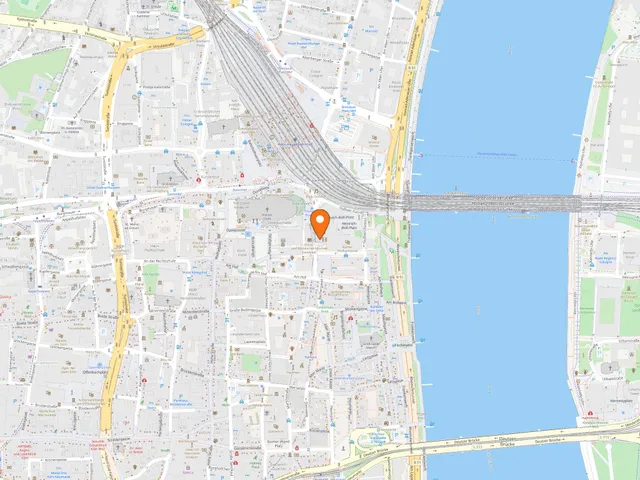
Map
Blue dots: other places nearby — tap to explore.
Address
Köln-Altstadt-Nord
50667 Köln
Hours
So: 00:00–24:00
You might also like — related or nearby
Comments
- Loading comments…
Sources & links
- Official website
- Official website (retrieved 2026-06-25)
- Wikidata (retrieved 2026-06-24)
- Wikipedia (retrieved 2026-06-24, rev 254559300)
Auto-generated, last verified: 2026-06-27
How this page is made
This page draws on open sources — Wikipedia, Wikidata, official websites and the city’s open data. Every statement is checked against the sources linked here, and pages are refreshed regularly.
Spotted a mistake anyway? Tell us below — we read every submission.