Trinitatiskirche
The oldest newly built Protestant church on Cologne's left bank of the Rhine — a classicist basilica inspired by northern Italian models.
since 1860
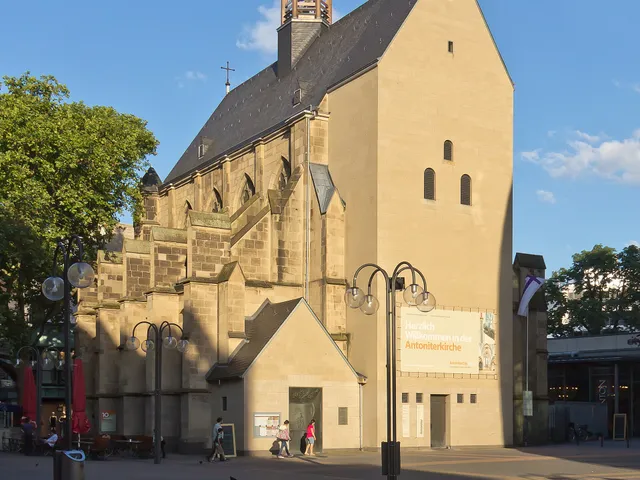
The Trinitatiskirche is the oldest Protestant church purpose-built on the left bank of the Rhine in Cologne. It stands on Filzengraben in the southern old town, between Heumarkt and Rheinauhafen.
At a Glance
- Type
- Protestant church, classicist basilica with galleries in the side aisles
- Location
- Filzengraben, Altstadt-Süd (Innenstadt district)
- Architect
- Friedrich August Stüler
- Construction
- Foundation stone laid 1857, consecrated 1860
- Capacity
- Around 1,000 seats at consecration
- Organ
- Klais organ, three manuals, 44 stops, 3,000 pipes
- Listed
- Protected monument since 1982
Prussian King Frederick William IV personally dictated the design direction: in a city with as many Romanesque and Gothic churches as Cologne, an Evangelical church had to stand apart by adopting the style of an early Christian basilica — as a result, not a single competition entry won approval and Berlin's star architect Friedrich August Stüler had to submit an entirely new design.
Age comparison
Age compared with other places in Cologne.
History
After the French occupation of 1794, Cologne's Protestant community was free to worship openly and initially used the former Antoniterkirche. Under Prussian rule from 1815, the congregation grew until that building's roughly 800 seats were no longer sufficient. In 1850, with support from King Friedrich Wilhelm IV, the congregation acquired land on the site of the former Servite convent of St. Lucia. A 1943 air raid almost completely destroyed the church; rebuilding stretched from 1952 to 1965.
Architecture
The king stipulated that the Protestant building should stand apart from Cologne's Romanesque and Gothic churches, which led to the choice of an early Christian basilica form. Stüler had already built churches in this style in and around Berlin. Because the church was integrated into a row of houses, he built it tall to admit more light through the windows and placed a full-width portico across the street-facing entrance. The roughly 41-metre tower, built on a square footprint, stands behind the choir and contrasts with the light tufa facade through its darker brickwork — a deliberate nod to the campaniles of Italian basilicas.
Interior
Surviving from the original construction are the figuratively decorated walls, a marble baptismal font, and three of the five bells. The altar, pulpit, and cross were created in 1962 by Cologne artist Kurt-Wolf von Borries, who also designed the coffered ceiling; that same year Wolfhard Röhrig produced the artistic glazing. The Klais organ was originally built in 1987 for the Dreifaltigkeitskirche in Aachen and was installed here in 2010 after extensive modification and adaptation.
Today
Due to the declining population of the city centre, regular parish services are no longer held here. Instead, the church serves the Evangelical Church Association of Cologne and Region for major events, as well as hosting concerts, lectures, and art exhibitions, and functions as a place of worship for the Protestant deaf congregation. The WDR Radio Choir is a regular cultural partner.
Timeline
- 1794French occupation of Cologne; Protestant worship permitted
- 1850Protestant congregation acquires plot on Filzengraben for church construction
- 1855Architect Friedrich August Stüler submits his own design
- 1857Foundation stone laid on 28 October
- 1860Church consecrated with approximately 1,000 seats on 3 June
- 1899First renovation of the church
- 1943Air raid almost completely destroys the church
- 1952–1965Reconstruction of the church
- 1982Trinitatiskirche listed as protected monument
- 2010New Klais organ inaugurated on 24 January
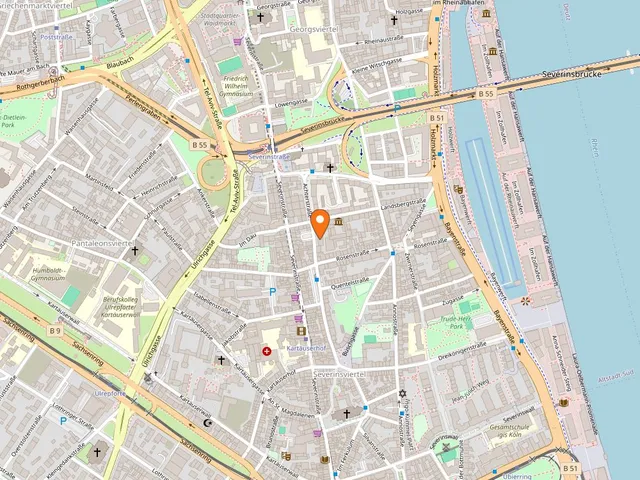
Map
Blue dots: other places nearby — tap to explore.
Address
Filzengraben 4
50676 Köln
Contact
You might also like — related or nearby
Comments
- Loading comments…
Sources & links
- Official website
- Official website (retrieved 2026-06-25)
- Wikidata (retrieved 2026-06-24)
- Wikipedia (retrieved 2026-06-24, rev 255343991)
Auto-generated, last verified: 2026-06-27
How this page is made
This page draws on open sources — Wikipedia, Wikidata, official websites and the city’s open data. Every statement is checked against the sources linked here, and pages are refreshed regularly.
Spotted a mistake anyway? Tell us below — we read every submission.