Neu St. Alban
Post-war church in the Stadtgarten built from rubble bricks of the destroyed Cologne Opera, with a pentagonal floor plan inspired by Le Corbusier.
since 1958
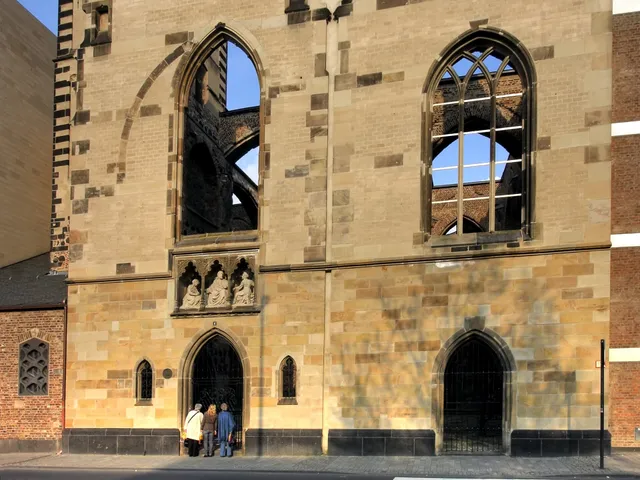
Neu St. Alban is a Catholic parish church on the northern edge of the Stadtgarten in Cologne's Neustadt-Nord district. Built in 1958/59 by architect Hans Schilling using salvaged rubble bricks, it inherited the furnishings and patronage of Alt St. Alban — the ruined medieval church preserved as a memorial near the Gürzenich.
At a Glance
- Type
- Catholic parish church, listed monument in North Rhine-Westphalia
- Location
- Gilbachstraße 25, northern edge of the Stadtgarten, Neustadt-Nord
- Built
- 1958/1959, consecrated 1959
- Architect
- Hans Schilling
- Style
- Modernist
- Floor plan
- Pentagonal nave with a distinct sanctuary
- Patron saint
- Alban of Mainz
The church was built from around 400,000 salvaged rubble bricks, many of them from the ruins of Cologne's old opera house. Even more remarkably, its pentagonal layout with an altar facing the congregation anticipated the liturgical reforms of the Second Vatican Council by five years – and required a special dispensation from Cardinal Frings to do so.
Things to do here
- Marvel at the unusual post-war architecture built from rubble bricks
- Take in the colored light from the narrow stained-glass windows
- Quietly explore the five-sided interior and the soaring chancel
- Discover the historic figures – apostles, Pietà and crucifixion group
- Photograph the striking exterior with its tower-like chancel
- Take a stroll afterwards in the adjoining Stadtgarten park
Age comparison
Age compared with other places in Cologne.
History
After World War II, rebuilding the destroyed Romanesque church of St. Alban was deemed impractical. The ruin was preserved as a memorial instead, and a new parish was established at the Stadtgarten through a land exchange, drawing congregants from St. Gereon and Neustadt-Nord. The driving force was priest Hugo Poth, who became its first pastor. Rubble bricks were chosen for construction because they were far cheaper than new ones — a large portion came from the ruins of the old opera house at Rudolfplatz.
Architecture
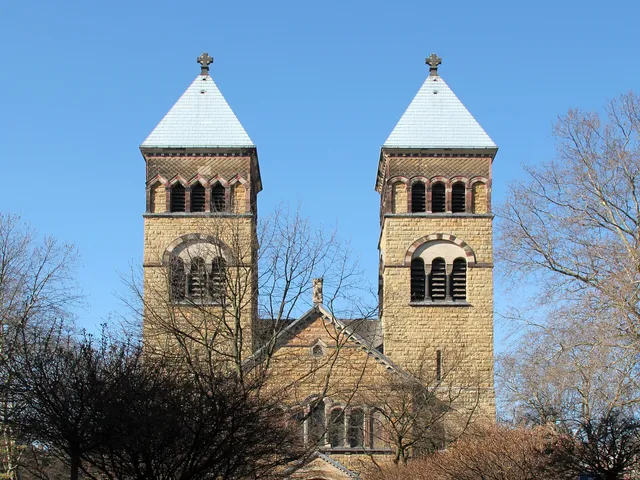
The nave has a pentagonal floor plan, fully enclosed, with light entering only through narrow, irregularly placed stained-glass windows in red, green, and grey tones by Franz Pauli. The design was inspired by Le Corbusier's pilgrimage chapel Notre Dame du Haut in Ronchamp. Adjoining the nave is a parabolic sanctuary rising 18 metres, which reads as a tower from the outside. There is no bell tower; a single bell hangs on the exterior wall.
Liturgical Innovation
With special dispensation from the Cardinal, the raised altar was moved away from the apse wall and oriented toward the congregation — an arrangement that only became standard practice after the Second Vatican Council. An attached sacrament chapel features an entrance door designed by Elmar Hillebrand. Below the church, a crypt serves as a baptismal chapel.
Furnishings
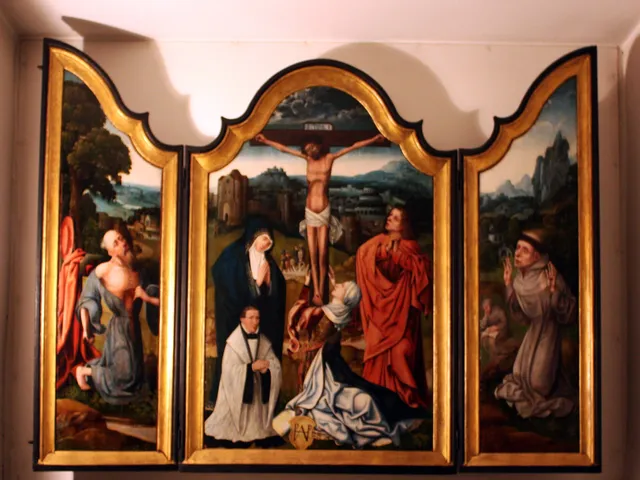
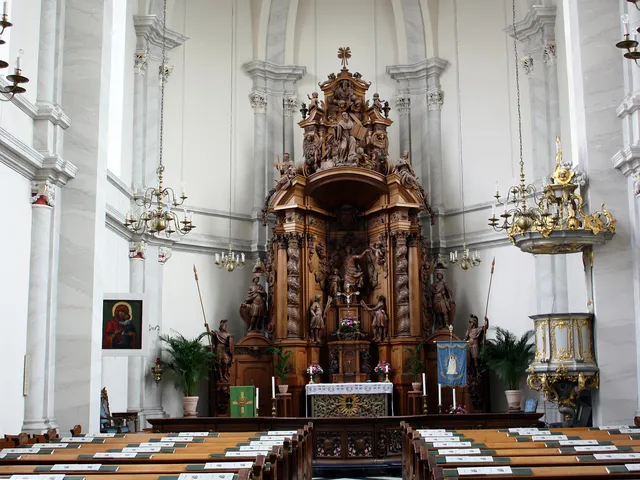
Several pieces were transferred from the old church: a Crucifixion group from the 16th and 17th centuries, twelve apostle figures from the former high altar, and a Pietà reassembled from 407 individual fragments. On the west wall hangs the triptych once donated by Cologne mayor Konrad von Schürenfels. The original furnishings also include a gem-studded cross above the altar by Lioba Munz.
Today
The church opens onto the Stadtgarten, and Mass is occasionally celebrated outdoors in the park in front of the building.
Timeline
- 1642Baptismal font made for Alt St. Alban (now in Neu St. Alban)
- 1957Groundbreaking on 21 June (feast day of St. Alban)
- 1957Foundation stone laid on 17 November
- 1958Topping-out ceremony on 21 April
- 1958Old opera house demolished; rubble bricks salvaged for the church
- 1958Completion: organ consecration 13 Dec., first mass 14 Dec.
- 1959Solemn consecration by Cardinal Frings on 16/17 June
Gallery
Map
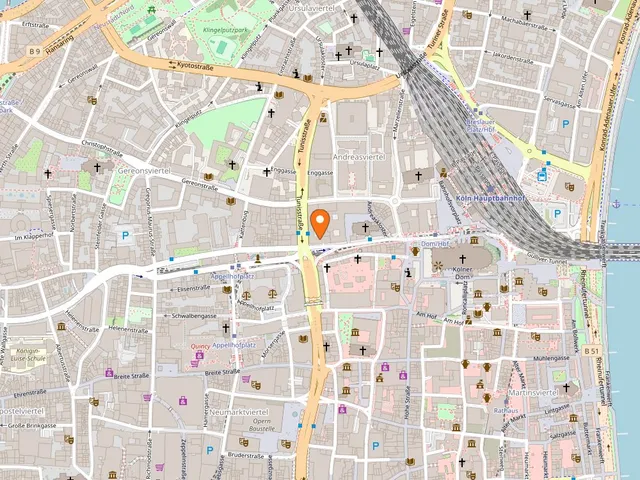
Blue dots: other places nearby — tap to explore.
Address
Gilbachstraße 25
50672 Köln
Contact
You might also like — related or nearby
Comments
- Loading comments…
Sources & links
- Official website
- Official website (retrieved 2026-06-25)
- Wikidata (retrieved 2026-06-23)
- Wikipedia (retrieved 2026-06-23, rev 250760503)
Auto-generated, last verified: 2026-06-26
How this page is made
This page draws on open sources — Wikipedia, Wikidata, official websites and the city’s open data. Every statement is checked against the sources linked here, and pages are refreshed regularly.
Spotted a mistake anyway? Tell us below — we read every submission.