Klein-Nazareth Cellite Convent
Former Cologne convent whose Cellite sisters, unlike the rest of their order, did not permanently work in nursing care.
Growing out of a beguinage on the street Unter Sachsenhausen, this community of Cellite sisters can be traced across roughly five centuries.
Source: Wikipedia
Auf einen Blick
- Art
- Former convent (no longer existing)
- Lage
- Cologne, Altstadt-Nord district, Innenstadt borough
- Orden
- Cellites
- Gründung
- Established 1307 as a beguine convent
- Kapelle
- Hall of about 8 × 12 m
- Belegung
- From six sisters (1477) to as many as 51 in the 17th century
- Aufhebung
- 2 September 1802
When the convent set up a chapel in 1486, mass had to be read behind locked doors and without bell-ringing – yet this very compromise foiled the city council's plan to merge the convent with another one.
Gründung
In 1307, Heymo dictus de Duren and his wife decreed that their house near the Würfelpforte on the street Unter Sachsenhausen should, after their death, serve as a convent for twelve beguines. The pleban of St. Paul and the officials of Niederich were entrusted with carrying this out. In 1314 the founders bequeathed their daughter Bela, who had entered the convent, an annual rent of one mark, to be divided among the three eldest beguines after her death. The community was governed by a mistress or rectrix, with spiritual oversight initially held by the parish priest of St. Paul and later by the Crosier Fathers.
Entwicklung
In 1474 the convent adopted the Rule of St. Augustine along with the Cellite constitutions; by 1477 it counted only six sisters. In 1486 the convent received permission to install a prayer room with an altar in the house and to have Mass read there — behind closed doors and without ringing bells. Consecrating this non-public chapel thwarted the city magistrate's plan to merge the convent with another.
Krankenpflege und Wachstum
The sisters supported themselves chiefly through manual labor, and initially also through nursing care. At the General Chapter held in Haarlem in 1500, they were released from this duty. The convent grew substantially in the 17th century, reaching as many as 51 sisters, prompting a major building expansion in 1639.
Kapelle und Bauten
The convent received a new chapel in 1501, though the chapel consecrated in 1551 may in fact have been the first freestanding structure. Known since the 16th century as Klein-Nazareth, the complex had its chapel's north side directly on the street. To the south lay a narrow cloister courtyard of about 7 × 28 m, to the west a small forecourt with the convent gate, and further south a larger garden area.
Aufhebung
When the convent was dissolved in 1802, its total capital value was estimated at 32,696 francs, with pensions owed to the sisters amounting to about 4,300 francs. A cotton spinning mill was later built on the site.
Timeline
- 1307Heymo de Duren designates his house as future beguine convent for 12 beguines
- 1335Construction/opening of the convent
- 1474Adoption of the Rule of St. Augustine with Cellite constitutions
- 1477Convent has only six sisters
- 1486Permission for prayer room/altar; dedication of the non-public chapel
- 1500Released from nursing duties at the general chapter in Haarlem
- 1551Consecration of a new, independent chapel
- 1639Significant building expansion
- 1802Dissolution of the convent on 2 September
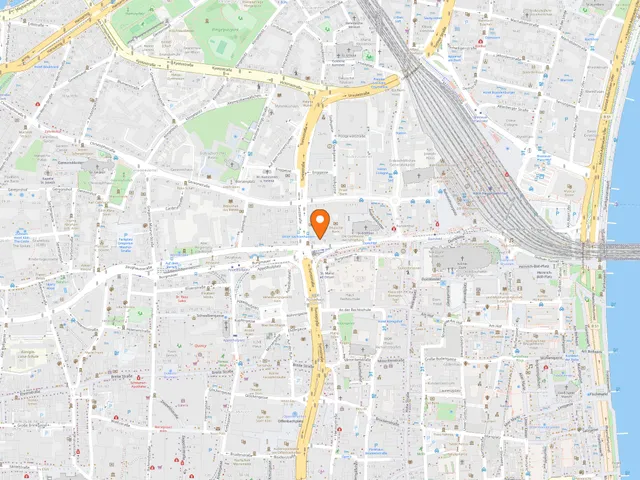
Map
Blue dots: other places nearby — tap to explore.
You might also like — related or nearby
Comments
- Loading comments…
Sources & links
Auto-generated, last verified: 2026-09-07
How this page is made
This page draws on open sources — Wikipedia, Wikidata, official websites and the city’s open data. Every statement is checked against the sources linked here, and pages are refreshed regularly.
Spotted a mistake anyway? Tell us below — we read every submission.