Humboldtpark
A listed 2.2-hectare park designed by Fritz Encke in 1913/14 — one of the few inner-city green spaces in the Kalk district of Cologne.
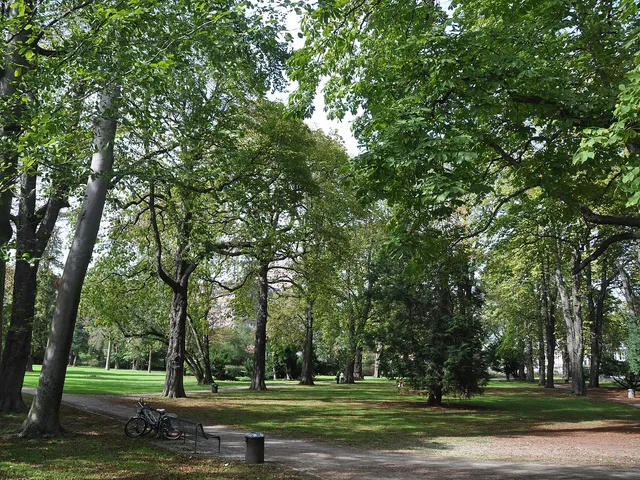
Humboldtpark in Cologne's Humboldt neighbourhood is part of the Humboldt-Kolonie, a residential quarter built from 1874/75 to house workers of the Humboldt AG industrial company. Today, circular pathways wind through the triangular grounds, lined by plane trees and horse chestnuts, with a playground at its centre.
At a Glance
- Type
- listed public park (protected monument in North Rhine-Westphalia)
- Size
- 2.2 hectares
- Location
- Humboldt neighbourhood, Kalk district
- Laid out
- 1913/14, designed by Fritz Encke
- Style
- Neoclassicism and Art Nouveau
- Renovated
- 2012–2013
- Special feature
- one of the few inner-city parks in the Kalk district
The park was built on land where a gunpowder mill once stood (1858–1870), and its playground had to be extensively remediated in 2012–2013 due to contamination from the area's heavy and chemical industry era.
Things to do here
- Stroll the loop paths beneath old plane and chestnut trees
- Let the kids romp on the playground at the park's center
- Play a round of pétanque on the boules court
- Linger by the flower gardens and admire the plantings
- Discover and photograph the heritage-listed grounds by Fritz Encke
- Relax on a bench amid the greenery and take a breather
Area comparison
Area compared with other Cologne parks and green spaces.
History
Before the park existed, a gunpowder mill operated on or near the site between roughly 1858 and 1870 — lending its name to the adjacent street An der Pulvermühle. From 1874/75, the Humboldt AG developed the land to the east as a worker's housing estate. This Humboldt-Kolonie became one of the first right-bank neighbourhoods to be incorporated into Cologne in 1888, when the city merged with the then-independent town of Deutz. The park was laid out in 1913/14 based on plans drawn up by Fritz Encke in 1912; a small wooden milk kiosk was designed by Hans Verbeek.
Design
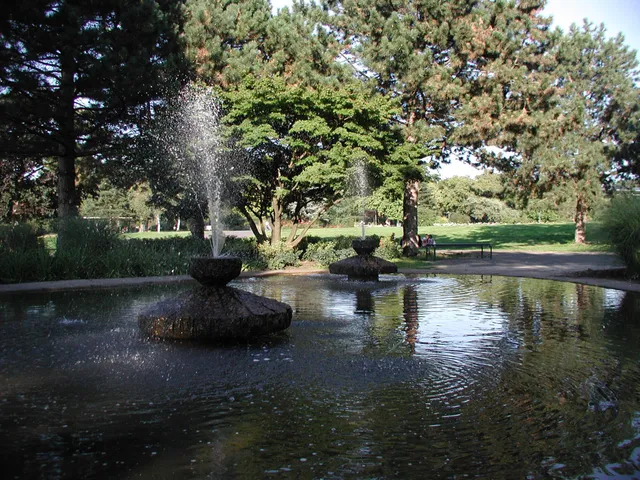
Circular paths traverse the triangular grounds, shaded by tall plane trees and horse chestnuts. A playground occupies the central open area, flanked by flower gardens. A former kitchen and school garden has since been replaced by a pétanque court.
Renovation
Around a century after it was created, the park was restored by the Kölner Grün Stiftung, funded largely by a €300,000 donation from Klosterfrau Healthcare Group and supported by local community groups and the city's parks department. The playground — contaminated by the area's industrial past in heavy industry and chemicals — was remediated separately by the city. Works ran from April 2012 to December 2013.
Location
The park sits in the western part of the Humboldt-Kolonie, which is separated from the neighbouring Deutz district by a freight railway line. It is bounded by the streets An der Pulvermühle, Gremberger Straße, and Burgenlandstraße, all of which provide access to the park.
Timeline
- 1858–1870Powder mill in the area of today's park; gives the street its name
- 1874/75Humboldt AG develops the area as a residential district (Humboldt-Kolonie)
- 1888Humboldt-Kolonie incorporated into Cologne as its first right-bank district
- 1912Planning drawn up by Cologne garden director Fritz Encke
- 1913/14Park laid out in Neoclassical and Art Nouveau style
- April 2012Start of renovation works (Klosterfrau donation of €300,000)
- Dezember 2013Renovation completed; park reopened for contemporary use
Gallery
Map
Blue dots: other places nearby — tap to explore.
Address
Burgenlandstraße 3b
51105 Köln
Hours
So: 00:00–24:00
You might also like — related or nearby
Comments
- Loading comments…
Sources & links
Auto-generated, last verified: 2026-06-26
How this page is made
This page draws on open sources — Wikipedia, Wikidata, official websites and the city’s open data. Every statement is checked against the sources linked here, and pages are refreshed regularly.
Spotted a mistake anyway? Tell us below — we read every submission.