Haus Haan (Moated Castle)
A medieval moated castle in Höhenhaus – first documented in 1203, with the present manor house dating from 1730 and converted into private apartments behind its old moat in 1986.
since 1730
On the edge of Höhenhaus, near the boundary with Dünnwald, stands Haus Haan, a medieval moated castle and former knight's estate. The complex is visible from the outside as a historic ensemble; there is no public access to the interior, as it now serves as a private residential complex.
At a Glance
- District
- Höhenhaus, on the border with Dünnwald
- Type
- Moated castle / former knight's estate
- First mention
- 1203 (an earlier structure existed before 1200)
- Present manor house
- built 1730, renovated 1786
- Moat
- fed by a stream branching off the Mutzbach at Dünnwalder Mauspfad
- Current use
- private residential complex (converted in 1986)
- Access
- gateway to the Zeisbuschweg; no public interior viewing
Age comparison
Age compared with other places in Cologne.
Layout and Architecture
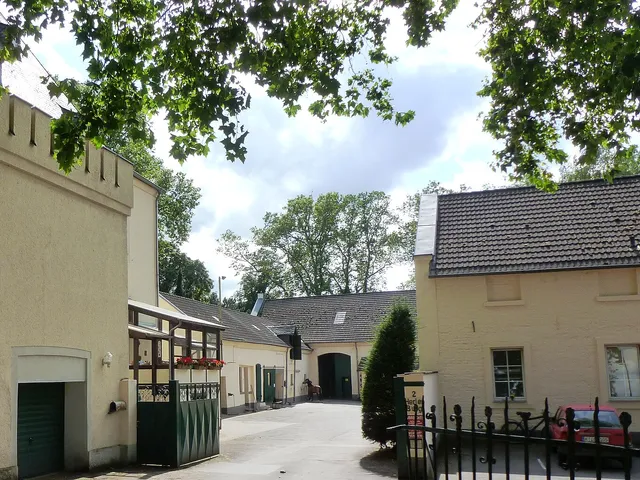
Haus Haan is laid out as a quadrangle that is not entirely enclosed by buildings. At its centre stands the main house on a raised, masonry-built island completely surrounded by a moat. A steeply rising stone arched bridge leads from the inner courtyard onto the island.
The manor house itself is a plain, two-storey quadrangular building with window bays on each side and a tall mansard roof. On three sides, beyond the moat, it is framed by the more recent former farm buildings. Opposite the entrance to the manor house lies a gateway to today's Zeisbuschweg.
A Dispute Over Water
The castle owes its name to the von Haane family of knights, who owned the estate from 1230. Even before 1200, the knight Seybold von Blech had built an early motte here on cleared land. The von Haane knights became known above all through a long legal dispute with the convent in Dünnwald over water rights on the Mutzbach.
In 1264 the brothers Nikolaus and Jakob von Haane clashed with the convent, which held the right to use the stream for its mill. The knights instead diverted the water into their own moat. Only a twelve-member court of arbitration, appointed by Countess Margarete von Berg and her son Adolf, ended the decades-long feud: sole rights went to the convent, which nonetheless had to grant the knights water on two days and nights each week "for the sake of peace" and pay them 20 marks of Cologne currency in compensation. In addition, a relative of the knights was to be admitted to the Dünnwald convent.
From Knights to the City of Cologne
In 1355 the knight Wilhelm von Haane had a mill built where the Mutzbach flowed down into the Rhine valley – roughly at today's Dünnwalder Mauspfad. It operated as a fulling mill and was later called the "lower fulling mill"; before then, cloth and leather had to be carried far, as far as Mülheim, for fulling.
From 1373 the von Lülsdorf family became owners and made Haus Haan their family seat until 1710. During the Thirty Years' War the castle was burned down by imperial troops in 1628; the present manor house was built in 1730. Through the Droste zu Vischering family the estate passed in 1812 to a Mr Brügelmann from Ratingen – Friedrich Wilhelm Brügelmann founded the Brügelmann company, still based in Cologne today, here in 1822. In 1828 the City of Cologne bought the complex. Lacking a plan for its use, it fell into disrepair over the years, with parts serving as a riding stable. In 1986 the city sold the ensemble, which was then converted into a private residential complex.
Legends and Lore
One legend tells of an underground passage said to have linked Haus Haan with the Dünnwald convent – through it, the nuns are said to have escaped to safety during hostile raids. The dialect poet Franz Peter Kürten also commemorated the place in his poem "der Grafenstohl en dr Kirch," recalling the "Count of Stammheim" and his church pew, which also served the "castle folk of Haan."
Map
Blue dots: other places nearby — tap to explore.
Address
Dünnwald
51061 Köln
You might also like — related or nearby


Comments
- Loading comments…
Sources & links
- Official website
- Official website (retrieved 2026-08-20)
- Wikipedia (retrieved 2026-08-20)
- Wikidata (retrieved 2026-08-20)
Auto-generated, last verified: 2026-08-20
How this page is made
This page draws on open sources — Wikipedia, Wikidata, official websites and the city’s open data. Every statement is checked against the sources linked here, and pages are refreshed regularly.
Spotted a mistake anyway? Tell us below — we read every submission.