Blau-Gold-Haus
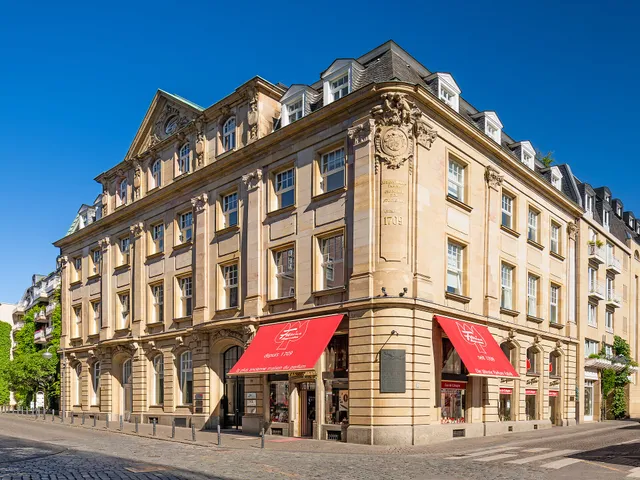
Right next to Cologne Cathedral stands the Blau-Gold-Haus, a turquoise-and-gold office and commercial building from 1952 that is a listed monument and a notable example of German post-war modernism, today home to hotel suites and luxury boutiques.
Just steps from Cologne Cathedral, at Domkloster 2 in the northern Old Town, the Blau-Gold-Haus catches the eye with its turquoise-and-gold façade. Completed in 1952, it counts among the significant examples of German post-war modernism.
Source: Wikipedia
At a Glance
- Address
- Domkloster 2, Cologne, Old Town North (right by the cathedral)
- Completed
- October 1952
- Architect
- Wilhelm Koep (in-house architect for 4711)
- Style
- German post-war modernism, six-storey steel-frame structure
- Façade
- Turquoise-and-gold curtain wall of aluminium, steel and glass
- Listed monument
- since 18 June 1991
- Today
- Suites of the Dom-Hotel plus luxury shops
History
Two buildings from the Gründerzeit era once stood on this spot. The first was a mansion erected in 1843 on the south side as a home and business premises for the banker Simon Oppenheim. When the surrounding complex was demolished from November 1886 onward to give the cathedral more open space, the Oppenheim mansion at Domkloster 2 was the only part left standing.
In 1892 the perfume manufacturer Ferdinand Mülhens had architect Wilhelm Kurth convert the mansion into a 65-room hotel. Opened on 2 November 1893, it first bore the name "Großer Kurfürst"; after a remodelling in 1905 it was simply called the "Savoy-Hotel". A demolition bomb destroyed the building during the Second World War, and it was taken down in 1950.
Architecture and Colour
Commissioned by the Mülhens family, 4711's in-house architect Wilhelm Koep completed the plans for a new commercial building by October 1951. A richly decorated curtain wall of aluminium, steel and glass wrapped around the six-storey steel frame.
By day, gold-anodised aluminium and turquoise parapets define its appearance — a colour pairing that goes back to the turquoise-and-gold that Peter Joseph Mülhens had already fixed for the 4711 brand in 1839. This combination gave rise to the popular name "Blau-Gold-Haus" (Blue-and-Gold House). The building is especially striking at night, when indirect lighting makes the façade glow along Domkloster and Wallrafplatz.
From Advertising Landmark to Hotel
Although 4711's company headquarters moved to Glockengasse 4 in October 1964, the new building on the prominent southern cathedral plaza was meant to serve as an advertising landmark aimed above all at tourists. A 4711 shop existed only in the early years; today the premises house stores such as Louis Vuitton, Hermès and Longchamp. After renovations in 1979 and 1991, the building has been a listed monument since 18 June 1991.
Since January 2010 the Blau-Gold-Haus has belonged to the pension fund of the Bavarian municipalities, which also owns the neighbouring Dom-Hotel. Between June 2010 and August 2012 it was gutted and redesigned under architect Johannes Kister. From the second upper floor onward, 42 suites were created for the Dom-Hotel, including an 88 m² "Presidential Suite" on the fourth floor. The refurbishment earned the building a special award from the Federal Ministry of Building and the German Steel Construction association in 2012.
Gallery
Map
Blue dots: other places nearby — tap to explore.
You might also like — related or nearby


Comments
- Loading comments…
Sources & links
Auto-generated, last verified: 2026-08-27
How this page is made
This page draws on open sources — Wikipedia, Wikidata, official websites and the city’s open data. Every statement is checked against the sources linked here, and pages are refreshed regularly.
Spotted a mistake anyway? Tell us below — we read every submission.