Haus Saaleck
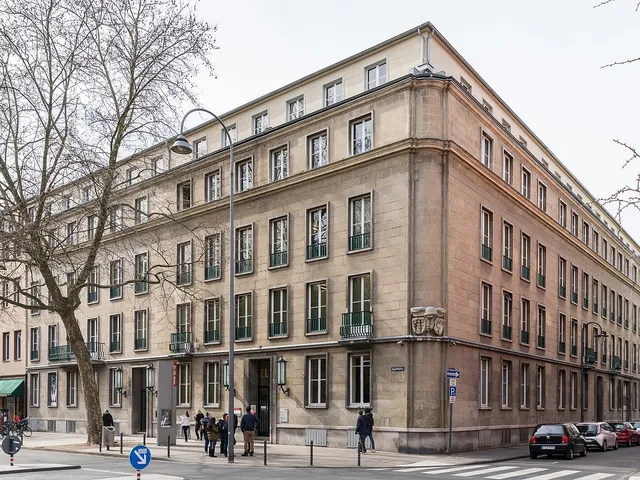
Medieval Cologne townhouse with late-Gothic corner turrets – today home to the city's Artothek, a lending library for art.
The name combines the base word "Eck" (corner) with "Saal," preserving the memory of the archbishop's palace, the so-called Saal, which once stood nearby at the Domhof.
Source: Wikipedia
At a Glance
- Type
- former medieval townhouse
- Location
- corner of "Unter Taschenmacher" and "Am Hof," Altstadt-Nord, Innenstadt district
- Rebuilt
- around 1461 in late-Gothic style
- Architectural features
- mullioned windows, three corner turrets, octagonal towers at the building's corners
- Protection status
- listed heritage building in North Rhine-Westphalia
- Today
- home to the Cologne Artothek
After being almost completely destroyed in World War II, Haus Saaleck was rebuilt true to its original form using surviving remnant walls and rubble pieces recovered from the surrounding area.
History
A house on this site is first mentioned around 1281 in connection with the stonemason Theoderich, who acquired it. Historians believe he was one of the craftsmen working at the nearby cathedral construction site. In 1283, records refer to it as "saileckin" — the plural form suggests a property consisting of two parts. Over time, the name shifted through several variants, such as "salecken" or "sallecken." Around 1461, a new building was erected on the same spot.
Architecture
The late-Gothic structure featured mullioned windows and three corner turrets reminiscent of the style of Cologne's Gürzenich. Octagonal towers, originally topped with pointed roofs, sit at the building's corners. During the Second World War, the building was almost completely destroyed by air raids: the façades were heavily damaged and the interior gutted by fire. In the postwar years it was rebuilt in its original form, using the surviving remnants of the walls along with rubble found in the surrounding area.
Today
In the 1970s, the Cologne City Museum used the building for exhibitions. Today it houses the city's Artothek, where art objects, paintings, and sculptures can be borrowed much like books from a library. Between 2010 and 2014, the house underwent heritage-conscious restoration. In December 2013, the Rhenish Association for Heritage and Landscape Protection named it Monument of the Month.
Timeline
- 1281First mention of a house associated with stonemason Theoderich
- 1283Term „saileckin“ for the house appears in documents
- um 1461Magnificent late Gothic building with three corner turrets erected
- 1970er JahreBuilding used by Cologne City Museum for exhibitions
- März 2005Remaining building areas have stood vacant since then
- März 2007City of Cologne offers building for sale
- August 2010Interested buyer acquires the property
- 2010–2014Heritage-conservation renovation of Haus Saaleck
Gallery
Map
Blue dots: other places nearby — tap to explore.
You might also like — related or nearby

Comments
- Loading comments…
Sources & links
Auto-generated, last verified: 2026-09-18
How this page is made
This page draws on open sources — Wikipedia, Wikidata, official websites and the city’s open data. Every statement is checked against the sources linked here, and pages are refreshed regularly.
Spotted a mistake anyway? Tell us below — we read every submission.