EL-DE House
Former Gestapo headquarters with a preserved cell block and around 1,800 prisoner wall inscriptions — now Cologne's Nazi documentation center.
since 1934
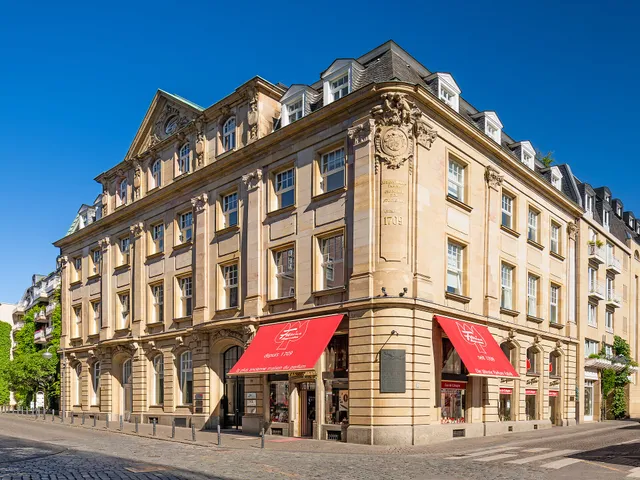
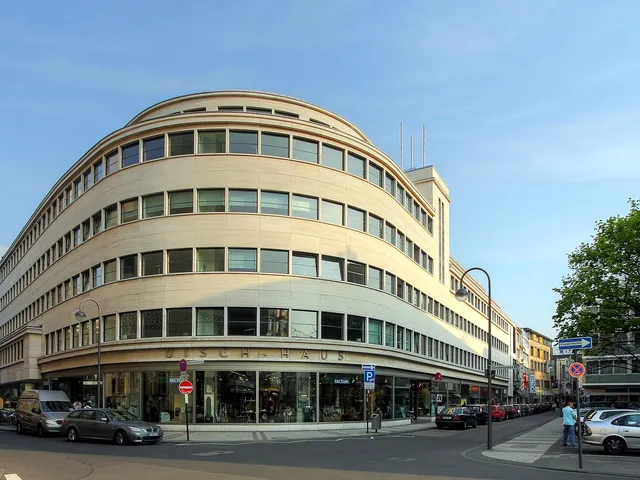
The EL-DE House in Cologne's Altstadt-Nord district served as the Gestapo's headquarters and prison from 1935 to 1945. Since 1988 it has housed the city's NS Documentation Center.
Source: Wikipedia
At a Glance
- Type
- Former Gestapo headquarters, now a documentation center
- Location
- Altstadt-Nord, Appellhofplatz 23–25, at the corner of Elisenstraße
- Built
- 1934/35 as a residential and commercial building
- Architect
- Hans Erberich, commissioned by Leopold Dahmen
- Cell block
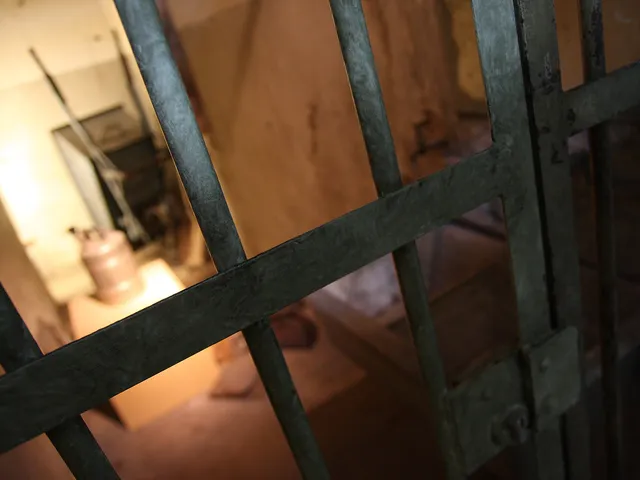
- Ten basement cells ranging from 4.6 to 9.3 m²
- Notable feature
- Around 1,800 surviving wall inscriptions by prisoners
- Use as documentation center
- since 1988
Age comparison
Age compared with other places in Cologne.
Name and Construction
Cologne gold and watch wholesaler Leopold Dahmen had the building constructed in 1934/35. On the corner he placed his own coat of arms beside the Cologne city crest: two crossed clock hands with the initials L and D, topped by the lettering EL-DE — the source of the building's name. After construction stalled in the summer of 1935, the Gestapo seized the still-unfinished building, though without expropriating the owner.
Gestapo Headquarters
On 1 December 1935 the Gestapo moved into the unfinished building as a tenant. Its location was convenient for them, close to the police headquarters, the courthouse, and the Klingelpütz central prison. Prisoners were forced to build ten cells in the basement fitted with iron bunks, along with guard rooms, washing and toilet alcoves, and a gallows. The cells were originally meant to hold detainees only during interrogations, but wall inscriptions reveal that prisoners were often kept there for weeks or months.
Prisoners and Interrogations
Among the prisoners were many POWs and forced laborers, as well as resistance fighters, including members of the Ehrenfeld Group and the Free Germany Committee. Interrogations initially took place on the same level as the cell block, so passersby outside could hear the screams of the tortured; later they were moved to a deeper basement level. The Gestapo carried out mass executions without trial; the last one at the EL-DE House took place on 2 March 1945, shortly before American troops arrived.
Wall Inscriptions
Around 1,800 inscriptions survive in the cells, dating from late 1943 to 1945. Prisoners left messages for their loved ones as well as drawings of figures, landscapes, and animals. About 600 are written in Cyrillic script, with roughly 300 more in French, Dutch, Polish, English, and Spanish. Some inscriptions were lost after the war when certain partition walls were removed.
After the War
The building survived the war largely undamaged by bombing. After 1945 it housed municipal offices, including the registry office and pension bureau. Between 1947 and 1949 it was remodeled and connected to neighboring buildings. In 1979 calls arose to turn it into a memorial and documentation site.
Gallery
Map
Blue dots: other places nearby — tap to explore.
You might also like — related or nearby

Comments
- Loading comments…
Sources & links
Auto-generated, last verified: 2026-06-30
How this page is made
This page draws on open sources — Wikipedia, Wikidata, official websites and the city’s open data. Every statement is checked against the sources linked here, and pages are refreshed regularly.
Spotted a mistake anyway? Tell us below — we read every submission.