Cologne Rose Monday Parade
Germany's largest and oldest Rose Monday parade — the "Zoch" has wound its way through Cologne for eight kilometres since 1823.
since 1823
approx. 1 M visitors per event
The Cologne Rose Monday Parade (Rosenmontagszug) is the largest carnival procession in Germany and the highlight of Cologne Carnival on Rose Monday. The "Zoch" — as locals call it — has been held since 1823, making it the oldest of Germany's major Rose Monday parades.
Source: Wikipedia
At a Glance
- Type
- Carnival procession on Rose Monday
- District
- Altstadt-Nord (Innenstadt borough)
- Held since
- 1823
- Length
- approximately eight kilometres
- Throws
- around 300 tonnes of sweets ("Kamelle"), plus flowers, soft toys and other gifts
- Distinction
- oldest of Germany's major Rose Monday parades
According to the dictionary of the Brothers Grimm, the name "Rosenmontag" derives from the Middle High German "Rasenmontag" – meaning the "raging, riotous" Monday – and has nothing to do with roses at all.
Things to do here
- Watch the "Zoch" from the roadside and marvel at the colourful floats
- Catch "Kamelle" sweets and flowers tossed into the crowd
- Join the fun in costume and face paint like a true reveller
- Sway to the marching bands and sing along to Cologne's carnival songs
- Spot the costumed walking groups, riders and dance troupes
- Soak up the festive atmosphere in the crowd and take photos
Age comparison
Age compared with other places in Cologne.
Procession and Crowds
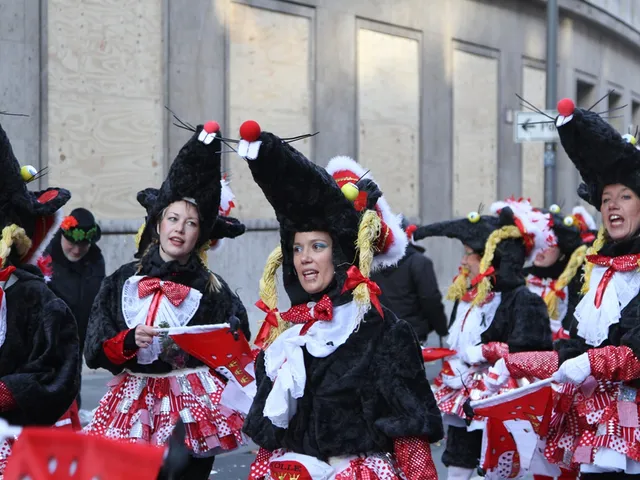
The parade is made up of costumed walking groups, marching bands, horse riders, floats and support vehicles. Hundreds of thousands of spectators line the route. Revellers — known as "Jecken" — crowd the pavements in rows, hoping both to catch a glimpse of the parade and to grab some of the thrown sweets.
The Name "Rose Monday"
Several explanations exist for the name "Rosenmontag." The linguist Adam Wrede links it to the Christian Rose Sunday (Laetare Sunday), observed at mid-Lent as a follow-up celebration in the early years of organised carnival. The term is documented from the early 1830s. Other scholars, such as art historian Michael Euler-Schmidt, trace it to the Middle High German "Rasenmontag" — the "raging, riotous" Monday.
Origins Under French Occupation
Towards the end of the 18th century, Cologne — still largely shaped by medieval traditions — was thrown into upheaval by French occupation. Among the bourgeoisie this sparked a renewed interest in Cologne's own customs, including the pre-Lenten festivities. The men's association Olympische Gesellschaft zu Köln held literary carnival celebrations, while merchants, lawyers and occupation officers organised masked balls. Wealthy citizens also staged the first small, themed processions.
Foundation in 1823
After Prussian rule began in 1815, carnival development stalled. As masquerades declined, income from the entertainment tax — which supported Cologne's poor relief administration — dried up; the system was abolished in 1821. Officials of the poor relief board, including its president Heinrich von Wittgenstein, responded by founding the Grosse Karnevalsgesellschaft in 1823 (today known as "Die Grosse von 1823"), whose members elected the parade's stewards.
Timeline
- 1798French occupation begins reforming Cologne's political and social structures
- 1815Prussian rule begins; Cologne carnival stagnates after loss of French protections
- 1821Entertainment taxes fully abolished; revenues for poor relief administration collapse
- 1823Founding of the Grosse Karnevalsgesellschaft; first organised Rose Monday parade
- um 1830Term 'Rose Monday' attested for the day, as Laetare Sunday celebration dies out
- Ende 19. Jh.Term 'Rose Monday' increasingly adopted for the carnival procession itself
Gallery
Map
Blue dots: other places nearby — tap to explore.
You might also like — related or nearby




Comments
- Loading comments…
How this page is made
This page draws on open sources — Wikipedia, Wikidata, official websites and the city’s open data. Every statement is checked against the sources linked here, and pages are refreshed regularly.
Spotted a mistake anyway? Tell us below — we read every submission.