St. Bruno
A Catholic parish church in Cologne's Klettenberg district, built in the 1920s in a restrained Expressionist style and repeatedly remodelled after heavy wartime damage.
since 1924
In Cologne's residential Klettenberg district stands St. Bruno, a Roman Catholic parish church built between 1924 and 1926 to designs by Ludwig Becker, cathedral architect from Mainz. It is named after Bruno, a medieval archbishop of Cologne.
Source: Wikipedia
At a Glance
- Building type
- Catholic parish church laid out as a basilica
- Architect
- Ludwig Becker (interior: Hans Hansen)
- Construction
- 1924 to 1926, consecrated in October 1926
- District
- Cologne-Klettenberg, on the Klettenberggürtel
- Dedication
- Archbishop Bruno of Cologne
- Style
- Restrained Expressionism with Baroque and Neoclassical notes
- Heritage status
- Protected since 1983 (No. 1271 on Cologne's monument list)
- Denomination
- Roman Catholic
The silver triumphal cross from 1957 was made from jewellery and tableware silver that parishioners donated specifically for it.
Things to do here
- Admire the massive war-surviving tower with its copper ogee dome
- Discover Elmar Hillebrand's marble sculptures on the forecourt
- Experience the Klais organ with its 44 stops and original console
- Explore the post-war concrete tracery windows in the choir
- View Hanns Rheindorff's silver triumphal cross made from donated jewellery
Age comparison
Age compared with other places in Cologne.
History
The project began around 1914, when the Sülz parish of St. Nikolaus sought a daughter church for the growing Klettenberg neighbourhood. A plot was secured during the First World War, and in 1919 Becker was commissioned to design a large church seating roughly 950 with room for 1,200 more standing. Ground was broken in August 1924; Cardinal Karl Joseph Schulte laid the foundation stone in 1925 and consecrated the completed church in 1926.
The Second World War hit St. Bruno hard: air raids destroyed the roof and windows in 1942, and by 1944 only the tower and outer walls remained. A makeshift church in the neighbouring Brunosaal bridged the gap until Hans Hansen led the rebuilding from 1948, and the church was reconsecrated in 1949. When the newly installed ceiling soon cracked, a thorough remodelling followed within a few years, adding concrete tracery windows to the choir. Further changes came with the reforms of the Second Vatican Council from 1973 and a ceiling renovation from 2005.
Architecture
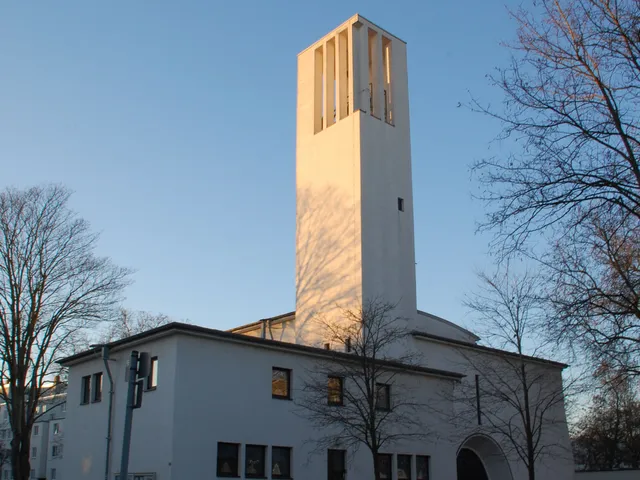
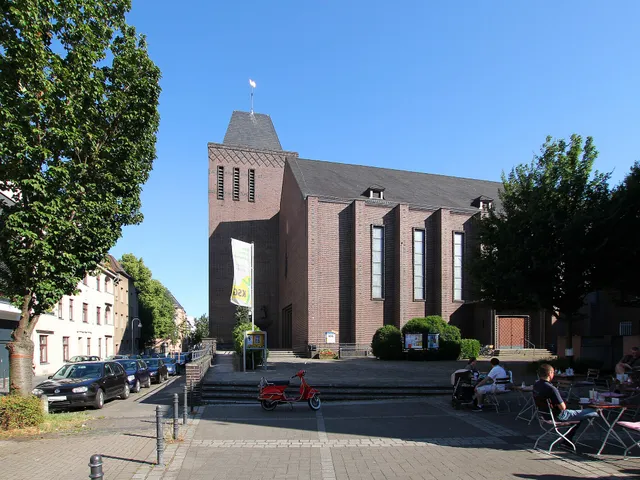
The church is not oriented to the east but sits slightly raised, its entrance side blending into the surrounding housing; the recessed façade creates a small forecourt. Facing the street is the massive tower that survived the war, capped by a copper ogee dome and flanked by symmetrical annexes. The gabled nave follows a basilica plan, accompanied by lower, narrow side aisles and closed by an equally low choir apse whose deep concrete tracery windows date only from the post-war period.
Furnishings
Two marble figures by Elmar Hillebrand stand on the street-side forecourt, depicting Jacob wrestling the angel and Jesus as the Good Shepherd; Hillebrand also created the altar, bronze candelabrum and font cover. The silver-and-enamel triumphal cross was made in 1957 by Hanns Rheindorff, with parishioners donating jewellery and tableware silver for the material. For the four crypt windows, Jakob Berwange chose Old Testament scenes.
Organ
Built in 1940 by the Johannes Klais workshop in Bonn, the organ was enlarged in 1959 and thoroughly overhauled in 2008. It has three manuals, a pedal division and 44 stops; its console, including keys, stop switches and wooden casing, remains in its original condition.
Timeline
- 1924Ground broken and construction begins in August
- 1925Cardinal Karl Joseph Schulte lays the foundation stone
- 1926The completed church is consecrated in October
- 1942An air raid destroys the roof and windows
- 1944After another raid only the tower and outer walls remain
- 1948Hans Hansen starts the rebuilding; new cast-steel bells
- 1949Reconsecration by auxiliary bishop Wilhelm Stockums
- 1983Added to Cologne's monument list under No. 1271
- 2008Thorough overhaul of the Klais organ
Gallery
Map
Blue dots: other places nearby — tap to explore.
You might also like — related or nearby
Comments
- Loading comments…
Sources & links
Auto-generated, last verified: 2026-08-26
How this page is made
This page draws on open sources — Wikipedia, Wikidata, official websites and the city’s open data. Every statement is checked against the sources linked here, and pages are refreshed regularly.
Spotted a mistake anyway? Tell us below — we read every submission.