Cologne City Museum
Cologne's urban history museum, open for over 130 years — since 2024 it organises its collection around emotions rather than chronology; currently in temporary premises.
since 1888
Cologne's past comes to life in this municipal museum, which since 2024 has arranged its holdings around emotions rather than strictly along a timeline.
At a Glance
- Type
- Municipal history museum of the City of Cologne
- Founded
- 1888 as the Historical Museum
- First home
- Hahnentor gatehouse, part of the medieval city fortifications
- Location
- Altstadt-Nord, city-centre district
- Collection
- approximately 350,000 objects
- Period covered
- Middle Ages to the present (around 1,200 years)
- Current premises
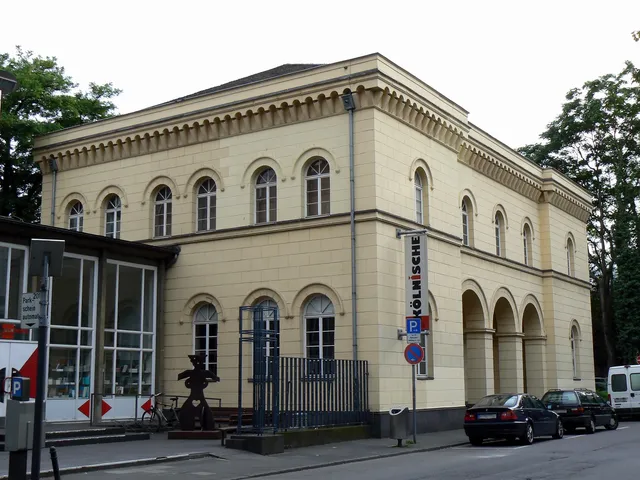
- former fashion house Franz Sauer, since March 2024
When the city museum opened in 1888 in the Hahnentorburg, there was no storage depot – staff simply used the hollow spaces beneath the display cases as cupboards for coins and parts of the graphic collection.
Things to do here
- Explore Cologne's history from the Middle Ages to today
- Wander the permanent exhibition arranged by emotions
- Marvel at the famous city seal from 1268
- Examine paintings, coins, textiles and everyday objects
- Combine your visit with a stroll through the old town
Age comparison
Age compared with other places in Cologne.
The Collection
Highlights include the city seal of 1268, alongside paintings and prints, militaria, coins, textiles, furniture and everyday objects — as well as items documenting more recent events in Cologne's history. The breadth of the holdings allows visitors to explore questions of social, economic and cultural history both through individual pieces and through thematic deep dives.
A New Approach
Under the concept introduced in 2024, only a selected portion of the collection is on display at any one time. The permanent exhibition cuts across historical periods, grouping objects by the emotions they evoke — making feeling the organising principle and shedding unexpected light on social and historical questions. The stated goal is to foster a sense of shared identity within the city.
Origins
The city council passed the founding resolution on 13 July 1888; the museum opened its doors on 14 August of the same year. One catalyst was the newly restored Hahnentor, whose future use was undecided: the proposal by archive director Konstantin Höhlbaum to install a historical museum there ultimately prevailed.
A Museum on the Move
The museum began in the Hahnentor, one of Cologne's surviving medieval gatehouses. In 1902 the Eigelsteintor was added as a second site, allowing a slightly larger permanent display. From 1958 the historic Zeughaus (arsenal) served as its home until water damage forced a move in 2017, leaving only the adjacent Alte Wache available for temporary exhibitions. The current address is likewise considered an interim solution — it sits centrally between the Minorite Church, Museum Kolumba and the lower end of Breite Straße.
Good to Know
In its final years at the old, increasingly restricted premises, annual visitor numbers stood at around 19,832. Notably for Cologne, roughly half of all visitors are registered residents of the city itself — something that has been read as a sign of the strong local attachment Cologne's inhabitants feel to their home.
Timeline
- 1827Founding of the Wallraf-Richartz-Museum as Cologne's oldest museum
- 1874Düsseldorf founds its historical museum (reference point)
- 1888Founding resolution on 13 July; opening of the Historical Museum on 14 August
- 1894Director Arthur Pabst takes early retirement; Joseph Hansen takes over
- 1902Eigelsteintorburg acquired as a second location
- 1913Major special exhibition 'Old and New Cologne' in the Sonderbund exhibition halls
- 1958Move into the historic arsenal building
- 2017Arsenal evacuated due to water damage; only the Alte Wache used for special exhibitions
- März 2024Move to temporary location in the former fashion house Franz Sauer
Treasures & artworks
A few highlights from the collection.
Nearly 3.5 m tall nail figure from 1915: donors supporting war widows and orphans could hammer in a nail. With 707,000 Marks raised in its first year, it was the most successful German fundraising "nail figure" of the First World War. Part of the permanent exhibition since 1984.
Wikipedia ↗Gallery
Map
Blue dots: other places nearby — tap to explore.
Address
Minoritenstraße 13
50667 Köln
Hours
Di: 10:00–17:00
Mi: 10:00–17:00
Do: 10:00–17:00
Fr: 10:00–17:00
Sa: 10:00–17:00
So: 10:00–17:00
You might also like — related or nearby
Comments
- Loading comments…
Sources & links
- Official website
- Official Instagram (@koelnisches_stadtmuseum)
- Wikidata (retrieved 2026-06-23)
- Wikipedia (retrieved 2026-06-23, rev 266187509)
- Official website (retrieved 2026-06-24)
Auto-generated, last verified: 2026-06-26
How this page is made
This page draws on open sources — Wikipedia, Wikidata, official websites and the city’s open data. Every statement is checked against the sources linked here, and pages are refreshed regularly.
Spotted a mistake anyway? Tell us below — we read every submission.