Uni-Center
One of Europe's largest residential buildings: the Y-shaped tower in Sülz combines 968 apartments with a 134-metre central core.
since 1973
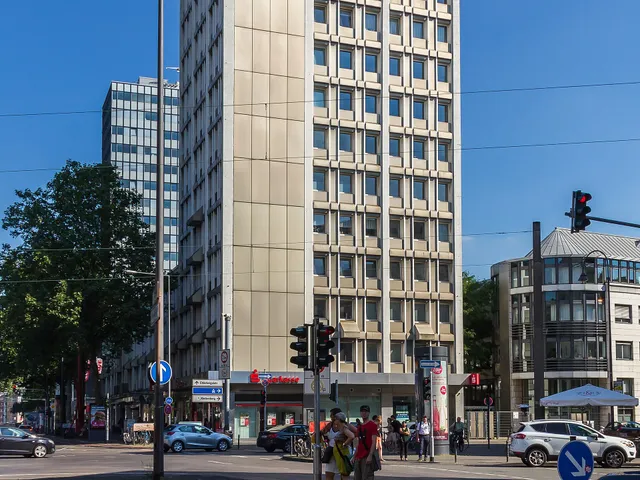
The Uni-Center is a residential high-rise in the Cologne district of Sülz, situated at the corner of Luxemburger Straße and Universitätsstraße, and ranks among the largest apartment buildings in Europe. Its footprint forms a Y of three wings joined by a central tower.
At a Glance
- Type
- Residential high-rise with shops, restaurants and a car park on the lower floors
- Location
- Cologne-Sülz (Lindenthal borough), corner of Luxemburger Straße/Universitätsstraße
- Completed
- 1 August 1973
- Height
- 134 m (central tower "C", 45 storeys)
- Apartments
- 968 units, including a student residence
- Architect
- Werner Ingendaay (1923–2008)
- Distinctive feature
- Y-shaped footprint with colour-coded wings
During the German Autumn of 1977, RAF terrorists rented an apartment in the Uni-Center to plan the kidnapping of Hanns Martin Schleyer – and it was precisely during the subsequent GSG-9 search of the building that the Lufthansa Landshut aircraft was hijacked simultaneously.
Size comparison
Height compared with other landmarks in Cologne.
Age comparison
Age compared with other places in Cologne.
Architecture
The complex is divided into three wings of different heights and a connecting core. The wings are labelled "U" (38+3 floors), "N" (31+3 floors) and "I" (26+3 floors); the core is labelled "C" with 45 floors. To aid orientation, each wing has its own colour: "U" in orange, "N" in green and "I" in yellow. Apartments occupy both sides of each wing from the fifth floor upwards; the uppermost levels consist of technical and storage space, two maisonette floors and a penthouse. At 134 metres, the central tower "C" is the tallest element, placing the Uni-Center third on Cologne's list of tallest buildings.
History
The building was designed by Cologne professor Werner Ingendaay and developed by the Kölner Bauträgergesellschaft Deba Wohnbau. Construction began in January 1971; the foundation stone was laid in February 1971 by the then Federal Transport Minister Lauritz Lauritzen, who described the project as a "bold experiment." After the topping-out ceremony in October 1972, the complex was ready for occupation on 1 August 1973.
Living in the Uni-Center
Around 60 percent of the units were sold as owner-occupied flats. The remaining apartments in the "I" wing were taken over by the Cologne Student Services organisation (Studierendenwerk), which operates 378 rooms of 14 to 24 m² as a student residence. Estimates of the total number of residents range from about 1,200 to nearly 2,000; nine lifts serve the floors.
Film Set and Recent History
The building served as a filming location for the 1975 film adaptation of Heinrich Böll's novel The Lost Honour of Katharina Blum, which premiered in October 1975. During the German Autumn of 1977, members of the RAF terrorist group rented a flat here to plan the kidnapping of Hanns Martin Schleyer. In October 1977, GSG 9 units searched several apartments and established that Adelheid Schulz had used a flat in the building as a safe house under the alias "Markward" until late September 1977 — the very period during which the Lufthansa "Landshut" aircraft was hijacked.
Timeline
- 1971-01Construction begins
- 1971-02Foundation stone laid by Federal Transport Minister Lauritz Lauritzen
- 1972-10Topping-out ceremony for the Y-shaped high-rise
- 1973-08-01Building ready for occupancy
- 1975-10Premiere of film "The Lost Honour of Katharina Blum" (filmed at Uni-Center)
- 1977-10GSG-9 searches several apartments during German Autumn (RAF connection)
Gallery
Map
Blue dots: other places nearby — tap to explore.
You might also like — related or nearby
Comments
- Loading comments…
Sources & links
- Official website
- Official website (retrieved 2026-06-25)
- Wikidata (retrieved 2026-06-24)
- Wikipedia (retrieved 2026-06-24, rev 267288751)
Auto-generated, last verified: 2026-06-27
How this page is made
This page draws on open sources — Wikipedia, Wikidata, official websites and the city’s open data. Every statement is checked against the sources linked here, and pages are refreshed regularly.
Spotted a mistake anyway? Tell us below — we read every submission.