Herz-Jesu-Kirche
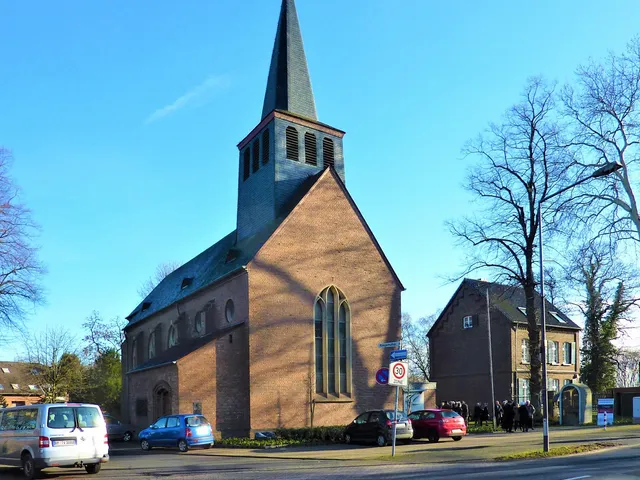
Neo-Gothic church on Zülpicher Platz whose tower was modelled on Freiburg Minster — rebuilt in a modern form after wartime destruction.
The Herz-Jesu-Kirche is a Roman Catholic church on Zülpicher Platz, in the southern part of Cologne's Neustadt — developed from 1880 onwards and today known as the Südstadt district. It was built as one of the new parish churches for this expanding quarter and is dedicated to the Sacred Heart of Jesus.
At a Glance
- Type
- Roman Catholic parish church
- Location
- Zülpicher Platz, Südstadt district, Innenstadt borough
- Architectural style
- Neo-Gothic
- Built
- 1893–1895, bell tower 1906–1909
- Architect
- Friedrich von Schmidt (Vienna cathedral architect)
- Rebuilt
- 1953–1957 after wartime destruction
- Distinctive feature
- Tower modelled on the spire of Freiburg Minster
Pope Leo XIII personally donated a stone bearing the Chi-Rho monogram from the ancient Priscilla Catacomb in Rome for the church's foundation stone – one of the oldest Christian burial sites in the world.
Things to do here
- Admire the neo-Gothic tower modelled on Freiburg Minster's spire
- Take in the colourful stained-glass windows by Franz Pauli
- Pause for a quiet moment in the sacrament chapel
- Discover Alexander Iven's Sacred Heart statue at the chapel entrance
- Photograph the striking church on Zülpicher Platz
- Hear the Kemper organ and the bronze bells during a service
History
An architectural competition was announced in 1889 with the ambitious stipulation that the new church should be able to hold its own against Cologne Cathedral. The jury chose the design by Friedrich von Schmidt from eight submissions; after his death in 1891, his son Heinrich completed the project. Pope Leo XII donated a stone bearing the Chi-Rho monogram from the Catacomb of Priscilla in Rome for the 1892 foundation stone. The church was consecrated in 1900, with the tower finished by 1909.
Destruction and Rebuilding
Air raids in October 1944 and March 1945 largely destroyed the building, leaving only the tower and the north wall standing. From 1946, a temporary church was installed within the ruins. The reconstruction between 1953 and 1957, led by cathedral architects Willy Weyres and Wilhelm Hartmann, retained the surviving tower while giving the interior a thoroughly modern character.
Architecture
The original building was a Neo-Gothic hall church with a transept, basilica-style ambulatory choir, and west tower. During rebuilding, the proportions were shaped by the salvageable remains. The former ribbed vaulting gave way to a folded wooden ceiling suspended from slender steel columns, and the original choir was reduced to a standalone Chapel of the Blessed Sacrament. The stained glass was designed by Cologne glass painter Franz Pauli.
Notable Facts
Since 1964 the parish has been served by the Marist Fathers. At the entrance to the Chapel of the Blessed Sacrament stands a Sacred Heart statue created in 1902 by sculptor Alexander Iven. The current organ was built in 1962 by the firm Emanuel Kemper & Sohn. The original bells were melted down during wartime requisitioning; five new bronze bells, cast by the foundry Petit & Gebr. Edelbrock in Gescher, replaced them in 1966.
Timeline
- 1893Foundation stone laid on 8 May by Archbishop Krementz
- 1895Nave and transept completed (17 October)
- 1900Church consecrated by Archbishop Simar (31 May)
- 1906–1909Bell tower built to designs by Wilhelm Hospelt
- 1944–1945Church largely destroyed in air raids
- 1946Emergency church opened on Ascension Day
- 1953–1957Rebuilt by cathedral architect Weyres and Hartmann
- 1957New church consecrated on 17 March
Map
Blue dots: other places nearby — tap to explore.
Address
Zülpicher Pl.
50674 Köln
Contact
You might also like — related or nearby
Comments
- Loading comments…
Sources & links
- Official website
- Official website (retrieved 2026-07-17)
- Wikidata (retrieved 2026-06-26)
- Wikipedia (retrieved 2026-06-26)
Auto-generated, last verified: 2026-06-26
How this page is made
This page draws on open sources — Wikipedia, Wikidata, official websites and the city’s open data. Every statement is checked against the sources linked here, and pages are refreshed regularly.
Spotted a mistake anyway? Tell us below — we read every submission.