St. Mary's Church (Cologne-Fühlingen)
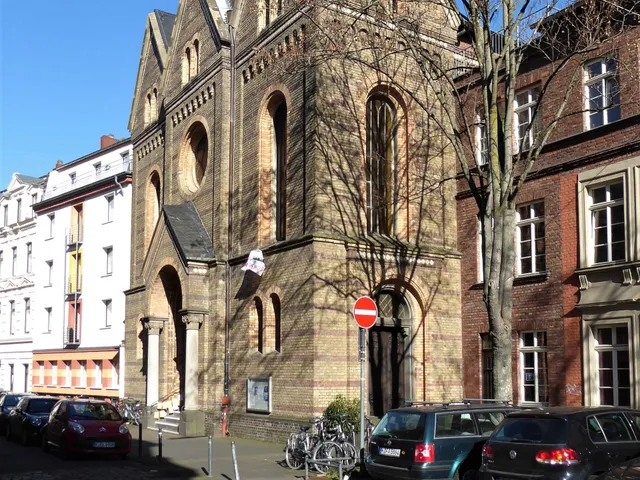
Neo-Gothic church in Fühlingen featuring pointed-arch windows salvaged from a demolished English church.
The church's construction was funded by proceeds from a stud farm and racecourse that the Cologne banking family von Oppenheim established on the Fühlingen heath.
Source: Wikipedia
At a Glance
- Type
- Roman Catholic church
- Style
- Neo-Gothic
- Built
- 1887
- Architects
- Carl Rüdell and Richard Odenthal (who later also designed St. Agnes' Church)
- Location
- On the edge of the village of Cologne-Fühlingen, Chorweiler district
- Affiliation
- St. Pankratius Am Worringer Bruch parish association
- Heritage status
- Listed since 20 January 1983 (No. 1306)
The church's large pointed-arch windows originally came from an English church built in 1830/1894 and were brought to Fühlingen after its demolition in 1987 – in the process, a single large window was cut apart into several separate ones.
History
The church's origins trace back to 1884, when the von Oppenheim family purchased a large portion of the Fühlingen heath. From 1915 to 1922, Josef Frings served here as parish administrator before later becoming Archbishop, Cardinal, and honorary citizen of Cologne. The building was extended westward in 1934, and a low side aisle was added in 1962.
Stained Glass Windows
The church's large pointed-arch windows were originally crafted in 1830 and 1894 for an English church and came to Fühlingen after that building was demolished in 1987. The side panels were once part of a single large window that had to be dismantled and divided for installation, with missing sections completed afresh. The windows depict New Testament scenes ranging from the Annunciation to the conversion of Saul, while the choir windows explore Marian themes and the small side-aisle panes illustrate individual images from the Litany of Loreto.
Furnishings
The Neo-Gothic high altar was acquired in 1976 from the parish of St. Joseph in Viersen. To the left of the nave stands a modern tabernacle from 1962 by Anne Henecka, decorated with ivory panels depicting Old and New Testament scenes. A Gothic figure of Mary stands to the right of the choir; its Christ child was carved in 1985 by sculptor Heinrich Hofmann of Brühl during the church's renovation. A Baroque statue of St. Sebastian and the sacristy bell both came from the old chapel on Roggendorfer Weg, which was torn down when the new church was built.
Statues from Father Paessens' Estate
Much of the church's present furnishings trace back to Father Albert Paessens, who acquired almost all of these pieces himself. His estate includes a Gothic sculpture of St. Anthony, obtained in 2000, and a Baroque figure of St. Jude Thaddeus.
Did You Know?
In 1964, sculptor Anne Henecka's concrete relief of an apocalyptic angel was set into the church's western exterior wall.
Timeline
- 1830Large pointed-arch windows made for an English church
- 1887St. Marien Church built, financed by the von Oppenheim family's stud farm proceeds
- 1894Additional windows made for the English church
- 1915–1922Josef Frings served as parish rector
- 1934Church extended to the west
- 1962Low side aisle and modern tabernacle by Anne Henecka built
- 1964Concrete relief of an apocalyptic angel installed on the west side
- 1976Neo-Gothic high altar acquired from St. Joseph in Viersen
Gallery
Map
Blue dots: other places nearby — tap to explore.
You might also like — related or nearby
Comments
- Loading comments…
Sources & links
Auto-generated, last verified: 2026-09-05
How this page is made
This page draws on open sources — Wikipedia, Wikidata, official websites and the city’s open data. Every statement is checked against the sources linked here, and pages are refreshed regularly.
Spotted a mistake anyway? Tell us below — we read every submission.