Patton-Brücke
A historic temporary bridge over the Rhine that connected Cologne with right-bank Deutz between 1946 and 1951 and no longer exists today.
since 1946
The Patton Bridge was a temporary Rhine crossing built in Cologne in the immediate post-war years. Extending the Ringe, it connected them with the right-bank trade fair grounds in Deutz and served for five years before being demolished after the completion of the Mülheimer Brücke.
Source: Wikipedia
At a Glance
- Type
- Temporary yet solidly built auxiliary bridge over the Rhine
- Construction started
- 1 October 1945
- Inauguration
- 12 June 1946
- Demolition
- from November 1951, two months after the Mülheimer Brücke opened
- Location
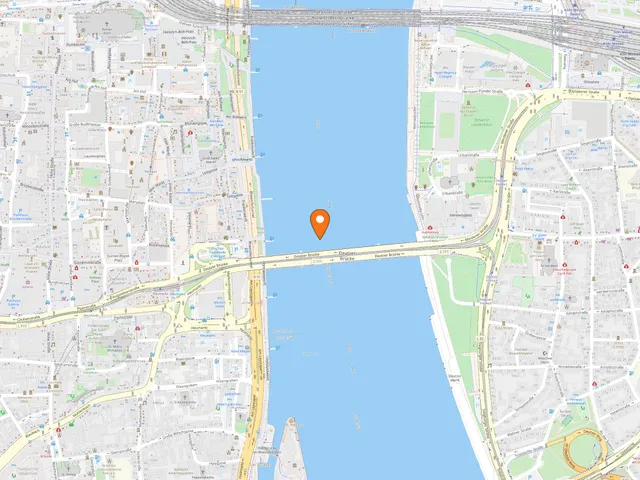
- between the Mülheimer Brücke and the Hohenzollernbrücke, directly south of the Bastei
- Shipping opening
- a 53.15-metre-wide central passage plus eleven further stream openings
- Features
- two separate carriageways, two footpaths and a cycle path
Things to do here
Age comparison
Age compared with other places in Cologne.
Why It Was Built
Cologne's Rhine bridges had been destroyed in the Second World War. In the earliest post-war period only makeshift solutions existed, such as the McNair Bridge beside the ruined Deutz suspension bridge or the American Bridge south of the Südbrücke. The British military government therefore decided to build a new auxiliary bridge which, unlike its predecessors, was designed as a fixed structure that ships could pass beneath.
Construction and Design
The work was led by a group of the Royal Engineers. Alongside 500 British sappers, 900 German workers were also involved. The bridge was built mainly from prefabricated Bailey bridge sections. At the central ship passage a proven German component was used, a Schaper-Krupp-Reichsbahn bridge element (SKR) with a larger span. It was the first post-war bridge with free passage for shipping traffic and was so high in the bank area that even tall vehicles such as trucks could pass beneath it at the Rheinuferstraße.
Inauguration and Name
The inauguration took place on 12 June 1946, led by the American Supreme Commander in Europe, General Joseph T. McNarney, who expressed the hope that the bridge might also be a bridge for the Germans into the future. It was named after US General George S. Patton, who had died the previous year, even though it had been built by British occupation troops. Chief engineer H. B. Pike called this a "recognition by the British Army of the great and upright soldier".
Daily Use and a Test of Strength
As the most important traffic link between the two Cologne banks of the Rhine, the bridge also carried buses; one bus line connected Ebertplatz with Deutz railway station. The electric lighting, completed only in 1947, had to be rebuilt that same year because of numerous thefts. On 20 January 1951 a Dutch barge loaded with 400 tonnes of cement rammed a pier, broke apart and sank. The temporary structure held firm, and the captain, his wife and four children were rescued.
Demolition and Afterlife
After the new Mülheimer Brücke opened on 8 September 1951, dismantling began two months later with the involvement of Stahlbau Rheinhausen. The bridge carried the Deutscher Ring (today the Theodor-Heuss-Ring) near Rhine kilometre 689 to the Deutzer Auenweg. In 2020 the city of Cologne awarded an architecture competition for a pedestrian and cycle bridge at this site. During the low water of 2022 and again in 2025, wooden logs appeared on the Deutz bank of the Rhine, prompting speculation about possible bridge remains. The idea remained questionable, however, since the Patton Bridge was a concrete-and-steel structure and the wooden piles had already been dated to the 19th century back in 2006.
Map
Blue dots: other places nearby — tap to explore.
You might also like — related or nearby
Comments
- Loading comments…
Sources & links
Auto-generated, last verified: 2026-07-08
How this page is made
This page draws on open sources — Wikipedia, Wikidata, official websites and the city’s open data. Every statement is checked against the sources linked here, and pages are refreshed regularly.
Spotted a mistake anyway? Tell us below — we read every submission.