Flag in the Wind – Granite Sculpture by Masayuki Nagare at the Aachener Weiher
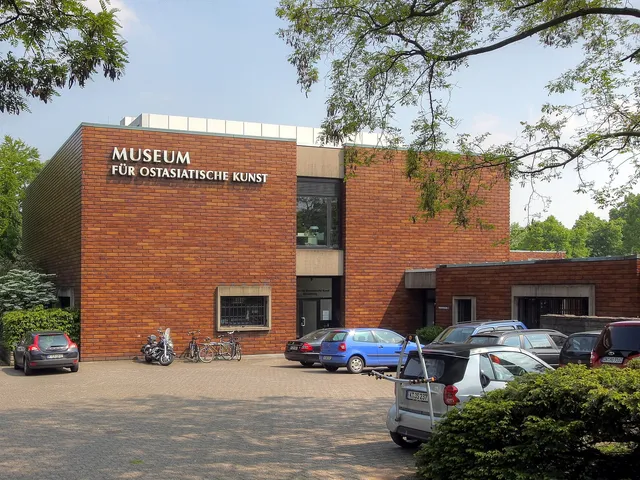
On a small artificial island in front of the Museum of East Asian Art, a granite sculpture has stood since 1980 that seeks to depict, despite all its stony weight, a flag fluttering in the wind.
since 1979
In front of Cologne's Museum of East Asian Art, on a small artificial island in the Aachener Weiher, stands the granite sculpture "Flag in the Wind" (Japanese 風の旗, kaze no hata) by the Japanese sculptor Masayuki Nagare.
Source: Wikipedia
At a Glance
- Location
- Artificial island in the Aachener Weiher, in front of the Museum of East Asian Art, Cologne's Inner Green Belt
- Artist
- Masayuki Nagare
- Created
- 1979
- Handover
- Mid-December 1980 to the City of Cologne
- Material
- Granite
- Height
- 2.60 metres (2.85 metres according to other sources)
- Structure
- Three parts — base, support and load — on a circular ground plate
- Occasion
- Gift within the framework of the Cologne–Kyoto city partnership
Age comparison
Age compared with other places in Cologne.
The Setting
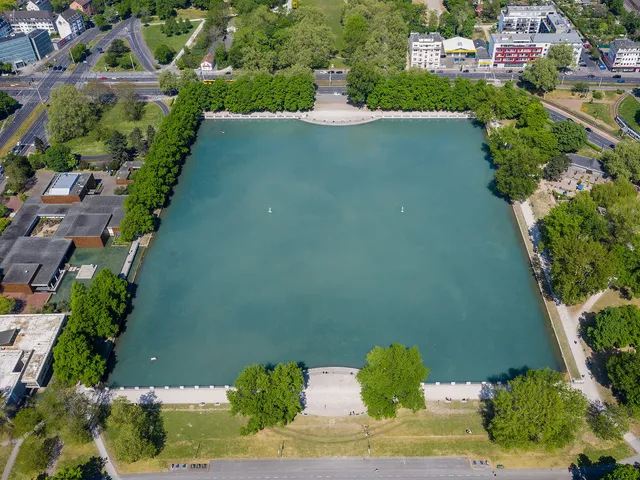
The Aachener Weiher is an artificial, rectangular body of water laid out in the early 1920s within Cologne's Inner Green Belt. The Museum of East Asian Art sits on its western side. A nearly rectangular inlet of the pond encloses a small island, which became the sculpture's home.
Origins
When the architect Kunio Maekawa began planning the museum building in the second half of the 1960s, he proposed Masayuki Nagare as garden architect and sculptor. Nagare went on to design the museum's inner garden as well as the island in the pond and the granite sculpture placed upon it.
The finished work was shipped from Japan in August 1980. In mid-December, Japanese Foreign Minister Itō Masayoshi and Bunroko Yoshino, the Japanese ambassador in Bonn, presented and unveiled it to the City of Cologne. The Kölnische Rundschau described the gift as "the setting of a milestone in the long-standing cultural relations [with] its Japanese partner city of Kyoto."
Description
The sculpture is built in three parts — base, support and load — and rests on a circular ground plate. Its surface is deliberately fractured, a texture known in Japanese as ware hada, "cracked skin."
The heavy upper load takes the form of a spherical segment. It has caused the slightly bevelled shaft to burst apart at half height; the shaft's axis is displaced, and the contact area with the sphere remains small. The result is the impression that the sphere might tumble down at any moment — "and yet the load rests."
Interpretation and Reception
The title stands in tension with the material. Helmut Fußbroich notes how "the heaviness inherent in granite" contrasts "with the title of the sculpture," and how "through the opposition of stability and instability" the viewer is "drawn under its spell."
In 1990, the writer Dieter Wellershoff observed: "The work is called 'Flag in the Wind', a daring theme for such compact material. But against this stony fluttering a mobile would be a mere banality. This is no toy, but a spiritual gesture that brings the entire airspace around it to life."
Gallery
Map
Blue dots: other places nearby — tap to explore.
Address
Aachener Weiher
50674 Köln
You might also like — related or nearby
Comments
- Loading comments…
Sources & links
Auto-generated, last verified: 2026-08-22
How this page is made
This page draws on open sources — Wikipedia, Wikidata, official websites and the city’s open data. Every statement is checked against the sources linked here, and pages are refreshed regularly.
Spotted a mistake anyway? Tell us below — we read every submission.