Museum of East Asian Art
Germany's first dedicated museum for East Asian art displays works from China, Japan and Korea beside the Aachener Weiher pond.
since 1913
On the edge of Cologne's green belt, right by the Aachener Weiher pond, the Museum of East Asian Art (MOK) has been collecting and displaying art from China, Japan and Korea for more than a century. It was the first museum of its kind in Germany devoted solely to this field.
At a Glance
- Collection focus
- Art from China, Japan and Korea
- Location
- Universitätsstraße 100, beside the Aachener Weiher
- Founded
- Opened on 25 October 1913
- Present building
- New building by Kunio Maekawa, opened 1977
- Founders
- Collector Adolf Fischer (1856–1914) and his wife Frieda
- Japanese garden
- Outdoor grounds by Masayuki Nagare, with rock and water
Age comparison
Age compared with other places in Cologne.
History
Around 1900, interest in East Asian art as a field of its own was growing in Germany. Adolf and Frieda Fischer, who worked in Berlin as private scholars of ethnography, decided in 1903 to devote their collecting entirely to it. An initial attempt to found a museum in Kiel in 1904 failed because of the city's finances.
The decisive push for Cologne came from Max Creutz, director of the Museum of Applied Arts, and the entrepreneur Arnold von Guilleaume, who set up a well-funded circle of patrons. In June 1909 the city council approved the contract with Fischer. Built as an extension to the Museum of Applied Arts on the Hansaring and designed by Franz Brantzky, the new museum opened on 25 October 1913. Just six months later Adolf Fischer died; his wife Frieda took over its direction and steered it through the First World War and the Weimar Republic.
From 1925 to 1933 Alfred Salmony served as deputy director and organised the first exhibition of Asian art in Cologne in 1926, before the National Socialists dismissed him from office in 1933. The collection of around 900 objects was rescued from destruction in April 1944 – the building itself was completely lost in the war, and the holdings remained without a permanent home for many years.
The Building by the Aachener Weiher
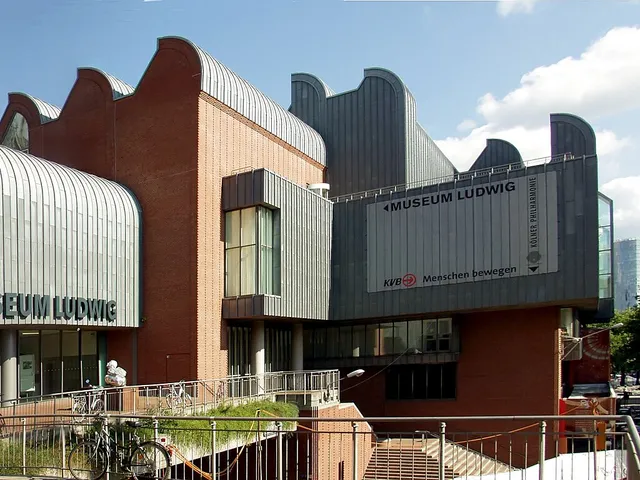
In 1976 a new building designed by the Japanese architect Kunio Maekawa was erected beside the Aachener Weiher; it opened on 2 December 1977 and remains the museum's home today. The grounds, including a small Japanese garden of rock and water, were designed by the artist Masayuki Nagare, among them the stone sculpture "The Flag in the Wind" from 1980. The very first building of 1913 had already been kept plain inside by the Viennese architect Josef Frank, so that the art took centre stage and visitors could walk around three-dimensional objects – a novel concept for the time. To mark its centenary, the museum reopened after extensive renovation on 16 May 2014 with a special exhibition.
Collection and Exhibitions
Alongside the permanent collection, the museum regularly presents changing special exhibitions on Chinese, Japanese and Korean art – from porcelain and calligraphy to woodblock prints and contemporary work. A support association founded in 1989 assists the museum both practically and financially.
Worth Knowing
For many years the director was Adele Schlombs, who led the museum for 32 years until October 2022; since 1 July 2023 the sinologist Shao-Lan Hertel has been its academic director. On the night of 13 September 2023, burglars stole nine porcelain pieces from the founding collection (16th to 19th century, of imperial provenance) worth more than one million euros in total.
Gallery
Map
Blue dots: other places nearby — tap to explore.
Address
Universitätsstraße 100
50674 Köln
Hours
Di: 11:00–17:00
Mi: 11:00–17:00
Do: 11:00–17:00
Fr: 11:00–17:00
Sa: 11:00–17:00
So: 11:00–17:00
Contact
You might also like — related or nearby
Comments
- Loading comments…
Sources & links
- Official website
- Official website (retrieved 2026-08-14)
- Wikidata (retrieved 2026-08-14)
- Wikipedia (retrieved 2026-08-14)
Auto-generated, last verified: 2026-08-14
How this page is made
This page draws on open sources — Wikipedia, Wikidata, official websites and the city’s open data. Every statement is checked against the sources linked here, and pages are refreshed regularly.
Spotted a mistake anyway? Tell us below — we read every submission.