Cologne-Kalk Civil Defence Bunker
Cologne's only fully preserved civil defence facility – a Cold War relic beneath Kalker Hauptstraße that can be visited today.
since 1979
Beneath Kalker Hauptstraße lies a structure from the Cold War era: a shelter designed to house thousands of people for two weeks in the event of a nuclear war. It is considered the only completely preserved civil defence facility in Cologne.
Source: Wikipedia
At a Glance
- Location
- Kalker Hauptstraße, at the Kalk Post underground station, Cologne-Kalk
- Year built
- 1979
- Capacity
- designed for 2,366 people, with a planned stay of 14 days
- Area
- around 4,000 square metres (roughly 1.7 m² per person)
- Construction cost
- estimated at around seven million marks
- Distinction
- the only fully preserved civil defence facility in Cologne
- Visits
- according to reports (as of 2019), every first Sunday of the month
- Managed by
- the volunteer association „Dokumentationsstätte Kalter Krieg"
Age comparison
Age compared with other places in Cologne.
A Product of the Cold War
In the late 1970s, nine to ten underground civil defence facilities were planned across Cologne. Of these, only the one in Kalk was completed; at Rudolfplatz, work stopped at a few partial structures that are no longer accessible. The facility was built in 1979 together with the Kalk Post underground station and, across two levels, forms the Kalker Hauptstraße multi-purpose civil defence complex. The bunker was not designed to withstand a direct nuclear strike, but rather to offer protection against falling debris and radioactive fallout.
Engineering and Equipment
The bunker itself is encased in 1.40-metre-thick concrete and could be sealed hermetically using gas-tight tunnel closures and roughly 40-centimetre-thick armoured steel doors made by the Heintzmann ironworks in Bochum – also as protection against biological and chemical weapons. A 75-metre-long corridor leads to the supply rooms: a first-aid room and a medical station equipped even for surgery, along with 354 four-tier seat-berth combinations and food supplies. Should public utilities fail, pumps were meant to draw drinking water from a dedicated well, and a large ship's engine would generate electricity, including power for the elaborate ventilation system.
An Emergency Plan with Gaps
The plan called for additional capacity in an emergency: camp beds for 354 people in front of the kiosk in the entrance area and on the platforms, along with tram trains that would enter the station from both sides and serve as quarters for around 432 people. Robert Schwienbacher, chairman of the Cologne Cold War documentation centre, nonetheless doubts the shelter's real value: it would likely have worked only if an attack had been announced roughly two weeks in advance and the operating crew had arrived in time. Access was also intended solely for travellers passing through the Deutz/Trimbornstraße transport hub, while local residents were directed to their own private shelters. It remained unclear how people were meant to survive after two weeks in a destroyed and contaminated environment.
From Shelter to Place of Remembrance
The bunker was decommissioned in 2005, and its technical systems have not been maintained since. Initially, use as a storage space was foreseen from 2014, but the facility has been open for visits since 2016 – according to reports (as of 2019), every first Sunday of the month. Because of the long waiting list, a virtual 3D tour was also created that can be viewed online. The site is looked after on a voluntary basis by the association „Dokumentationsstätte Kalter Krieg", a spin-off of the Cologne fortress museum, which maintains Prussian forts and Second World War bunkers.
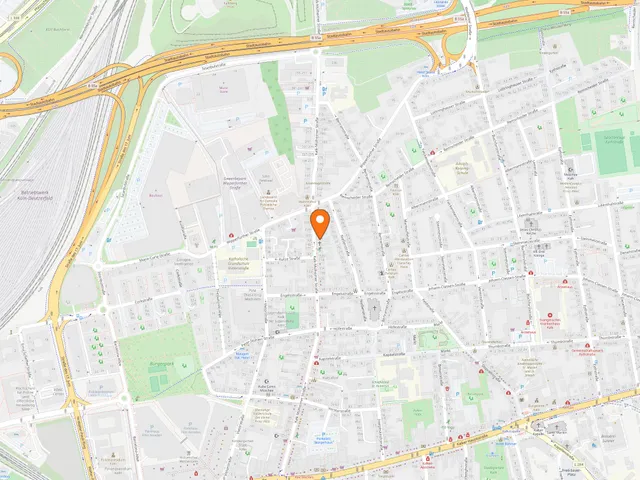
Map
Blue dots: other places nearby — tap to explore.
You might also like — related or nearby
Comments
- Loading comments…
Sources & links
Auto-generated, last verified: 2026-08-23
How this page is made
This page draws on open sources — Wikipedia, Wikidata, official websites and the city’s open data. Every statement is checked against the sources linked here, and pages are refreshed regularly.
Spotted a mistake anyway? Tell us below — we read every submission.