Kölnischer Kunstverein (Cologne Art Association)
Founded in 1839, the Kölnischer Kunstverein is one of the oldest and most respected institutions for contemporary art in Germany. Today it resides in the striking building "Die Brücke" on Hahnenstraße, presenting current international art in Cologne.
since 1839
Anyone interested in contemporary art will find it hard to miss this place in Cologne: for almost two centuries, the Kölnischer Kunstverein has presented current artistic positions and remains deeply rooted in the city's cultural life.
At a Glance
- Founded
- 1839
- Type
- Non-profit art association for contemporary art
- Current location
- "Die Brücke" building on Hahnenstraße (since 2003)
- Members
- around 2,300 (as of 2018)
- Membership
- Association of German Art Societies (ADKV)
- Director
- Valérie Knoll (since July 2023)
- Funding
- Membership fees plus public and private grants
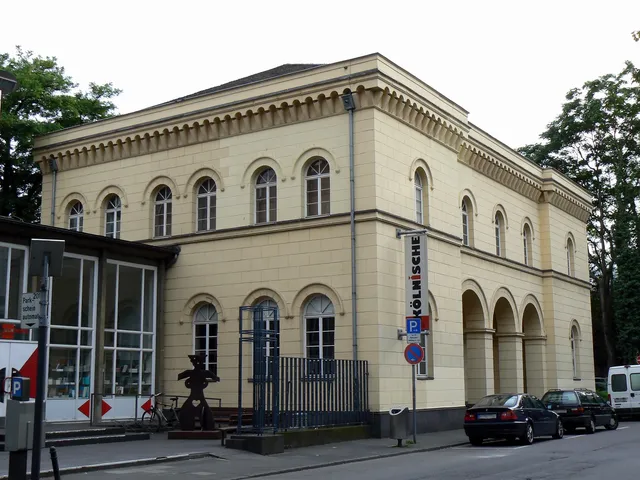
The association's current home, the "Die Brücke" building, owes its name to the post-war British Information Centre "Die Brücke", which was housed here as a symbolic place of dialogue in the war-ravaged city.
Age comparison
Age compared with other places in Cologne.
History
On 7 April 1839, the chief president of the Prussian Rhine Province approved the statutes, and the association was founded. Its founders were Cologne citizens, including first president Everhard von Groote, eau-de-Cologne manufacturer Johann Maria Farina, and city councillor Matthias Joseph de Noël. More than 1,300 members joined in the first year alone. The first exhibition ran from April to September 1839 at the Gürzenich and featured over 500 European works, many of them for sale.
Turbulent Decades
In the first half of the 20th century, the programme repeatedly caused a stir. Legendary was the 1919 Dada exhibition featuring Group D around Max Ernst, Paul Klee, Hans Arp and the Hoerle siblings. In 1922 the association moved into a new building on Friesenplatz, opened by mayor Konrad Adenauer. A 1926 painting by Max Ernst sparked a scandal, with even the archbishop demanding its removal – today it hangs in the Museum Ludwig. During the Nazi era the association continued its work and still showed unwelcome artists such as Emil Nolde. In 1943 the building was destroyed by bombs.
Architecture and Current Location
Since 2003, the art association has resided in the "Die Brücke" building on Hahnenstraße. Cologne architect Wilhelm Riphahn built it in 1949/50 as a symbolic place of dialogue in the war-ravaged city. It first housed the British Information Centre "Die Brücke" – which gave the building its name – and later the British Council.
Awards and Art Education
For its commitment, the association has received several prizes, including the Art Frankfurt Prize in 2005 and the Jump Prize of the Kunststiftung NRW in 2010. From 1997 to 2008 it awarded the Central Kunstpreis, endowed with 75,000 euros, together with the Central health insurance company. Since 2011 the "Gleis 9 ¾" education project has supported schoolchildren in Cologne.
Good to Know
The association's complete archive is held in the Historical Archive of the City of Cologne, which collapsed in 2009. Since then, staff have been working on the recovery, restoration and digitisation of the rescued documents.
Timeline
- 1839Founding of the Kölnischer Kunstverein and first exhibition at the Gürzenich
- 1919Sensational Dada exhibition featuring Group D around Max Ernst
- 1922Move to the new building on Friesenplatz, opened by Konrad Adenauer
- 1943Destruction of the association's building by bombs
- 2003Move into the "Die Brücke" building on Hahnenstraße
- 2023Valérie Knoll takes over as director
Gallery
Map
Blue dots: other places nearby — tap to explore.
Address
Hahnenstraße 6
50667 Köln
Hours
Di: 11:00–18:00
Mi: 11:00–18:00
Do: 11:00–18:00
Fr: 11:00–18:00
Sa: 11:00–18:00
So: 11:00–18:00
You might also like — related or nearby
Comments
- Loading comments…
Sources & links
- Official website
- Wikidata (retrieved 2026-07-13)
- Wikipedia (retrieved 2026-07-13, rev 268417621)
Auto-generated, last verified: 2026-07-13
How this page is made
This page draws on open sources — Wikipedia, Wikidata, official websites and the city’s open data. Every statement is checked against the sources linked here, and pages are refreshed regularly.
Spotted a mistake anyway? Tell us below — we read every submission.