Deserters' Memorial
A memorial to victims of Nazi military justice at Appellhofplatz — a pergola whose chained tribute inscription seems written in colored letters across the sky.
since 2009
At Appellhofplatz in Cologne's Altstadt-Nord district, the Deserters' Memorial commemorates the victims of Nazi military justice, honoring those who refused to fight and opposed the war during the National Socialist era. It was inaugurated on 1 September 2009, the 70th anniversary of Germany's invasion of Poland.
At a Glance
- Type
- Memorial to victims of Nazi military justice, designed as a pergola
- Location
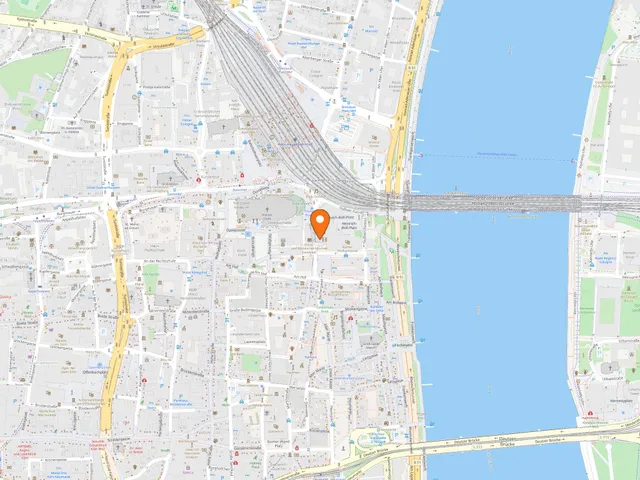
- Cologne-Altstadt-Nord, Appellhofplatz (city district: Innenstadt)
- Design
- Swiss designer Ruedi Baur and his team
- Inauguration
- 1 September 2009
- Inscription
- Colored aluminum letters across an area of eight by four meters
- Distinctive feature
- The text faces upward and appears to be written into the sky against no fixed background
The monument's inscription is an endlessly nested sentence that forces the reader to look upward – the colorful aluminum letters spanning eight by four meters deliberately have no solid background, making the text appear as if written into the sky.
Things to do here
- Read the upward-facing inscription and let it sink in
- Photograph the colorful aluminum letters against the sky
- Pause for a moment to remember the victims of Nazi military justice
- Take in Ruedi Baur's pergola design at leisure
- Walk on to the three surrounding Nazi-era memorial sites — the city museum, NS Documentation Centre and former criminal court
Age comparison
Age compared with other places in Cologne.
The Inscription
The heart of the memorial is its text, read by tilting one's gaze skyward. In a cascading chain of tribute, it links together those who refused — making each act of resistance the counterpart to the next: "Homage to the soldiers who refused to shoot at the soldiers who refused to shoot … to the people who showed solidarity and civil courage when the majority fell silent and followed along…" The chain moves from shooting through killing, torture, denunciation and discrimination, all the way to those who took a stand.
Between Three Historic Buildings
The memorial stands equidistant from three sites connected to the Nazi era: the former Zeughaus (arsenal), now part of the Cologne City Museum; the EL-DE House, whose former Gestapo torture cellar now houses the NS Documentation Center; and the building of the former Cologne criminal court, where at least 123 people were sentenced to death during the Nazi period.
Origins
The memorial came about following a motion by the PDS to Cologne City Council in September 2006, backed by the SPD and the Greens. The council voted to erect a memorial for deserters, those convicted of "undermining military morale," and conscientious objectors, and launched an artist competition won by Ruedi Baur's design. The city contributed €80,000, with the remaining €10,000 of the €90,000 budget raised through donations.
Worth Knowing
Research drew on the Military Archive in Freiburg, divisional court records, and the death sentence index card file, revealing that 104 Cologne soldiers deserted — most permanently (classified as "desertion"), some only temporarily ("unauthorized absence"). Virtually all were of lower enlisted rank. An earlier proposal to site the memorial at the Dünnwald shooting range, where deserters had been executed during the war, was abandoned due to its distance from the city center.
Timeline
- 2006PDS submits motion to Cologne city council (28 September)
- 2008City council approves artist competition (13 November)
- 2009Jury selects design by Ruedi Baur (24 April)
- 2009City council follows jury recommendation (30 June)
- 2009Inauguration on 70th anniversary of the invasion of Poland (1 September)
Map
Blue dots: other places nearby — tap to explore.
Address
Appellhofplatz (Stadtbahn
50667 Köln
Hours
So: 00:00–24:00
You might also like — related or nearby
Comments
- Loading comments…
Sources & links
- Official website
- Official website (retrieved 2026-07-17)
- Wikidata (retrieved 2026-06-26)
- Wikipedia (retrieved 2026-06-26)
Auto-generated, last verified: 2026-06-26
How this page is made
This page draws on open sources — Wikipedia, Wikidata, official websites and the city’s open data. Every statement is checked against the sources linked here, and pages are refreshed regularly.
Spotted a mistake anyway? Tell us below — we read every submission.