St. Georg (Cologne-Weiß)
A listed Catholic hall church in Cologne's Weiß district, consecrated in 1954, whose outdoor altar faces directly toward the Rhine.
since 1953
The Catholic church of St. Georg stands in Cologne's Weiß district right beside the Rhine and was consecrated in 1954 to plans by the architect Joseph Bernard. It is dedicated to Saint George and has been a protected monument since 2003.
Source: Wikipedia
At a Glance
- Building type
- Hall church seating over 300
- Architect
- Joseph Bernard
- Consecrated
- 5 December 1954
- District
- Cologne-Weiß
- Dedication
- Saint George
- Denomination
- Roman Catholic
- Heritage status
- listed since 24 July 2003 (monument list no. 8626)
- Materials
- brick façade, slate-clad gabled roof
The altar wall stands so close to the Rhine that a small round window with a sanctuary lamp shaped like a boatman's lantern can be seen from the river at night.
Things to do here
- View the covered outdoor altar ("boatmen's chapel") right on the Rhine bank
- See the altar cross from around 1500 and the medieval Madonna and Child in the weekday chapel
- Discover the abstract stained-glass windows by Paul Weigmann and Lucyna Mentis
- Experience the open roof truss with dark beams and the stepped sequence from font to altar
- Look at dusk from the Rhine for the boatman's-lantern sanctuary lamp in the round window
Age comparison
Age compared with other places in Cologne.
History
The parish of St. Georg was founded in 1923 and initially worshipped in the St. George's Chapel, documented since the Middle Ages and enlarged from the 1920s into an emergency church. First plans for a new building on the present site date back to 1927. After the chapel was destroyed to its foundations in the Second World War, it was decided to restore it in its historic form and to build a new church alongside. Joseph Bernard, who had worked before the war with church architect Dominikus Böhm, took on the design in 1953/1954. The foundation stone laid in 1953 was created by Willy Meller, and the church was consecrated on 5 December 1954. In 2007 a parish merger cost the church its status as a parish church; that role passed to St. Joseph in Rodenkirchen.
Architecture
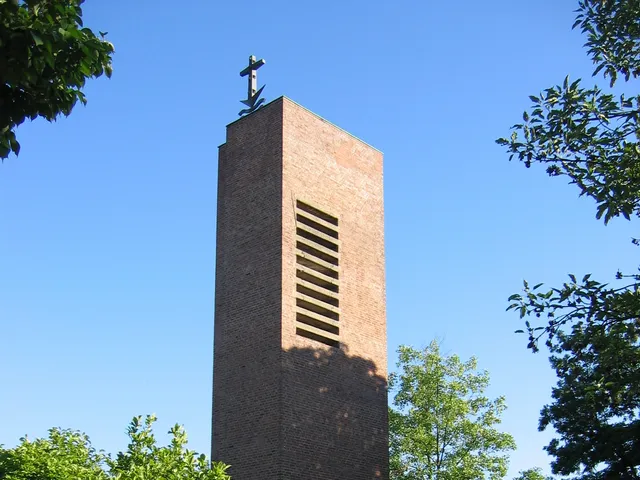
The building is a large hall church with a slate-clad gabled roof that sweeps far down on the north side. The altar wall stands directly at the edge of the Rhine valley's middle terrace: a canopy, formed as a narrow extension of the gabled roof, reaches down on two long columns almost to the riverside path, creating a covered outdoor altar facing the river, known as the "boatmen's chapel." The otherwise closed wall is pierced only by a small round window, behind which a sanctuary lamp shaped like a boatman's lantern hangs, visible from the Rhine at night. The windowless entrance wall faces the village and forms an oblique axis with the square bell tower. Inside, a "barn atmosphere" continues with an open roof truss and dark beams, read variously as an allusion to the stable in Bethlehem, God's tent, or an upturned ship's hull. Light enters mainly through the clerestory windows. The path from baptism to Eucharist is expressed through changes in level: the baptismal area sits several steps lower, while the altar is markedly raised.
Furnishings
The shell-limestone altar table, whose feet are read as starfish, was made by Hein Gernot; the tabernacle was executed under Elmar Hillebrand's direction by the Weiß artist couple Tong. The dominant altar cross on the east wall bears a corpus made around 1500 that originally hung in a church in Esenhausen and stands here on permanent loan. In 2010 Clemens Hillebrand painted symbolic medallions along the nave, expanded in 2024 with a symbol for Mary Magdalene. The abstract windows in the altar wall and baptistery are by Paul Weigmann, while those in the weekday chapel, depicting three angels, are by Lucyna Mentis. Historic pieces include a 17th-century Flemish oil painting and a Madonna and Child from the mid-14th century that came from the old George's Chapel. The organ, built in 1955 by Romanus Seifert, was renovated and enlarged by Willi Peter in 1988; the six-bell peal was cast in 1959 by Petit & Gebr. Edelbrock.
Timeline
- 1923Founding of the parish of St. Georg
- 1927First plans for a new church on the present site
- 1953Foundation stone laid, designed by Willy Meller
- 1954Consecration of the new church on 5 December
- 1955Organ built by Romanus Seifert
- 1959Six-bell peal cast by Petit & Gebr. Edelbrock
- 2003Added to the City of Cologne's list of monuments
- 2007Loss of parish-church status through a parish merger
Gallery
Map
Blue dots: other places nearby — tap to explore.
You might also like — related or nearby
Comments
- Loading comments…
Sources & links
Auto-generated, last verified: 2026-08-26
How this page is made
This page draws on open sources — Wikipedia, Wikidata, official websites and the city’s open data. Every statement is checked against the sources linked here, and pages are refreshed regularly.
Spotted a mistake anyway? Tell us below — we read every submission.