St. George's Chapel
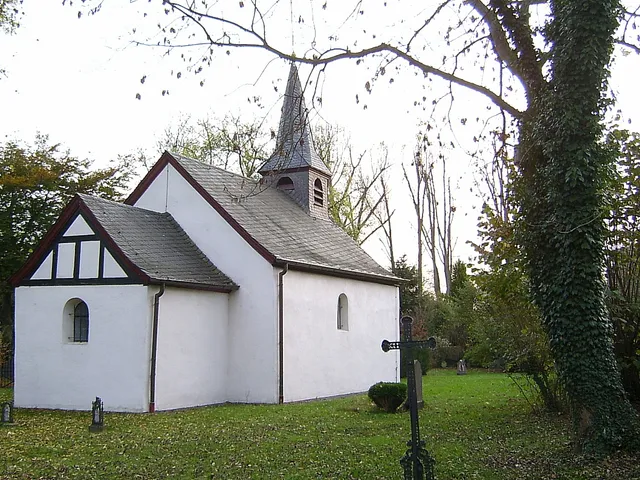
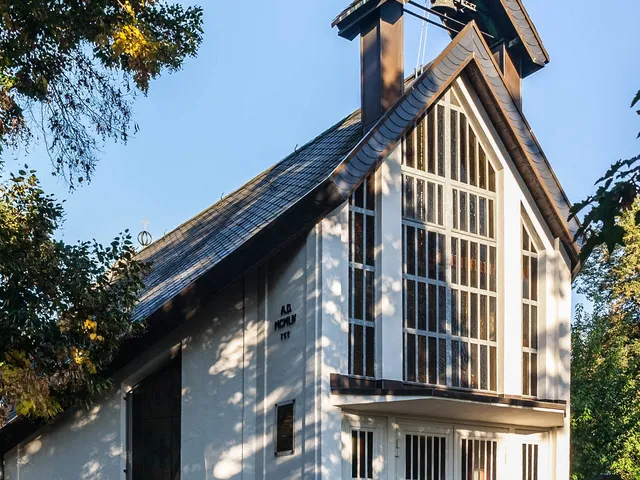
Late Gothic chapel in Cologne-Weiß, first mentioned in 1433, featuring vivid murals from the 1980s.
Stop number 8 on the Rodenkirchen Cultural Trail, the chapel is woven into a local walking route steeped in village history.
Source: Wikipedia
At a Glance
- Type
- Roman Catholic chapel, hall church with semicircular apse
- Style
- Late Gothic core
- Location
- Weiß district, Rodenkirchen borough
- Named after
- Saint George
- Parish
- Catholic Parish Im Rheinbogen
- First mentioned
- 1433
When the villagers of Weiß built the late-Gothic chapel in the 15th century, the Archbishop of Cologne, Dietrich von Moers, was only informed of the completed construction after the fact.
History
The chapel's earliest documented mention dates to 1433, when villagers informed Cologne's archbishop, Dietrich von Moers, of the building only after they had already completed it themselves. Local residents also covered the costs of upkeep and the priest's salary. Originally attached to the parish church of St. Servatius in Immendorf, it came under St. Remigius in Sürth from the 18th century onward. The building was enlarged in 1821 and again in 1923, when it was elevated to an independent parish.
War and Reconstruction
The chapel suffered severe damage during the Second World War and burned out entirely in 1944. In 1953/54 the people of Weiß opted to build a new parish church of St. George further south instead of rebuilding on site. The original structure was restored to its historic form in 1965, though without reinstating its 1923 extension.
Interior and Restorations
A thorough overhaul of the interior took place in the 1980s: in 1985, artists Elmar Hillebrand, Anna M'barek and Theo Heiermann created the chapel's murals, while Hillebrand also designed the tracery window in the choir. From November 2023 to March 2024, the interior was refurbished again under Cologne architect Jens Kratzheller, with the paintings retouched by Anna M'barek, Clemens Hillebrand and Paul Heiermann alongside conservators from Restauratoren Karthäuserhof.
Bells
Two bells hang in the roof turret, though their exact origins remain uncertain. One is attributed to Kaiserslautern founder Johann Georg Pfeiffer and thought to date from 1922, sounding the note e²+6⁄16. The other is traced to Heinrich Claren in 1825 and rings at gis²−4⁄16.
Timeline
- 1433First documented mention of the chapel
- 1821Chapel extended
- 1923Elevation to independent parish and further enlargement
- 1944Heavily damaged and gutted by fire in World War II
- 1953/54Decision to build a new parish church St. Georg further south
- 1965Old chapel restored to its original form as a hall church
- 1985Interior painted by Elmar Hillebrand, Anna M'barek and Theo Heiermann
- 2023–2024Extensive interior renovation led by Jens Kratzheller
Gallery
Map
Blue dots: other places nearby — tap to explore.
You might also like — related or nearby

Comments
- Loading comments…
Sources & links
Auto-generated, last verified: 2026-09-01
How this page is made
This page draws on open sources — Wikipedia, Wikidata, official websites and the city’s open data. Every statement is checked against the sources linked here, and pages are refreshed regularly.
Spotted a mistake anyway? Tell us below — we read every submission.