Zündorf Synagogue
Consecrated in 1882, the synagogue in Cologne's Zündorf district survives today as a residential house; a memorial plaque recalls its history.
The Zündorf Synagogue was a Jewish house of prayer in the right-bank Cologne district of Zündorf. Consecrated in 1882, the building at Hauptstraße 159 still stands today – converted into a residential house – and a memorial plaque recalls its original purpose.
Source: Wikipedia
At a Glance
- Location
- Zündorf district of Cologne (right bank of the Rhine), Hauptstraße 159
- Prayer room since
- 1713, in a converted room in the house of Andreas Salomon
- New building consecrated
- 18 August 1882
- Congregation
- Zündorf Special Synagogue Community (from 1853), serving Heumar, Wahn and Rösrath
- End as a synagogue
- sold on 9 February 1938 and converted into a residential house
- Construction
- two-storey brick building with a gabled roof, about 59.6 m² of floor area
- Present state
- residential house, renovated in 2020/2021; memorial plaque since 2011
History of the Jewish Community
Jewish life in Zündorf is documented as early as before 1700; the first record is the burial of a Jew named Ischar on 2 July 1708 at the Deutz cemetery, which also served Zündorf's Jews until a burial ground of their own was established in 1923. The Jewish cemetery north of the town still holds eight graves with six gravestones. As a place of trade, Zündorf attracted Jewish cattle and horse dealers as well as butchers, moneylenders, small craftsmen and goods traders; the former Judengasse, today's Gütergasse, also recalls this Jewish life.
A prayer room existed as early as 1713, in a converted room in the house of Andreas Salomon. The Zündorf Special Synagogue Community emerged from the Mülheim community in 1853. As the community grew, a new building was decided upon: begun in 1880, it was consecrated on 18 August 1882 and, from 5 November 1883, was owned by the community, which included the Jews of the municipalities of Heumar, Wahn and Rösrath.
Persecution and the End of the Community
After the National Socialists came to power in 1933, the already declining membership fell more sharply still through emigration, expulsion, deportation and murder, until community life came to a standstill, not least owing to a lack of income. On 29 November 1937 the community offered to sell the synagogue for 800 Marks, among other conditions requiring that the windows facing a Jewish neighbour's garden be walled up. On 9 February 1938 the synagogue was sold and subsequently converted into a residential house, in the course of which the architectural details that pointed to its former use disappeared. The Zündorf Jewish community dissolved between 1938 and 1942 as a result of relocations and deportations.
Architecture
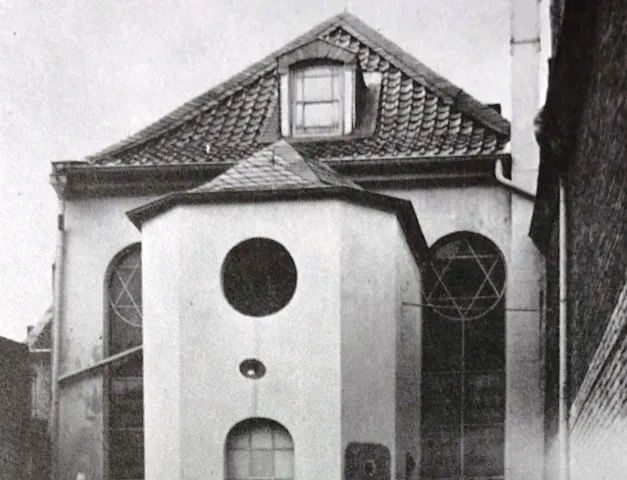
The two-storey brick building with a gabled roof measured 6.7 metres wide and 8.9 metres deep, giving it a floor area of only 59.6 m². From Hauptstraße it could be reached via a three-metre-wide path that led past an older building in front onto the plot behind. A building description dated 15 February 1938 records three large windows (1.50 × 2.50 m) and two arched windows on the west side; a tall window at the north-west corner was walled up as agreed. Whether a room in the courtyard was a ritual bath could no longer be determined as early as 1970.
Remembrance Today
On 9 November 2011 a bronze memorial plaque was mounted on the building, its inscription recalling the years 1882–1938: "The Zündorf synagogue was built in 1882. The building was sold in 1938." After a change of ownership, the former house of prayer, used as a residence, was extensively renovated and carefully redesigned from 2020 until the end of 2021, so that the architecture of the former synagogue remained recognisable or could be made visible again – the original arrangement of the windows was restored and previously walled-up round-arched windows on the upper floor were uncovered. It is thought that a women's gallery once stood inside; the original position of the Torah ark is unclear for lack of traces. There is still no firm evidence of a ritual bath (mikveh).
Map
Blue dots: other places nearby — tap to explore.
Address
Hauptstraße 159
51143 Köln
You might also like — related or nearby
Comments
- Loading comments…
Sources & links
Auto-generated, last verified: 2026-08-13
How this page is made
This page draws on open sources — Wikipedia, Wikidata, official websites and the city’s open data. Every statement is checked against the sources linked here, and pages are refreshed regularly.
Spotted a mistake anyway? Tell us below — we read every submission.