St. Petrus und Paulus (Vom Guten Hirten)
Built between 1962 and 1964 to designs by Fritz Schaller in Cologne's Lindenthal district, this church began as a convent church for the Sisters of the Good Shepherd and has served the Syriac Orthodox community as St. Petrus und Paulus since 1991.
since 1962
St. Petrus und Paulus, originally the convent church Vom Guten Hirten, is a Syriac Orthodox church in Cologne's Lindenthal district. It was built between 1962 and 1964 to plans by the architect Fritz Schaller and consecrated in December 1964.
Source: Wikipedia
Auf einen Blick
- District
- Lindenthal
- Architect
- Fritz Schaller
- Construction
- 1962–1964, consecrated 8 December 1964
- Origin
- convent church of the Sisters of the Good Shepherd
- Current use
- Syriac Orthodox community (since 1991)
- Windows
- coloured glazing by Franz Pauli
- Notable
- no bell tower, no bells, no known organ
In 1992 Fritz Schaller designed an iconostasis specifically for the Orthodox conversion of the church, but it was never built because a hand-crafted solution was chosen instead.
Things to do here
- Admire Franz Pauli's richly coloured windows with scenes from the Old and New Testaments and the Book of Revelation
- Explore the T-shaped composition of the main church space and the sisters' choir from outside
- Look for the gable window depicting the dove as a symbol of the Holy Spirit
- Discover Hildegard Domizlaff's Stations of the Cross and Karl Matthäus Winter's furnishings
Age comparison
Age compared with other places in Cologne.
History
The religious order of the Sisters of the Good Shepherd devoted itself to taking in women and girls in distress. The house they had run in Cologne since 1863 was destroyed by air raids in 1944. Planning for a new church began in 1958 but dragged on for financial reasons; only at the end of 1962 was Fritz Schaller commissioned to carry out the final design. Construction started in May 1963, the topping-out ceremony followed on 22 January 1964, and the church was consecrated on 8 December 1964 with Our Lady of Sorrows as its patron. In 1991 the sisters sold the building to the archdiocese, which leased it to the Syriac Orthodox community.
Architecture
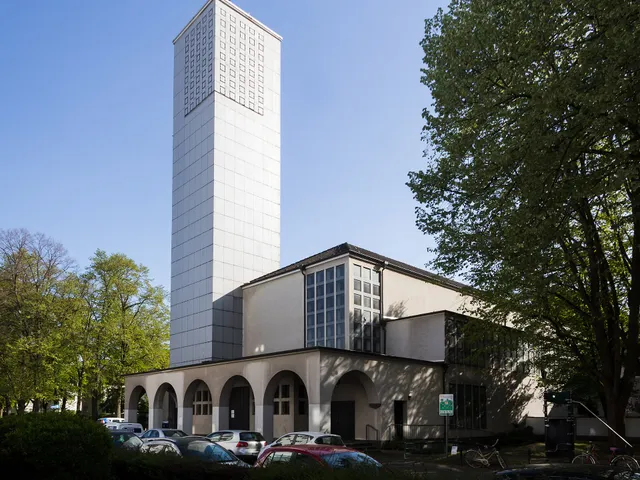
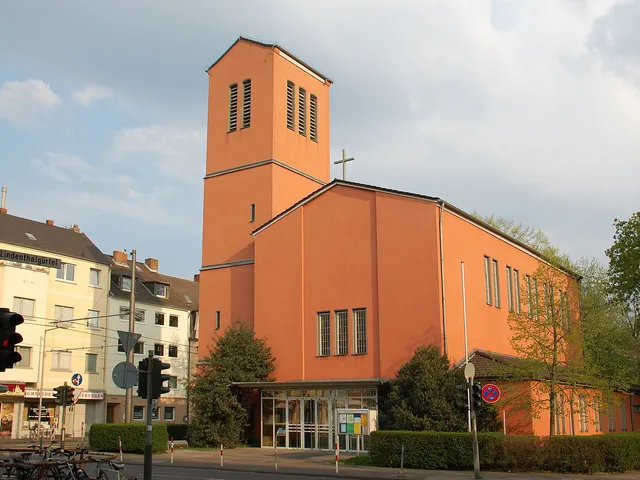
The church stands open on three sides in park-like surroundings and adjoins a surviving wing of the former convent on its narrow side. Closed off on the outside, it reads inside as a protective shell. Two structures are arranged in a T-shape: the main church space with a tall, tile-covered hipped roof, and the narrower, slightly higher sisters' choir capped by three small gables. Both parts are single-storey, and a continuous band of windows at eaves height, together with a second band up in the roof, brings in light. Inside, columns mark off a narrow ambulatory with a flat ceiling, above which the dark timber ceiling of the gable opens up. Beneath the raised sisters' choir lay the original crypt and confessional chapel, whose tabernacle rested on a column.
Furnishings
All of the windows are the work of Franz Pauli and are regarded as his richly coloured principal work. The encircling band of windows depicts scenes from the Old and New Testaments as well as motifs from the Book of Revelation; there are also crypt windows, a further band of light, and triangular windows in the gable peaks, one of which shows the dove as a symbol of the Holy Spirit. The original altars, the tabernacle and the eternal light were created by Karl Matthäus Winter, while Hildegard Domizlaff designed the Stations of the Cross. As the planned bell tower was omitted, the church has neither bells nor a known organ.
Present use and future
Since 1991 the Syriac Orthodox community has used the church under the patronage of St. Petrus und Paulus. Today only the main church space is used for the liturgy, and the alterations made are considered reversible; an iconostasis designed by Fritz Schaller in 1992 was set aside in favour of a hand-crafted solution and never built. The lease expired in 2021, and a new Syriac Orthodox community centre is planned for Cologne-Fühlingen. As of 2022, demolition of the church was reportedly under discussion, though no final decision had been made at that point.
Gallery
Map
Blue dots: other places nearby — tap to explore.
You might also like — related or nearby
Comments
- Loading comments…
Sources & links
Auto-generated, last verified: 2026-08-29
How this page is made
This page draws on open sources — Wikipedia, Wikidata, official websites and the city’s open data. Every statement is checked against the sources linked here, and pages are refreshed regularly.
Spotted a mistake anyway? Tell us below — we read every submission.