St. Maximilian Kolbe
Catholic church in Cologne-Finkenberg with a concrete inlay in the floor commemorating the starvation bunker of Auschwitz.
since 1977
The church and adjoining parish rooms sit beneath a single shared roof, making the complex the first Catholic parish center of its kind.
Source: Wikipedia
At a Glance
- Type
- Catholic subsidiary church
- Location
- Cologne-Finkenberg, on the so-called Kirchenhügel
- Built
- 1977, designed by Hans Schilling
- Consecrated
- 30 September 1978 by auxiliary bishop Augustinus Frotz
- Patron saint
- Maximilian Kolbe (1894–1941), venerated as a martyr
- Distinctive feature
- tiled floor with a concrete inlay recalling Auschwitz
Age comparison
Age compared with other places in Cologne.
History
In the new development area between Porz-Eil and Gremberghoven, which only became part of the Finkenberg district in 2007, a pastoral team had held services in a provisional "church shop" since 1971. In 1974 the mother parish of St. Michael in Porz-Eil commissioned architects Hans Schilling, Heinz Schwarz, and Edmund Fuchs to design the building. At the foundation stone laying on 8 May 1977, cathedral master builder Arnold Wolff presented a fragment of Cologne Cathedral. The parish became independent in February 1978. From 1991 the archdiocese, facing a shortage of priests, pursued plans to merge four Porz parishes; in 2001, as part of this reorganization, the church became a subsidiary church.
Location and Surroundings
On the Kirchenhügel it stands in close proximity to the Protestant Hoffnungskirche and the church of a Free Christian congregation. The hill rises above a lower-lying street, connected to the housing on the opposite side by a pedestrian bridge.
Architecture
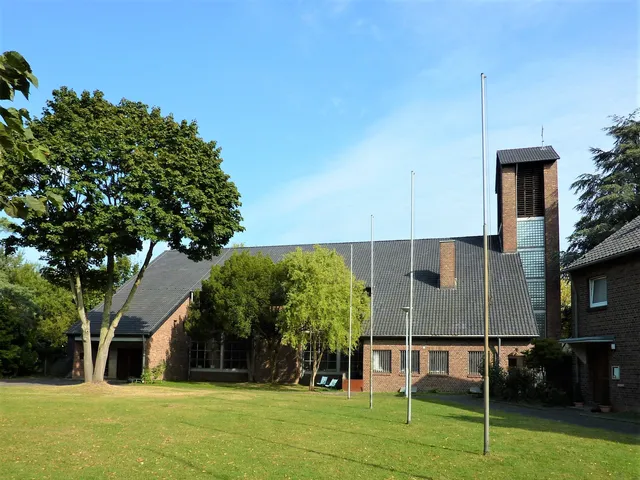
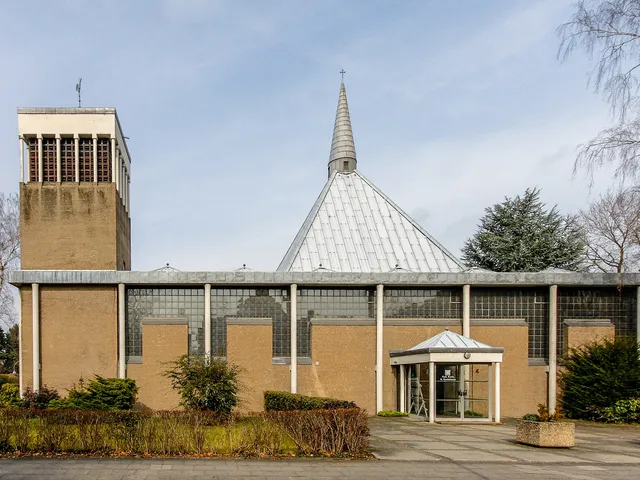
The brick building combines church and parish rooms within a single structure. Facing the lower street, the polygonal church with its asymmetrical floor plan and the inset octagonal tower rise steeply and enclosed, while the roof slopes down to single-storey height toward the crest of the hill. There, the entrance sits discreetly in a niche between the one- and two-storey sections. The interior is lit by narrow side windows along the sloping roof and a strip window in the choir; the clear glass opens views to the sky on one side and to a high-rise building on the other. The wooden ceiling features battens running crosswise to the slope. Four sides of the inset tower project into the interior, forming a niche for the tabernacle and providing access to the weekday chapel. The altar area is level with the floor and can be seated from all sides.
Furnishings
The furnishings are deliberately simple. The altar table by Egino Weinert (1972/1973) came from the former "church shop" and bears four scenes from the New Testament. A wall hanging in a niche above the altar depicts the seventh day of creation and is displayed only in summer; based on designs by Monika Möller and Monika Jilke, women of the parish worked it in silk painting over two years, completing it in 1987. A horizontal Way of the Cross along the altar wall was created in 1981 by Dieter Valk and Alfred Kupper. The Marian chapel has held windows by Käthe Bartels in a free composition since 1978 and contains a copy of the Black Madonna of Częstochowa. A bell cast in 1521, tuned to c1 and attributed to Jochim Ingermann or of anonymous origin, came to the tower in 1982 on loan from the Protestant congregation. It originates from Wojęcino in Poland and is rung for both Catholic and Protestant services on the Kirchenhügel.
Remembering Maximilian Kolbe
The tiled floor, whose design is attributed to Klaus Balke or Paul Bahlke, extends into the parish rooms, combining leaf, blossom, and geometric motifs with bicycles. Beneath the image of the church's patron saint, it is interrupted by a rectangular concrete inlay recalling the floor of the starvation bunker at Auschwitz concentration camp, where Kolbe sacrificed himself for a fellow prisoner and was murdered. Resting on it is a black wooden cross from Zduńska Wola, Kolbe's birthplace, given as a gift by former concentration camp inmates in 1988.
Gallery
Map
Blue dots: other places nearby — tap to explore.
You might also like — related or nearby
Comments
- Loading comments…
Sources & links
Auto-generated, last verified: 2026-08-30
How this page is made
This page draws on open sources — Wikipedia, Wikidata, official websites and the city’s open data. Every statement is checked against the sources linked here, and pages are refreshed regularly.
Spotted a mistake anyway? Tell us below — we read every submission.