St. Johannes vor dem Lateinischen Tore (Cologne-Bocklemünd)
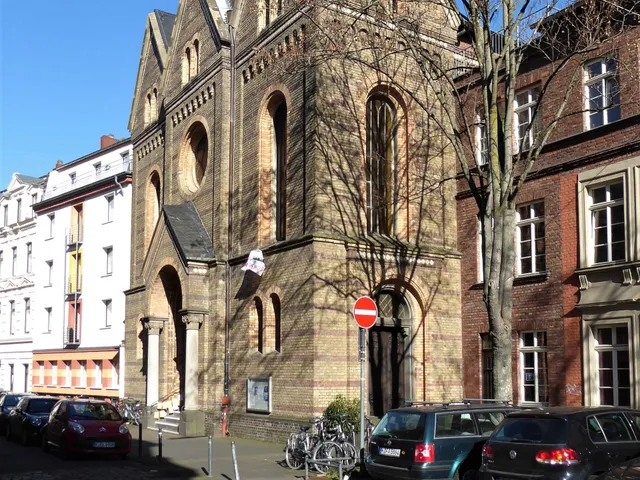
Neo-Gothic hall church by Vincenz Statz crowning a rise above Bocklemünd, its patronage recalling a martyrdom before Rome's Porta Latina.
since 1851
The church sits atop a hill on the northern edge of Bocklemünd, visibly rising above the surrounding neighborhood.
Source: Wikipedia
At a glance
- Type
- Roman Catholic parish church
- Location
- Bocklemünd, district of Cologne (North Rhine-Westphalia)
- Style
- Neo-Gothic, single-nave hall church
- Construction
- 1851–1853; west tower added 1875
- Architect
- Vincenz Statz
- Furnishings
- Three bronze bells (1926); organ with 18 stops (1989)
- Affiliation
- Pastoral area Bocklemünd/Mengenich and Vogelsang, Archdiocese of Cologne
Age comparison
Age compared with other places in Cologne.
Name and Patronage
The church is dedicated to John the Apostle and Evangelist. According to legend, he was martyred before the Porta Latina in Rome by being plunged into boiling oil, which he miraculously survived. His feast day is celebrated on 8 May.
History
A church in Bocklemünd was already mentioned in 941, when Archbishop Wichfried gave it to the Cäcilienstift. As the parish grew, plans arose in 1836 to enlarge the old church, but the site proved too small, prompting a decision to build entirely anew at the village's northern edge. The new church was erected between 1851 and 1853 to designs by Vincenz Statz, and the old one was demolished in 1855.
Architecture
Statz designed the building as a single-nave hall church with a three-sided chancel closure. Oriented almost precisely east–west, it comprises three parts: a four-bay nave under a gabled roof, a narrower, lower chancel to the east with a three-eighths polygonal end, and the tower to the west. The tower was not completed until 1875, twenty-two years after the rest of the church, and is topped by a steep octagonal spire crowned with a weathervane. Buttresses set between the window bays articulate the exterior walls.
Bells and Organ
The tower houses three bronze bells cast in 1926 by Albert Junker Sr. at the Heinrich Humpert foundry in Brilon, tuned to the Te Deum motif. The organ on the rear gallery was built in 1989 by Romanus Seifert & Sohn of Kevelaer and features 18 stops across two manuals and pedal.
Gallery
Map
Blue dots: other places nearby — tap to explore.
You might also like — related or nearby
Comments
- Loading comments…
Sources & links
Auto-generated, last verified: 2026-08-30
How this page is made
This page draws on open sources — Wikipedia, Wikidata, official websites and the city’s open data. Every statement is checked against the sources linked here, and pages are refreshed regularly.
Spotted a mistake anyway? Tell us below — we read every submission.