St. John the Evangelist (Cologne-Stammheim)
Catholic church in Cologne-Stammheim built as a literal "tent of God," its copper roof sweeping all the way to the ground — demolished in 2025.
The building translated the biblical image of the "tent of God" (Rev 21:3) into architectural form, standing in the Cologne district of Stammheim until 2025.
Source: Wikipedia
At a Glance
- Type
- former Roman Catholic church
- Location
- Stammheim district, Mülheim borough (Cologne)
- Built
- 1969–1970
- Architects
- Karl and Gero Band
- Design concept
- "tent of God," roof reaching to the ground, no vertical walls
- Furnishings
- stained-glass windows (1972, Will Thonett), digital organ (2000)
- Status
- deconsecration approved in 2018, demolished in summer 2025
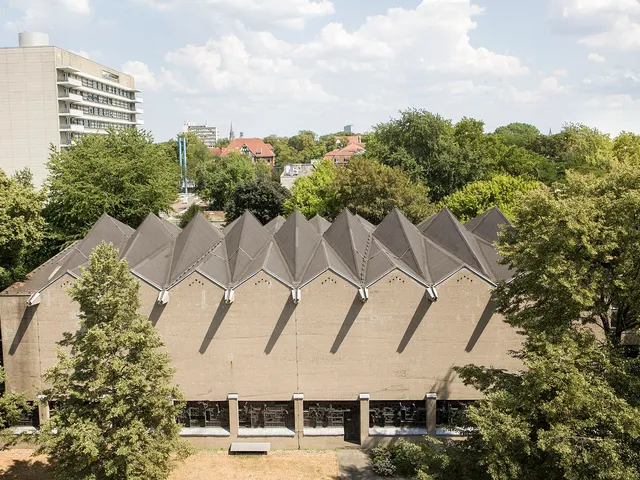
The church embodied the idea of the „tent of God“ as a pure roof-only structure: its copper-clad roof extended all the way to the ground, meaning the building had no vertical walls at all.
Architecture
The building was designed as a roof-only structure (Nurdachhaus): its roof, clad in green-patinated copper sheeting, extended all the way to the ground, leaving no vertical walls at all. The gable ends were built of brick masonry, with three vertical wall strips articulating the chancel side. On the opposite, brightly glazed gable, a cylindrical brick staircase led up to the gallery and bell chamber, both of which projected slightly and were clad in timber. Four pointed dormers on each side of the roof created a deeply folded roofline, opening the light-timber-clad interior to daylight from above.
Sanctuary
The altar stood slightly raised and set asymmetrically to the right. The altar wall was capped along the gable edge by a narrow strip of light, complemented by slender window slits, two rectangular windows at eye level, and a horizontal band of light above a wall niche.
Furnishings
The stained-glass windows of the altar wall were designed by Will Thonett in 1972. Beneath the window slits hung an enamelled altar cross by Egino Weinert. Local Stammheim artist Herbert Labusga created two sculptures for the side wall projections, depicting the church's patron saint and a Pietà. A digital organ by the Allen Organ Company, installed in 2000, had two manuals and 28 stops; the church had no bells.
Parish and Demise
The church belonged to the parish of St. Hubertus and Mariä Geburt, formed in 2010 from the merger of three separate congregations. Following the deconsecration approved in 2018, the building was torn down in the summer of 2025.
Timeline
- 1969–1970Church built according to design by Karl and Gero Band
- 1972Stained-glass windows of the altar wall designed by Will Thonett
- 2000Digital organ by Allen Organ Company installed
- 2010Parish of St. Hubertus and Mariä Geburt formed from three congregations
- 2018Deconsecration of the church approved
- 2025Church demolished in summer
Gallery
Map
Blue dots: other places nearby — tap to explore.
You might also like — related or nearby
Comments
- Loading comments…
Sources & links
Auto-generated, last verified: 2026-09-03
How this page is made
This page draws on open sources — Wikipedia, Wikidata, official websites and the city’s open data. Every statement is checked against the sources linked here, and pages are refreshed regularly.
Spotted a mistake anyway? Tell us below — we read every submission.