St. Johann Evangelist
Demolished parish church that once stood south of Cologne Cathedral on the Domhof, serving for a time as the Archbishop's private chapel.
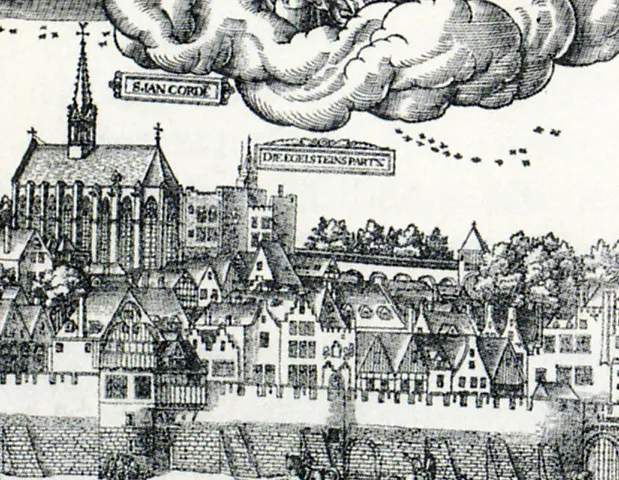
St. Johann Evangelist was a parish church and parish in Cologne, situated on the south side of the Cathedral on the Domhof. For a period it served as the private chapel of the Archbishop of Cologne.
Source: Wikipedia
At a Glance
- Type
- Former parish church and parish
- Location
- Domhof, south of Cologne Cathedral (Altstadt-Nord, city centre)
- Origin
- Built around 1000 as a two-storey palace chapel
- Named after
- John the Evangelist
- Baroque rebuild
- 1744–1747, following a fire
- Demolished
- 1828/1829
When the church was demolished in 1828/1829 to expose Cologne Cathedral, a couple bought the entire interior — altars, pulpit, confessionals, and communion rail — apparently already planned for a new church in Cologne-Sürth: the floor plans of both churches are so strikingly similar that a niche in St. Remigius fits the old confessional exactly and the pews align perfectly with the nave.
Origins and Interpretations
Around 1000, a two-storey palace chapel — a church for the ruling family — was erected on the Domhof and consecrated as St. Johannis in curia. The name St. Johann Evangelist came only later. Scholars disagree on its original function: art historian Jansen, pointing to a comparable layout in Worms, suggested it may once have been a baptistery of the Cathedral. Klaus Gereon Beuckers, however, argues for an archiepiscopal palace chapel — built by Archbishop Hermann II — based on its connection to the bishop's palace and its architectural kinship with the Marian chapel at the Goslar Imperial Palace.
Rebuilds and Fire
Around 1250 a new building went up in the Rhenish transitional style, bridging Romanesque and Gothic. By the late 14th century the former cemetery of St. Mariengraden had passed to the parish. After the church burned down in 1743, it was rebuilt in Baroque style between 1744 and 1747.
Suppression and Demolition
During the secularisation the church was dissolved as a parish. When the Cathedral precinct was cleared in 1828/1829, the building was torn down. The bishop's throne passed to the merchant and art collector Matthias Joseph de Noël, the first conservator of the Wallrafianum. The couple Breuer purchased the remaining furnishings — including altars, pulpit, communion rail, and confessionals — for the new St. Remigius in Cologne-Sürth. Because the floor plans of both churches are similar and individual pieces fit the Sürth building precisely, it is believed the furnishings had already been earmarked for it. Some pieces remain in St. Remigius to this day.
Notable Facts
In May and June 1969, archaeological excavations directed by Otto Doppelfeld took place on the site of the demolished church.
Timeline
- um 1000Construction of a two-storey palatine chapel (St. Johannis in curia) on the cathedral grounds
- um 1250Reconstruction in the Rhenish transitional style from Romanesque to Gothic
- Ende 14. Jh.Cemetery of St. Mariengraden transferred to the parish
- 1743St. Johann Evangelist destroyed by fire
- 1744–1747Reconstruction and furnishing in Baroque style
- 1828/1829Demolition of the church during the excavation of Cologne Cathedral
- 1828–1830Furnishings transferred to the new St. Remigius church in Cologne-Sürth
- Mai/Juni 1969Archaeological excavations on the site under Otto Doppelfeld
Map
Blue dots: other places nearby — tap to explore.
You might also like — related or nearby
Comments
- Loading comments…
Sources & links
Auto-generated, last verified: 2026-06-27
How this page is made
This page draws on open sources — Wikipedia, Wikidata, official websites and the city’s open data. Every statement is checked against the sources linked here, and pages are refreshed regularly.
Spotted a mistake anyway? Tell us below — we read every submission.