St. Bernhard (Longerich)
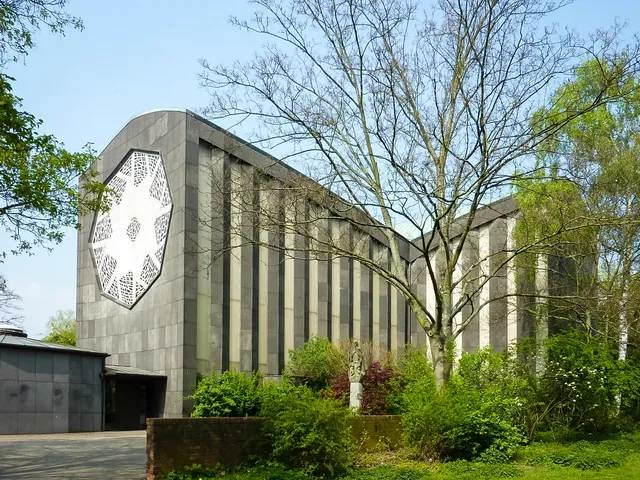
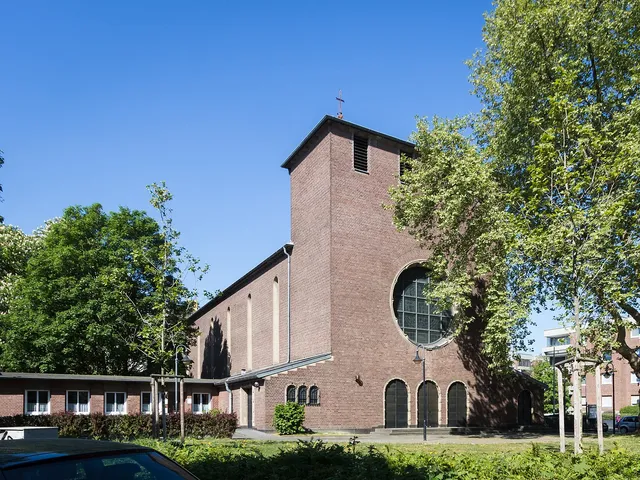
St. Bernhard is a Catholic branch church in the Cologne district of Longerich, built in 1961 to designs by architect Fritz Lill. Since a 2021 conversion its nave has served as a diocesan depot, while a reduced worship space remains in use.
since 1961
St. Bernhard is a Roman Catholic branch church in the Cologne district of Longerich, on the left bank of the Rhine. Completed in 1961, it belongs to the Longerich/Lindweiler parish association and was structurally reorganised in 2021, when part of its interior became a church depot.
Source: Wikipedia
At a Glance
- District
- Longerich (left-bank Cologne)
- Architect
- Fritz Lill
- Completed
- 1961
- Dedication
- Bernard of Clairvaux, founder of the Cistercian order
- Material
- red brick over a T-shaped floor plan
- Function today
- active branch church with a reduced worship space, nave used as a depot
- Notable feature
- free-standing round tower with a figure of St. Bernard atop a globe
Among the 36 stained-glass windows from 1961 are not only motifs of creation but also technological images such as a jet aircraft, power lines and the Brussels Atomium.
Things to do here
- View the free-standing round tower with the figure of St. Bernard on a globe
- Spot the Noah's Ark relief by Elisabeth Baumeister-Bühler at the entrance
- See the large round bronze cross by Blasius Spreng in the worship space
- Listen for the bells, tuned to harmonise with the neighbouring churches
Age comparison
Age compared with other places in Cologne.
History
The parish of St. Bernhard was founded on 1 January 1959, with the foundation stone laid on 2 October 1960. Auxiliary Bishop Wilhelm Cleven consecrated the church on the first Sunday of Advent, 3 December 1961. It was dedicated to St. Bernard of Clairvaux, founder of the Cistercian order, and at its completion was the largest post-war church building in the Archdiocese of Cologne.
Together with its parish centre, St. Bernhard formed the heart of the so-called Katholikentag settlement, whose first sod was turned in 1956 during the 77th German Katholikentag in Cologne. At the time it was considered one of the most child-rich settlements in Europe. Johannes Sporer was the first pastor, followed by Georg Biesenbach in 1971. In 2002 a new parish was formed with the neighbouring Christ König community, in which St. Bernhard became a branch church; since 2010 the site has belonged to a joint parish under the patronage of the older Longerich community of St. Dionysius.
Architecture
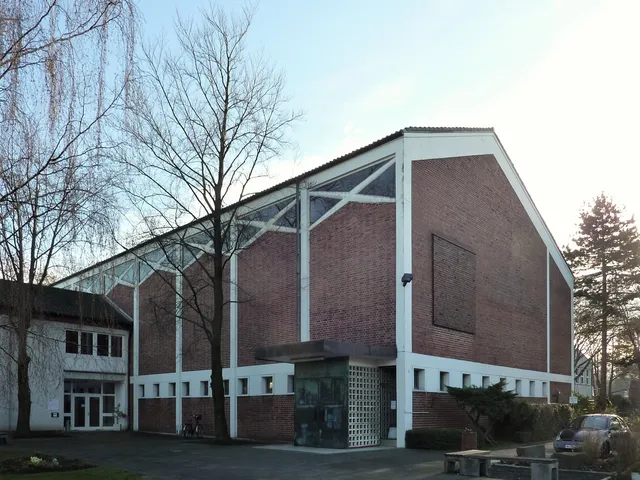
In keeping with the plain Cistercian ideal, Fritz Lill designed a simple red-brick building with a tall round tower. Its form echoes an ark, underlined by a relief of Noah's Ark at the entrance created by sculptor Elisabeth Baumeister-Bühler. The free-standing bell tower, topped by a figure of St. Bernard standing on a globe, follows a design by Cologne sculptor Elmar Hillebrand.
Furnishings
The font and tabernacle are the work of goldsmith and silversmith Hein Wimmer; the font's copper lid is crowned by a dove as a symbol of the Holy Spirit. The eastern wall behind the altar is dominated by a large round bronze cross by Blasius Spreng of Munich. The 36 stained-glass windows from 1961 were made by Hein Derich of Kevelaer to designs by Wilhelm Schmitz-Steinkrüger; they depict motifs of creation such as flowers, trees, animals, mountains, sun, moon and stars, as well as of technology, including a jet aircraft, power lines and the Brussels Atomium. The organ, built in 1967 by the Bonn firm Johannes Klais, has 36 stops, three manuals and pipes made of copper, with an asymmetrical case. The four-bell peal by Petit & Edelbrock of Gescher is tuned to harmonise with the neighbouring churches of St. Dionysius and Christ König.
Conversion and Use Today
St. Bernhard remains an active branch church but was spatially altered in 2021. An obtusely angled partition wall separated the nave from the worship space, which is now limited to the reduced choir area. The separated nave serves as a diocesan depot for sacred objects from deconsecrated churches in the Cologne area. As a result of the work, the font was moved to the northern part of the church, and most of the stained-glass windows are no longer freely accessible or visible.
Gallery
Map
Blue dots: other places nearby — tap to explore.
You might also like — related or nearby
Comments
- Loading comments…
Sources & links
Auto-generated, last verified: 2026-08-29
How this page is made
This page draws on open sources — Wikipedia, Wikidata, official websites and the city’s open data. Every statement is checked against the sources linked here, and pages are refreshed regularly.
Spotted a mistake anyway? Tell us below — we read every submission.