Christ's Transfiguration Church (Cologne-Heimersdorf)
A Catholic parish church in Cologne-Heimersdorf, built in the 1960s in a Brutalist style by Josef Lehmbrock on a cross-shaped ground plan.
since 1966
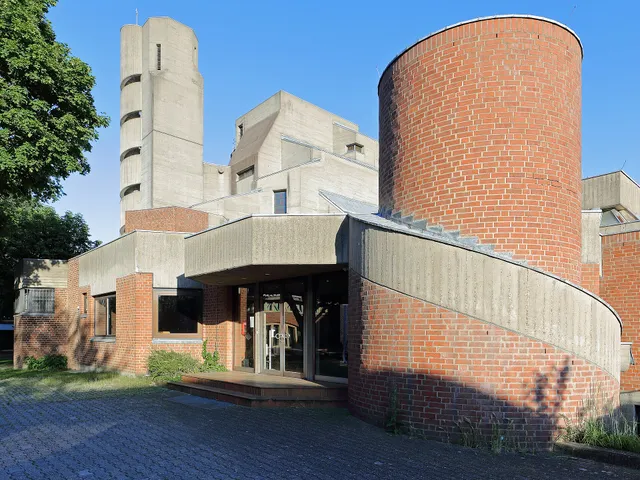
In the northern Cologne district of Heimersdorf stands Christ's Transfiguration, a Catholic parish church built between 1966 and 1967 whose original architectural language was counted among Brutalism. The design came from the Düsseldorf architect Josef Lehmbrock.
Auf einen Blick
- District
- Cologne-Heimersdorf
- Construction period
- 1966/1967
- Architect
- Josef Lehmbrock (Düsseldorf)
- Dedication
- the Transfiguration of Christ
- Consecration
- 29 October 1966 by auxiliary bishop Augustinus Frotz
- Denomination
- Roman Catholic (originally the rectorate parish Christi Verklärung, founded January 1963)
- Architectural style
- Brutalism
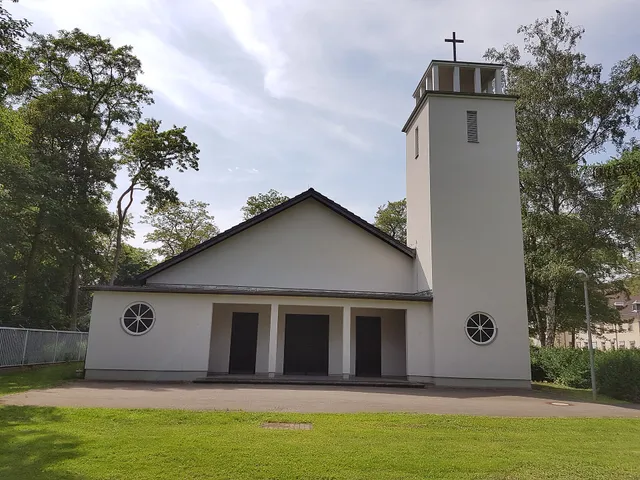
One of the two bells on the outdoor frame is a loan bell dating from 1669 — far older than the church itself, which deliberately does without any bell tower.
Things to do here
- Contemplate the oversized octagonal rose window by Günter Peltzer
- View Hubert Gülden's altar cross inspired by Romanesque triumphal crosses
- Discover the Baroque Madonna from Aargau to the left of the altar
- Experience the Klais organ with its 46 stops, consecrated in 2011
- Admire the interior's wooden lattice ceiling evoking Gothic net vaults
Age comparison
Age compared with other places in Cologne.
History
In the early 1960s the population of Heimersdorf grew sharply as part of the housing development of the Neue Stadt Chorweiler. From 1962 a separate pastoral district formed here, incorporating older settlements from the neighbouring parishes of Weiler, Longerich and Fühlingen. At first the attic of a private shop served as an emergency church — notably, the Protestant congregation also held its services there. The rectorate parish Christi Verklärung was founded in January 1963.
As the makeshift church soon proved too small for the growing congregation, Lehmbrock was commissioned in 1963 to plan a complex comprising a church, hall, youth centre, staff apartments, kindergarten and library. The parish hall was finished so quickly that from April 1965 services were celebrated in this Tabor Hall, complemented by a provisional bell tower. By October 1966 the church itself was complete; shortly before its consecration on 29 October, the foundation stone was placed within the masonry.
The furnishings continued to grow in the following years: bells were added at the end of 1967 and an organ in 1974. In 1978 the crypt received an altar slab found during excavations in the northern aisle of Cologne Cathedral. The last provisional element, the ambo, was replaced in 1979.
Architecture
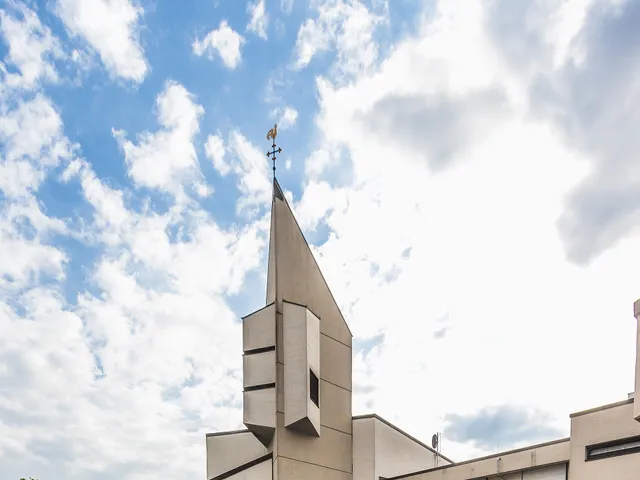
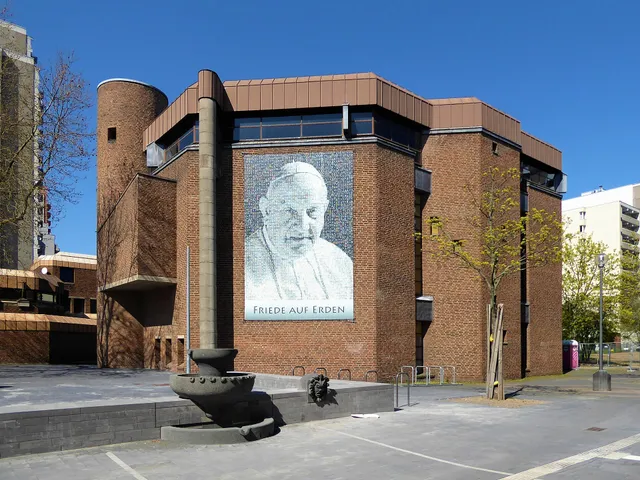
The church rests on an axially symmetrical, cross-shaped ground plan resembling a garment with outstretched arms, symbolising the outstretched arms of Christ. At the four end faces rise slightly inward-curving, originally unrendered concrete walls with segmental gables; three of them have no window openings at all. Only the nave wall to the south-west opens with an oversized octagonal rose window — the building's signature feature. A very flat, copper-clad pointed barrel roof closes off the space.
Between the end faces run closely spaced vertical concrete louvres, with tall white strips of window light entering the church from all sides. The altar area, raised by three steps, extends into the crossing, while the congregation's pews fill the three remaining arms of the cross, arranged in a semicircle around the altar. The open ceiling is structured in the manner of a Zollinger roof with a delicate wooden lattice reminiscent of Gothic net vaults. Through its light and verticality, the church as a whole follows the symbolic language of Gothic architecture.
Furnishings
In the single-storey baptistery, set two steps lower than its surroundings, stands a font made of various stone objects — some crafted by apprentices at the Cologne Cathedral workshop, some dating from the 19th century; an accompanying cross is the work of Toni Zenz. The large rose window with abstract compositions in red and blue was created by Günter Peltzer. Among the earliest pieces is a Baroque Madonna sculpture from Aargau in Switzerland, made around 1750 and placed to the left of the altar area.
The altar with its vine motif was made by the Düsseldorf sculptor Josef Klein from black Kattenfels. The altar cross hanging above it, by Hubert Gülden (1971), is inspired by Romanesque triumphal crosses and depicts a crowned, royal Christ surrounded by the symbols of the four evangelists. The eagle-shaped ambo comes from Paul Nagel. A 1975 work by the Cologne sculptor Jutta Osten first served as the tabernacle; it was later exchanged for the sacrament house of the sold sister church St. Markus, which is made from a pinnacle of Cologne Cathedral and contains a tabernacle by Paul Nagel. In 2000 a Russian icon of the Transfiguration of Christ was added, as well as the collaboratively created collage "Entfaltungen" by Eva Marie Degenhardt, which clads a concrete louvre to the left of the altar over its full height.
Organ and Bells
The first organ, a positive with five stops, was far too small for the large space and was passed on to St. Markus in 1974. The second organ, built by Willi Peter in 1974 with two manuals and 23 stops, also remained undersized for financial reasons. Only in 2010 did donation campaigns and a grant from the archdiocese make possible a renovation and expansion by Johannes Klais Orgelbau; the "new organ," with three manuals, 46 stops and LED lighting, was consecrated on 22 May 2011.
Both architect and congregation deliberately did without a bell tower — the former because of the building's already vertical effect, the latter for financial reasons. Two bells hang on an open bell frame outdoors; their strike tones are G-sharp1 and B1, the latter being a loan bell from the year 1669.
Good to Know
The condition of the outer walls no longer matches the original, which is why heritage protection by the monument conservator has so far not been granted. Between 2007 and 2011 the large rose window was restored over four years, and a later-added second entrance on the side aisle had to be repaired because of subsidence.
Timeline
- 1963The rectorate parish Christi Verklärung is founded in January; Lehmbrock is commissioned with the design.
- 1965From April, services are held in the completed Tabor Hall with a provisional bell tower.
- 1966The church is consecrated on 29 October by auxiliary bishop Augustinus Frotz.
- 1974Willi Peter builds the second organ with two manuals and 23 stops.
- 1978The crypt receives an altar slab excavated at Cologne Cathedral.
- 2011The organ, renovated and expanded by Klais, is consecrated on 22 May.
Gallery
Map
Blue dots: other places nearby — tap to explore.
Address
Taborplatz 2
50767 Köln
Contact
You might also like — related or nearby
Comments
- Loading comments…
Sources & links
- Official website
- Official website (retrieved 2026-07-17)
- Wikidata (retrieved 2026-07-06)
- Wikipedia (retrieved 2026-07-06, rev 255025529)
Auto-generated, last verified: 2026-07-06
How this page is made
This page draws on open sources — Wikipedia, Wikidata, official websites and the city’s open data. Every statement is checked against the sources linked here, and pages are refreshed regularly.
Spotted a mistake anyway? Tell us below — we read every submission.