St. Pius X.
A listed Catholic parish church built from 1959 to 1962 in Cologne's Flittard district, designed by Margot and Joachim Schürmann with a nave suspended from steel cables.
since 1958
St. Pius X. is a Catholic parish church in Cologne's Flittard district, built between 1959 and 1962 to designs by Margot and Joachim Schürmann. It is dedicated to Pope Pius X, canonized only a few years before construction, and should not be confused with the church of St. Pius in Zollstock, which honors Pope Pius I.
Source: Wikipedia
At a Glance
- Type
- Catholic parish church
- Architects
- Margot and Joachim Schürmann
- Built
- 1959–1962 (consecrated 1961)
- District
- Flittard
- Dedication
- Pope Pius X
- Heritage status
- listed since 2001 (monument no. 8548)
- Denomination
- Roman Catholic
The 14-meter nave is not built on masonry but hangs from a tubular-steel roof frame with cable-braced walls, held up by just four slender steel columns, so the walls appear to float.
Things to do here
- View the seemingly floating nave hall suspended from steel cables inside
- Discover Paul Weigmann's stained glass with heads of angels and saints
- Look at the basalt-lava reliefs of John the Baptist and Saint Michael at the courtyard gates
- Walk around the circular bell tower pierced by some 200 sound openings in the courtyard
- Take in the post-war sacred architecture by the Schürmann architects
Age comparison
Age compared with other places in Cologne.
History
The church grew out of the Bayer company housing estate in Flittard, laid out in 1937 and expanded during the 1950s. A Catholic parish was founded there on 1 May 1958. An architectural competition produced three designs in the summer of 1957, and a modified version of the Schürmann office's proposal was chosen. Ground was broken in March 1959, and the foundation stone was laid on 19 July. Services began in June 1960, and Auxiliary Bishop Joseph Ferche consecrated the church on 28 January 1961. A second construction phase from June 1961 added a youth hall opposite the church and the bell tower. On 19 June 2001 the building was entered in Cologne's list of monuments.
Architecture
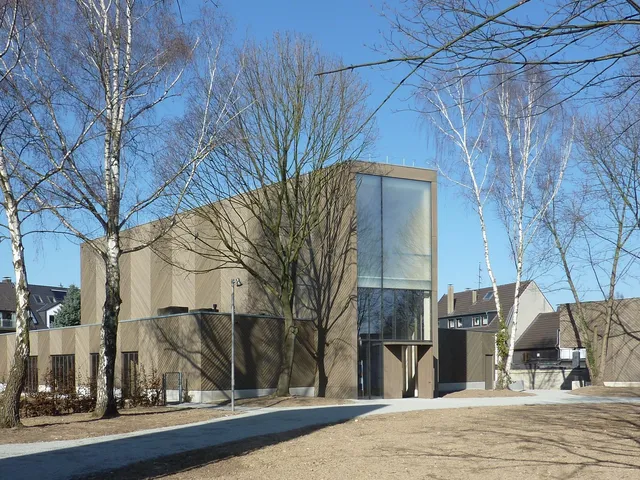
The worship hall sits within a walled "sacred precinct" on raised ground, from which its block-shaped upper structure rises. The church consists of two volumes: a low, single-story block filling three sides of the walled rectangle, and a 14-meter-high, slate-clad nave hall rising above it, marked by two horizontal window bands. The lower, narrower band is filled with colored glass and the upper with corrugated glass, making the walls appear to float. The upper structure is not built up on masonry but hangs from an open tubular-steel roof frame; its steel-truss side walls are suspended on steel cables and supported by four slender steel columns. Inside, the two volumes form a bright central "high space" and a low surrounding "ambulatory" for chapels and the sacristy, with the nave walls clad in natural fir-wood shingles. At the center of the courtyard stands a 23-meter-high circular bell tower, 4.50 meters in diameter, tapering toward the top and pierced by around 200 sound openings.
Furnishings
The two basalt-lava door supports at the courtyard gates were made in 1961 by Rudolf Peer, showing John the Baptist with the Lamb of God to the east and Saint Michael fighting the dragon to the west; Peer also created the altar block and the font. The roughly four-meter tower crown, an "angel cloud" completed in 1962, is the work of Werner Schürmann, the architect's brother. The lower window band, alternating heads of angels and saints with ornamental patterns, is stained glass by Paul Weigmann. A Madonna figure created in 1964 by Hans Karl Burgeff was replaced in 1976 after a parish vote. After a fire destroyed the organ in February 1964, the parish received a new instrument from Heyligers Orgelbau of Schmidtheim in 1977. The five-bell peal was cast in 1961 by Petit & Gebr. Edelbrock.
Timeline
- 1958Catholic parish founded on 1 May
- 1959Ground broken in March and foundation stone laid on 19 July
- 1961Church consecrated on 28 January by Auxiliary Bishop Joseph Ferche
- 1962Completion with the "angel cloud" tower crown
- 1964Organ destroyed by fire in February
- 1977New organ from Heyligers Orgelbau installed
- 2001Added to Cologne's list of monuments on 19 June
Gallery
Map
Blue dots: other places nearby — tap to explore.
You might also like — related or nearby
Comments
- Loading comments…
Sources & links
Auto-generated, last verified: 2026-08-26
How this page is made
This page draws on open sources — Wikipedia, Wikidata, official websites and the city’s open data. Every statement is checked against the sources linked here, and pages are refreshed regularly.
Spotted a mistake anyway? Tell us below — we read every submission.