St. Dreikönigen
Catholic parish church of 1928/29 in Cologne-Bickendorf, blending New Objectivity with Expressionist touches.
since 1929
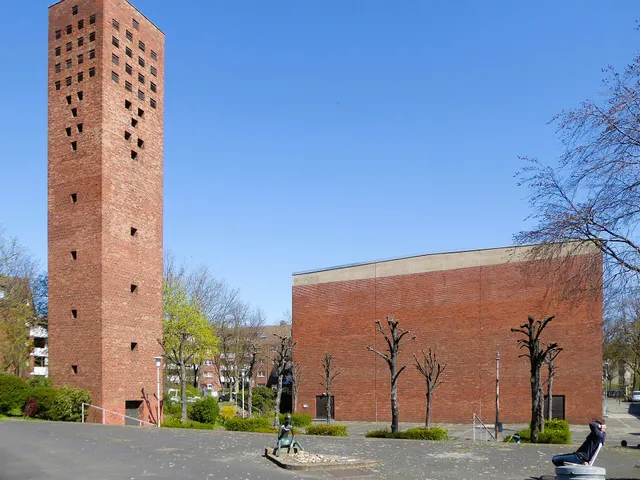
In Cologne's Bickendorf district stands St. Dreikönigen, a Catholic parish church built between 1928 and 1929 to designs by Hans Peter Fischer and Heinrich Forthmann. It is dedicated to the Three Kings, the patron saints of Cologne, and has been a listed monument since 1982.
At a Glance
- Type
- Catholic parish church
- Built
- 1928–1929, consecrated on 6 January 1929
- Location
- Bickendorf district, within the Bickendorf II housing estate
- Style
- New Objectivity (Neues Bauen) with Expressionist touches
- Architects
- Hans Peter Fischer and Heinrich Forthmann
- Dedication
- The Three Kings (patron saints of Cologne)
- Heritage status
- listed since 1 June 1982 (No. 1034 on the monument list)
Age comparison
Age compared with other places in Cologne.
Why It Was Built
As the GAG housing programme transformed Bickendorf from a village into a fast-growing suburb, the Catholic population of the St. Rochus parish grew so much that a new church became necessary. After a June 1927 exchange agreement with the City of Cologne secured a suitable plot in the Bickendorf II estate, a competition was held among 44 Cologne architects. The brief called for a church seating 800 adults and 300 children that would fit organically into the surrounding development. The jury chose the design by Fischer and Forthmann.
Construction and Completion
Groundbreaking took place on 26 February 1928 and the foundation stone was laid on 10 June the same year. After around ten months of building, auxiliary bishop Hermann Joseph Sträter consecrated the church for the Feast of the Epiphany on 6 January 1929. Yet it was far from finished: fittings, wall paintings and annexes with clergy apartments dragged on through the years of the Great Depression until 1934, when the tower clock was finally installed. In June 1931 the congregation became independent of St. Rochus and was raised to a rectorate.
War and Reconstruction
During the Second World War St. Dreikönigen was badly damaged by air raids and, in 1945, by shellfire, though not completely destroyed. By the war's end only the confession chapel could still be used for services. Unlike many other Cologne churches, it returned to use fairly quickly: Cardinal Frings celebrated the Epiphany Mass here for three years before it moved back to the cathedral in 1948. On 6 January 1948 the church also hosted the first radio broadcast of a cardinal's sermon combined with a Eucharistic celebration, transmitted by the NWDR. After the currency reform, new bronze bells were added in 1949 and 1955, and the stained-glass windows were renewed from 1950. Architect Fischer once again led the restoration, which was completed in 1959. From 1964, following the Second Vatican Council, the sanctuary, sacristy and confessionals were remodelled.
Architecture
The reinforced-concrete building clearly belongs to New Objectivity, with plain cubic forms and white wall surfaces, yet it retains Expressionist features such as the strikingly narrow, Gothic-inspired lancet windows and the pointed-arch portals. The entrance hall, nave and choir form a slightly stepped ensemble of equal height that narrows toward the choir. A slender, two-tiered tower stands at the entrance side, while an arcade of three arches links the church to the surrounding buildings and shapes a small forecourt. Inside, a flat, dark timber-beamed ceiling runs through to the choir, and light enters mainly through the lancet windows set on three sides.
Furnishings, Windows and Organ
The interior is very sparingly appointed and has no sculptures; a plain cross hangs before the altar wall. The ambo, altar table and tabernacle were created after the Council by Heinz Gernot. The geometric windows by Jan Thorn Prikker (1932/33) were destroyed in April 1944. The figurative "Three Kings window" in the portal wall is the work of Thorn Prikker's pupil Wilhelm Schmitz-Steinkrüger, who also carried out the restoration and reconstruction; further windows by Josef Henseler were added in 1965 and 1975. Two of the Otto bells from 1932 had to be surrendered for the war effort in 1942 and were later recast. The organ by W. Sauer Orgelbau (1986) has 44 stops and incorporates parts of the original Stahlhut organ of 1933–1935.
Gallery
Map
Blue dots: other places nearby — tap to explore.
Address
Weißdornweg 91
50827 Köln
Contact
You might also like — related or nearby
Comments
- Loading comments…
Sources & links
- Official website
- Official website (retrieved 2026-07-17)
- Wikidata (retrieved 2026-07-10)
- Wikipedia (retrieved 2026-07-10, rev 265524277)
Auto-generated, last verified: 2026-07-10
How this page is made
This page draws on open sources — Wikipedia, Wikidata, official websites and the city’s open data. Every statement is checked against the sources linked here, and pages are refreshed regularly.
Spotted a mistake anyway? Tell us below — we read every submission.