St. Joseph (Braunsfeld)
Roman Catholic post-war church in Köln-Braunsfeld, built between 1952 and 1954 to designs by Rudolf Schwarz and Joseph Bernard, and listed as a protected monument since 1999.
since 1952
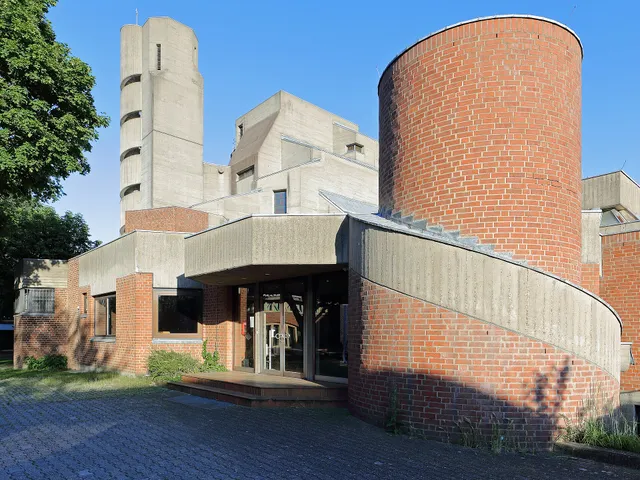
St. Joseph in Braunsfeld belongs today to the parish of St. Pankratius and was built between 1952 and 1954 as a concrete-frame structure of post-war modernism. The church is dedicated to Saint Joseph of Nazareth and goes back to designs by the architects Rudolf Schwarz and Joseph Bernard.
At a Glance
- District
- Köln-Braunsfeld
- Denomination
- Roman Catholic (parish of St. Pankratius)
- Construction period
- 1952–1954
- Architects
- Rudolf Schwarz and Joseph Bernard
- Consecration
- 19 September 1954 by Cardinal Frings
- Monument protection
- since 1999 (Monument List No. 8410)
- Tower
- free-standing campanile, 25 metres high
- Organ
- two manuals, 23 stops (Romanus Seifert & Sohn, 1956)
The originally very bright white-glass interior was so dazzling that the parish priest complained that one came "to the service with sunglasses on" – only in 1967/1968 did coloured windows by Georg Meistermann bring relief.
Things to do here
- View the post-war architecture of Rudolf Schwarz with its jagged concrete-frame roof
- Experience the coloured wave windows by Georg Meistermann in the interior
- Marvel at the free-standing campanile as an open concrete bell frame
- Visit the crypt as a memorial site for those who died in the world wars
Age comparison
Age compared with other places in Cologne.
History
Braunsfeld grew up in the second half of the 19th century and was incorporated into Cologne in 1888. A church-building association founded as early as 1897 pushed for the construction of its own parish church, which was built in 1906 as a three-aisled basilica for around 100 worshippers; from 1915 onwards Braunsfeld formed an independent parish. From 1924 to 1937 the later Cardinal Josef Frings served here as parish priest. This first building fell victim to the air raids of the Second World War in 1944.
Competition and New Building
After years with makeshift emergency churches, the parish held a competition with four participants in October 1952, which Rudolf Schwarz and Joseph Bernard won. The design was adjusted several times before it was carried out: a completely new plan was drawn up for the bell tower, and at the suggestion of Cardinal Frings a confession chapel and a baptismal chapel were added. Following the laying of the foundation stone on 10 May 1953, the consecration by Frings took place on 19 September 1954. As the last element of the original furnishings, the organ was installed in 1956.
Architecture
The south-facing church stands on a site open on three sides between several streets. It is a longitudinal rectangular concrete-frame building with a sixfold jagged gable roof, whose gables are filled with hexagonal window surfaces and supported by Y-shaped concrete piers. The slightly recessed brickwork forms small masonry crosses across the surfaces. On the west side, a single-storey extension reminiscent of a cloister adjoins around an inner courtyard, housing the sacristy as well as the confession and baptismal chapels. The separate campanile is a 25-metre-high "bell frame" of four concrete piers held together by five concrete discs, which at the same time carry the four bells.
Interior and Colour Scheme
The largely unarticulated, elongated church hall runs in a straight line towards the raised altar; side steps lead down into the crypt, which today serves as a memorial site for those who died in the world wars. Originally the design followed the image of the "Tent of God": bright white-glass windows, white piers and ceiling, light-blue panels. The very bright space came in for criticism from 1960 onwards – the complaint has been passed down that one came "to the service with sunglasses on". In 1967/1968 the parish had coloured windows by Georg Meistermann installed and the ceiling painted dark blue, which reversed the colour impression. This scheme was also preserved during the comprehensive renovation in 2001.
Furnishings
The furnishings come from various periods: among the items preserved from the destroyed predecessor church are the tabernacle doors, the baptismal font cover by Hans Hoffmann dates from 1935, and two sculptures were created in the 1940s. From the construction period come the altar table and font by Paul Nagel as well as a stone figure of the Mother of God by Kurt Zimmermann (1954). The tabernacle was created by the goldsmith Elisabeth Treskow; Heribert Calleen added an ambo and the Easter candlestick in 1974 and the altar cross in 1978. The coloured Meistermann windows, with their wave forms, take up the movement of the roof and window shapes.
Organ and Bells
The two-manual organ with 23 stops was built in 1956 by Romanus Seifert & Sohn; its case with unusually free-standing pipes fits the architecture so well that during the 2001 renovation it was carefully restored rather than replaced. The four-part peal from the Petit & Gebr. Edelbrock foundry consists of three bells cast in 1954 and an older one from 1934; the strike tones are a1–c2–d2–f2.
Timeline
- 1944Destruction of the predecessor church by air raids in the Second World War
- 1952Competition for the new building, won by Rudolf Schwarz and Joseph Bernard
- 1953Laying of the foundation stone on 10 May
- 1954Consecration of the church by Cardinal Frings on 19 September
- 1956Installation of the organ as the last element of the original furnishings
- 1968Installation of coloured Meistermann windows and dark-blue ceiling scheme
- 1999Addition to the monument list of the City of Cologne
Gallery
Map
Blue dots: other places nearby — tap to explore.
Address
Braunstraße 32
50933 Köln
Hours
Di: 10:00–17:00
Mi: 10:00–17:00
Do: 10:00–17:00
Fr: 10:00–17:00
Sa: 10:00–17:00
So: 10:00–17:00
Contact
You might also like — related or nearby
Comments
- Loading comments…
Sources & links
- Official website
- Official website (retrieved 2026-07-17)
- Wikidata (retrieved 2026-07-05)
- Wikipedia (retrieved 2026-07-05, rev 231338841)
Auto-generated, last verified: 2026-07-05
How this page is made
This page draws on open sources — Wikipedia, Wikidata, official websites and the city’s open data. Every statement is checked against the sources linked here, and pages are refreshed regularly.
Spotted a mistake anyway? Tell us below — we read every submission.