St. Stephan
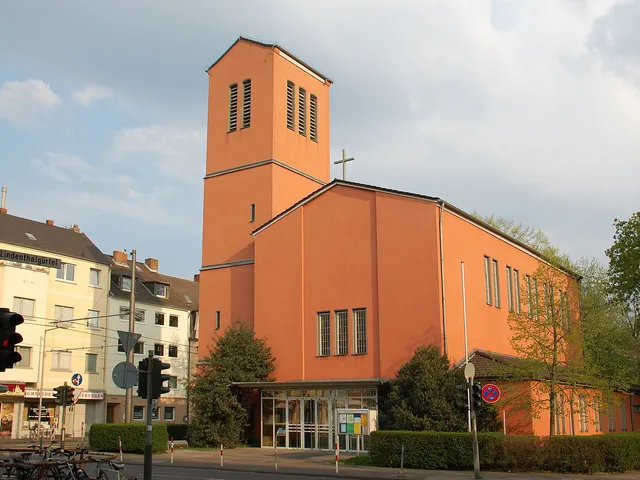
A church in Cologne's Lindenthal district: the 1887 Neo-Gothic building was destroyed in the war and replaced in 1961 by a modern glass church that incorporates the old tower.
St. Stephan is a Catholic church in Cologne's Lindenthal district. The Neo-Gothic church of 1887 was destroyed in the Second World War and replaced in 1961 by a modern building that incorporates the surviving old church tower.
At a Glance
- Built (new church)
- 1959–1961, designed by Joachim Schürmann
- Predecessor
- Neo-Gothic church of 1884–1887 (August Carl Lange, Robert Mohr)
- Location
- Bachemer Straße, Cologne-Lindenthal
- Tower
- surviving 1887 tower, without its spire, 56.80 m tall
- Style (new church)
- transparent glass building, influenced by Mies van der Rohe
- Consecration (new church)
- 12 March 1961 by Cardinal Joseph Frings
- Listed status
- tower and furnishings protected as monuments since 1985/2001
The foundation stone of the 1960 rebuild has a piece of marble from the Church of St. Stephen in Jerusalem set into it – a deliberate link to the origins of the church's patron saint, who was stoned to death in Jerusalem.
Things to do here
- See the surviving old tower standing beside the modern glass church
- Discover the controversial bronze hanging cross by Werner Schürmann
- Trace the connections to Konrad Adenauer's family inside the church
- View the centuries-old crucifix from St. Cäcilien with its hidden relics
Destruction and Rebuilding
St. Stephan was one of the first Cologne churches destroyed by an air raid in 1941 — it collapsed on the night of 27–28 May, with only the tower left standing. During a Royal Air Force raid on the night of 20–21 April 1944, the burning tower spire finally collapsed into the already ruined nave. The parish made do with a temporary church in the parish hall until 1961. Only in 1957 was the decision made to rebuild, supported by the church board member and then Cologne city director Max Adenauer. The archdiocese's vicariate general required that the tower ruin, without its spire, be incorporated into the new building as a freestanding campanile.
A Modern Glass Building
After a competition limited to three Lindenthal architects, Joachim Schürmann was awarded the commission in 1958. His design follows the concept of a transparent "light building" influenced by the architecture of Mies van der Rohe: the surrounding window front alternates between double-glazed panels with a translucent glass-fibre interlayer and double-glazed panels with a mineral-fibre panel. A piece of marble from the Church of St. Stephen in Jerusalem is set into the foundation stone, laid on 17 January 1960. Twelve slender columns inside recall the twelve apostles; the floor is paved with small natural-stone cobbles, while the sanctuary is finished in pale green quartzite.
Furnishings with History
Only a few pieces from the old church survived the war, including a reliquary statue of St. Stephen and a walnut-wood crucifix from around 1400 that originally hung in St. Cäcilien — during a restoration in 1987–1989 a reliquary sepulchre dated 1579 was found inside it. The slender bronze hanging cross above the altar was created by Werner Schürmann, the architect's brother; the controversial figure of Christ, evoking an emaciated concentration-camp prisoner, was designed in Dublin and cast in Düsseldorf. Four bronze standing candlesticks around the altar symbolise the patron saints of the Lindenthal and Kriel parishes: St. Stephan, St. Thomas More, St. Laurentius and St. Albertus Magnus. The organ was built in 1961–62 by the Bonn workshop Johannes Klais, with 22 stops and 1,675 pipes.
A Connection to Konrad Adenauer
The church has close ties to the family of Konrad Adenauer: here the then-assessor married his first wife, Emma Weyer, on 26 January 1904, and her funeral mass was also held here in 1916. Forty years later his son Max Adenauer, as a church board member, played a key role in championing the rebuilding of the destroyed church.
Timeline
- 1884Cornerstone laid for the Neo-Gothic predecessor church
- 1887Blessing of the Neo-Gothic church (23 October)
- 1941Destroyed in an air raid (27–28 May) – one of the first Cologne churches lost in the war
- 1944Burning tower spire collapses into the nave (20–21 April)
- 1960Cornerstone laid for the new building, with marble from Jerusalem (17 January)
- 1961Consecration of the new church by Cardinal Frings (12 March)
- 1986Restoration of the historic church tower
Gallery
Map
Blue dots: other places nearby — tap to explore.
Address
Bachemer Str. 104A
50931 Köln
Hours
Mo: 09:00–12:00
Di: 09:00–12:00
Mi: 09:00–12:00
Do: 09:00–12:00
Do: 15:00–18:00
Fr: 09:00–12:00
Contact
You might also like — related or nearby
Comments
- Loading comments…
Sources & links
- Official website
- Official website (retrieved 2026-07-20)
- Wikidata (retrieved 2026-07-03)
- Wikipedia (retrieved 2026-07-03, rev 268342735)
Auto-generated, last verified: 2026-07-03
How this page is made
This page draws on open sources — Wikipedia, Wikidata, official websites and the city’s open data. Every statement is checked against the sources linked here, and pages are refreshed regularly.
Spotted a mistake anyway? Tell us below — we read every submission.