Liebfrauenkirche
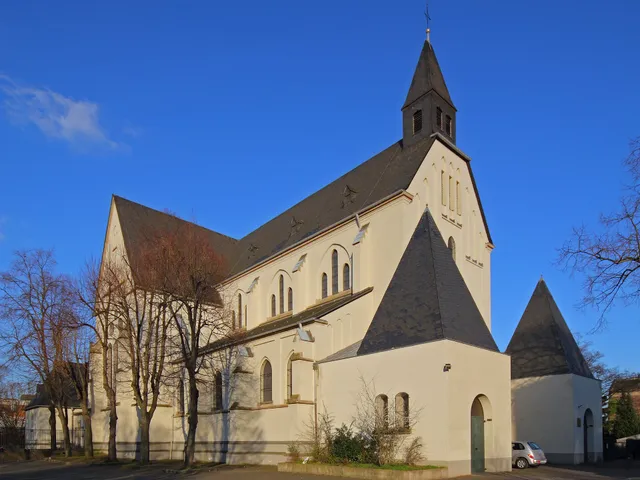
Neo-Gothic parish church in Cologne-Mülheim, rebuilt in modern form by Rudolf Schwarz after wartime destruction.
since 1864
The Liebfrauenkirche is a Roman Catholic, originally neo-Gothic church in the district of Mülheim on the right bank of the Rhine in Cologne. It combines surviving 19th-century fabric with modern post-war architecture in an unusual way.
At a Glance
- Type
- Roman Catholic parish church
- Building period
- 1857 to 1864, rebuilt 1953 to 1955
- Location
- Cologne-Mülheim, right bank of the Rhine
- Style
- Neo-Gothic, extended during reconstruction with modern reinforced concrete
- Architects
- Ernst Friedrich Zwirner (original building), Rudolf Schwarz (reconstruction)
- Parish
- part of the parish of St. Clemens und Mauritius
- Heritage status
- listed as a protected monument since 20 July 1983
Age comparison
Age compared with other places in Cologne.
History
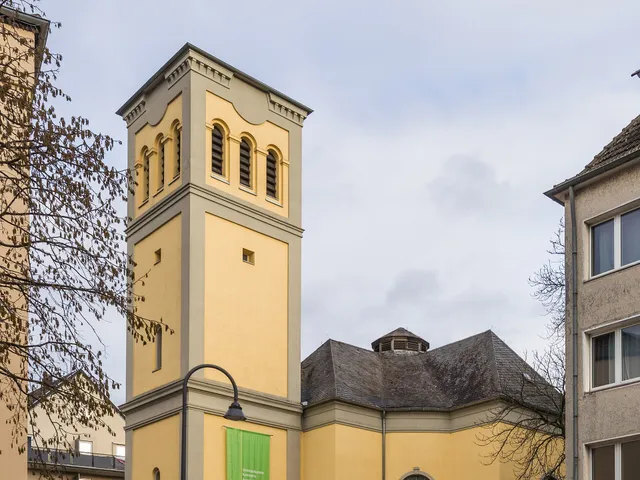
The church was designed by Cologne cathedral master builder Ernst Friedrich Zwirner, who conceived it as a three-aisled basilica in the neo-Gothic style. Built between 1857 and 1864, it took over the role of the previous Mülheim parish church, St. Clemens. Cologne auxiliary bishop Johann Anton Friedrich Baudri consecrated the building in 1865.
Until 1914 the church was known as „St. Mariä Himmelfahrt“. That year Mülheim was incorporated into Cologne, and since a church of the same name already existed on the left bank of the Rhine, it was given its present name, Liebfrauenkirche.
Destruction and Reconstruction
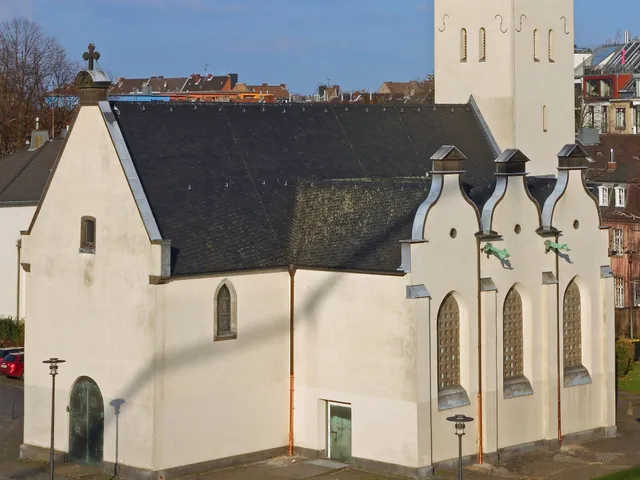
The church was badly damaged during the Second World War. While the kindergarten temporarily served as an emergency church, it was decided not to demolish the ruin. Between 1953 and 1955 architect Rudolf Schwarz rebuilt it in altered form as a reinforced concrete skeleton structure, blending old and new building elements.
The destroyed neo-Gothic eastern sections – the transept and long choir – were not reconstructed but replaced by a transverse choir hall. Measuring 26 metres long and 30 metres wide, it continues the 28-metre nave, whose enclosing walls were preserved. Concrete supports, gilded steel girders and a triple-folded concrete gable roof characterise the new choir area, while the continuous ceiling structure links the old and new parts of the building.
Furnishings
To mark the hundredth anniversary of its first consecration, the church was reconsecrated in 1965. In the same year the tower received a new spire with a copper crown, created by the artist Heinz Gernot. The main altar, carved from a single block of green marble, is also his work. Above it hangs a crucifix from 1930 by the Cologne sculptor Eduard Schmitz junior. Behind the altar area, a Lady Chapel invites visitors to prayer and eucharistic adoration.
Church Windows
In the new choir the colours white, yellow and green set the tone. The window bands are designed as „light trees“, their coloured antique-glass panes set into a lattice of reinforced concrete. The ornamental windows of the side aisles and the altar back wall were created by Anton Wendling between 1958 and 1962. The sacristy window by Josef Henseler dates from around 1955 and depicts Mary and John beneath the cross.
The Organs
In 1955 the firm Romanus Seifert & Sohn built an organ with 48 stops across three manuals and pedal. A distinctive feature is the pipework, which stands freely without a case; the second manual is also divided into two sections, six of whose stops are housed in a parapet positive. In 2024 the instrument was renovated and electrically modernised by the Seifert workshop in Kevelaer, with new stops added to the swell division. A Walcker series positive from 1956 serves as the choir organ and was comprehensively restored in 2024 by organ builder Eckehard Lüdke.
Gallery
Map
Blue dots: other places nearby — tap to explore.
Address
Regentenstraße 4
51063 Köln
Hours
Mo: 10:00–12:30
Di: 00:00–00:00
Fr: 10:00–12:30
Sa: 10:00–12:30
So: 00:00–00:00
You might also like — related or nearby
Comments
- Loading comments…
Sources & links
Auto-generated, last verified: 2026-07-10
How this page is made
This page draws on open sources — Wikipedia, Wikidata, official websites and the city’s open data. Every statement is checked against the sources linked here, and pages are refreshed regularly.
Spotted a mistake anyway? Tell us below — we read every submission.